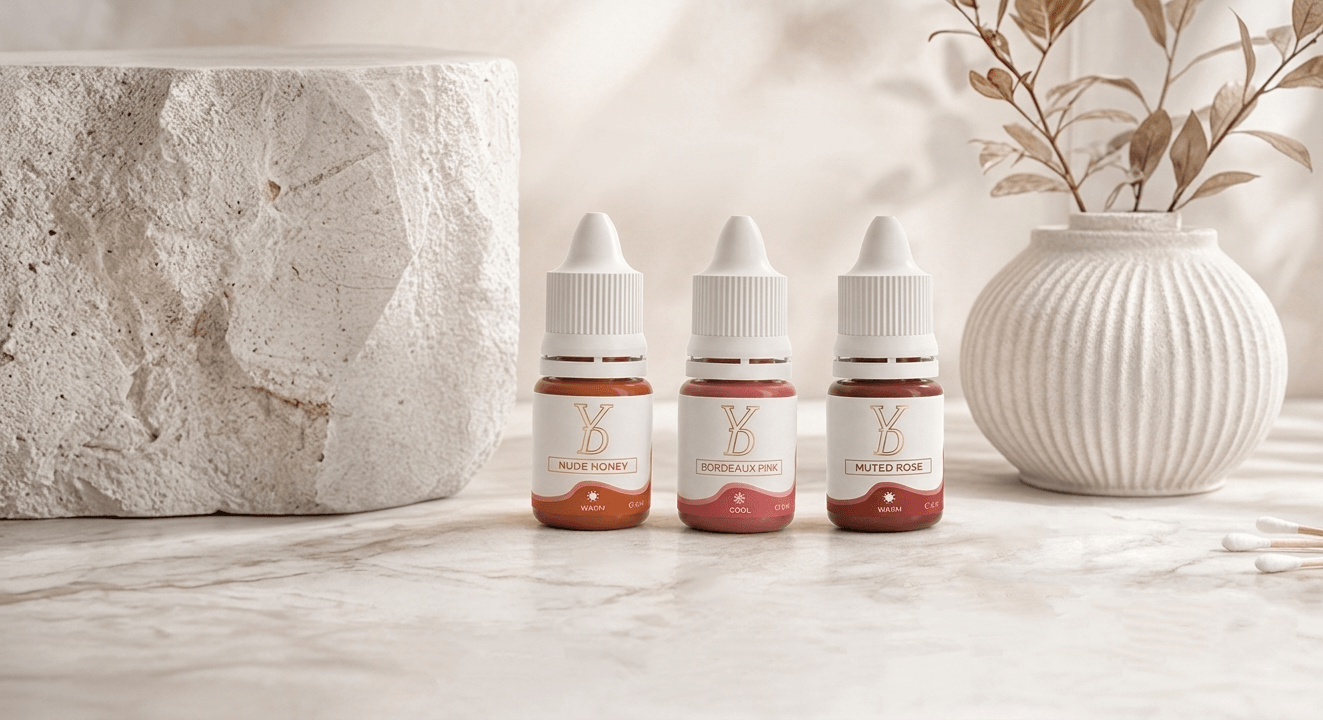

How many permanent makeup pigments does a professional artist actually need? The answer is not a universal number. A brow specialist, lip artist, SMP practitioner and multidisciplinary PMU studio will require different color systems.
However, owning more shades does not automatically produce better healed results. A focused palette built around well-understood core shades, compatible modifiers and procedure-specific correctors can make color selection, documentation and inventory control more consistent.
The objective is not to use the fewest pigments possible. It is to avoid unnecessary duplication while keeping enough appropriate shades to serve the artist’s procedures and client base responsibly.
Last reviewed: August 24, 2026
Quick answer: Build a PMU palette around the procedures you perform, several dependable core shades, compatible adjustment colors and only the correctors you are trained to use. Expand the system when documented healed results reveal a genuine color gap—not simply because another shade is available.
A Focused PMU Pigment System: Quick Framework
| Palette Component | Purpose | Selection Question |
|---|---|---|
| Core shades | Cover the most common healed-color goals within the artist’s procedure area. | Which shades are repeatedly appropriate for my actual clients? |
| Depth options | Provide controlled light, medium and deeper choices where needed. | Can I create appropriate contrast without relying on one universal shade? |
| Modifiers | Make controlled adjustments within a compatible pigment system. | Do I understand the modifier’s strength, direction and intended use? |
| Correctors | Support suitable color-correction procedures. | Am I trained to determine when correction is appropriate? |
| Specialty shades | Serve specific procedures or recurring client needs. | Does this shade fill a documented gap rather than duplicate another bottle? |

Why More PMU Pigments Do Not Automatically Mean Better Results
A large shade collection may appear to offer more flexibility, but the number of bottles does not determine the quality of the artist’s decisions.
The healed result can be affected by:
- The exact pigment shade and complete formulation
- The client’s natural skin, lip or hair color
- Visible undertone and skin-tone depth
- Existing permanent makeup
- The treatment area
- The planned technique and distribution pattern
- Implantation and saturation
- Tissue condition and individual healing response
- Aftercare, skincare and UV exposure
Adding more shades does not remove these variables. It may instead create more combinations for the artist to compare, document and evaluate.
A focused palette can make decision-making clearer because the artist repeatedly works with a manageable group of products and builds a more organized record of how those exact shades have been selected and used.
Fewer Pigments Are Not Automatically More Professional
A small palette is useful only when it is appropriate for the artist’s procedures and clients. Using too few pigments can also create problems.
An overly limited system may encourage an artist to:
- Use one shade across clients with very different natural coloring
- Darken or warm a color without understanding the mixture
- Use a brow pigment for a procedure for which it was not intended
- Attempt correction without an appropriate corrective shade
- Compensate for a missing color through excessive saturation
- Force every client into the same healed-color style
The goal is therefore not minimalism for its own sake. A professional palette should be broad enough to support responsible selection while remaining focused enough for the artist to understand and document.
Professional principle: The right palette is not the smallest palette or the largest palette. It is the smallest complete system that responsibly supports the artist’s procedure range and client base.
What Does It Mean to Know a PMU Pigment?
Knowing a pigment means more than recognizing the color on the bottle or remembering its shade name.

Before making a shade part of a core professional palette, the artist should understand:
- The pigment’s intended treatment areas
- Its visible mass tone and color direction
- How it compares with adjacent shades in the same range
- The product’s supplied preparation and usage instructions
- Whether it may be mixed with other shades in the system
- The relative strength of compatible modifiers and correctors
- Its batch, expiration and storage requirements
- How it performs during controlled practice
- How documented healed results compare with the original plan
A shade name such as “medium brown,” “warm brown” or “nude pink” does not provide all this information. Different manufacturers—and even different product lines—may use similar names for pigments with different formulations, color directions and intended applications.
Learn how to read a PMU pigment label, CI numbers and batch information.
Core Shades, Modifiers and Correctors Are Different Tools
A focused pigment system is easier to build when each bottle has a defined role.
Core shades
Core shades are the colors that repeatedly support the artist’s most common procedures and healed-result goals. A brow artist may organize core shades by relative depth and color direction. A lip artist may organize them by natural base, target family and intended intensity.
A core shade should not be described as universal. It is simply a dependable starting option for a clearly defined range of clients and procedures.
Modifiers
A modifier adjusts the direction or depth of a compatible shade. It should be used deliberately and documented accurately.
Artists should avoid adding a modifier based only on a memorized rule such as “warm every brow” or “cool every warm skin.” The amount and direction must relate to the client’s visible base, existing pigment, selected shade and desired healed result.
Correctors
A corrector is intended to reduce the visual dominance of an unwanted color direction in suitable existing PMU or natural pigmentation.
Correctors are not ordinary shade extenders. Before using one, the artist must assess:
- The dominant unwanted color
- The density and saturation of the existing pigment
- Possible implantation depth
- The remaining shape
- Tissue condition and scarring
- Whether more pigment should be implanted at all
Some old PMU is too dark, dense, deep or misplaced for direct color correction. Removal, lightening, postponement or referral may be more appropriate.
Read the complete PMU color theory, undertone and correction guide.
How to Build a Focused Brow Pigment Palette
A brow pigment system should support the techniques, natural hair colors and healed-result styles the artist regularly works with.
Begin by reviewing:
- The relative depth range required by the client base
- Warm, cool, neutral, muted or mixed color directions
- Natural brow hair color and density
- Skin-tone depth and visible undertone
- Existing brow PMU commonly encountered in the studio
- Manual hairstroke, machine hairstroke, powder, ombré or combination techniques
- The desired healed contrast and intensity
An artist may need several dependable core brow shades, one or more compatible adjustment colors and appropriate corrective options. The exact number depends on the product system and client base.
Avoid assuming that one light, one medium and one dark brown can serve every client. Relative depth alone does not describe warmth, coolness, saturation or the interaction with existing pigment.
Read the complete PMU brow pigment selection guide.
How to Build a Focused Lip Pigment Palette
Lip pigment selection must account for both the natural lip base and the desired healed color. A focused lip system may still require more color directions than a specialist brow palette.
When building a lip palette, consider:
- Natural pink, red, brown, blue, violet, grey or mixed lip characteristics
- Differences between the upper and lower lip
- Whether pigmentation is even, patterned or localized
- The range of requested healed colors
- Appropriate corrective directions
- Whether neutralization and target color should be staged
- Previous lip PMU
- Client suitability and tissue condition
Not every dark lip requires the same orange or peach corrector. “Dark” describes depth, not one specific undertone. A blue-violet base, warm-brown base and grey-brown base should not automatically receive an identical formula.
A lip specialist may therefore need a focused but sufficiently varied range of correctors and target colors. Reducing the palette should never mean removing colors required for appropriate assessment and staged treatment planning.
Read the dark lip neutralization and color correction guide.
Should Different PMU Techniques Use Different Pigments?
The treatment technique is part of pigment selection because it changes how color is distributed visually. Hairstrokes, powder shading, lip blush, eyeliner and SMP do not create the same pattern or healed appearance.
However, artists should avoid reducing technique selection to rules such as:
- Paste pigment is always required for microblading.
- Liquid pigment is automatically best for powder brows.
- Organic pigment is always for lips.
- Inorganic pigment is always for brows.
- One consistency guarantees better implantation.
Consistency, viscosity and formula category must be evaluated as characteristics of the complete finished product. The exact pigment should be intended for the planned procedure and used according to its supplied instructions.
A focused artist palette may therefore contain separate core groups for brows, lips, eyeliner or SMP rather than treating every bottle as interchangeable.
Why Random Mixing Makes a Palette Harder to Understand
Mixing can expand the usable range of a focused system, but only when the pigments are compatible and the artist records the formula accurately.
Random or undocumented mixing makes it difficult to determine:
- Which shade influenced the healed result
- Whether the mixture was too warm, cool, dark or saturated
- Whether a modifier was used at excessive strength
- Whether the same formula can be reproduced
- How the plan should be adjusted at a later appointment
Mixing unrelated pigment brands or systems may also change viscosity, concentration, handling and healed appearance. Confirm compatibility and follow the relevant manufacturer instructions.
Documentation rule: If a formula cannot be reproduced from the client record, the artist cannot evaluate it as a controlled professional mixture.
What to Record for Every PMU Pigment Formula
A focused palette becomes more valuable when it is supported by consistent records.

For each procedure, document:
- Brand and pigment range
- Exact shade names
- Batch or lot information
- Expiration status
- Mixing proportions
- Any modifier or corrector used
- Treatment area and technique
- Relevant machine and cartridge information
- Natural base color and visible undertone observations
- Previous PMU
- Procedure-day photographs under consistent lighting
- Healed-result photographs when available
- Adjustments made at later appointments
These records help the artist distinguish between pigment selection, technique, implantation, healing and aftercare factors. They also make it easier to decide whether the palette genuinely lacks a necessary shade.
How to Know When You Actually Need Another Pigment
A new pigment may be justified when it solves a repeated, documented problem that cannot be addressed appropriately within the current system.

Consider adding a shade when:
- A recurring client group is not adequately served by the current depth range.
- The available core shades require repeated, overly complex mixtures.
- A necessary color direction is missing from the palette.
- A procedure-specific shade is required for a service being added to the studio.
- A trained correction service requires an appropriate corrector.
- Documented healed results reveal a consistent gap between existing shades.
- A discontinued or unavailable shade needs a properly tested replacement.
Do not add a pigment solely because:
- The bottle color looks attractive online.
- The shade is temporarily popular on social media.
- Another artist uses it successfully.
- The name sounds more precise than an existing shade.
- The collection looks incomplete without every available color.
How to Test a New Pigment Before Adding It to Your Core System
A new shade should not immediately become a default client formula. Introduce it through a controlled evaluation process.
- Review the label. Confirm intended use, ingredients, CI information, batch, expiration, storage and supplied instructions.
- Compare it with existing shades. Determine whether it provides a meaningful new depth or color direction.
- Evaluate handling during controlled practice. Observe consistency, loading and application behavior without making unsupported assumptions from viscosity alone.
- Define its role. Decide whether it is a core shade, modifier, corrector or specialty color.
- Use conservative case selection. Select suitable clients and avoid promising an exact healed result.
- Document the formula. Record the exact shade, batch, technique and treatment observations.
- Review healed results. Evaluate the result only after the appropriate healing period.
- Decide whether it fills a genuine gap. Keep it in the core palette only when it provides repeatable professional value.
Inventory Advantages of a Focused Pigment Palette
A well-planned palette can improve more than color selection. It may also simplify studio inventory management.
Potential advantages include:
- Fewer duplicate shades
- Clearer batch and expiration tracking
- More frequent use of each core bottle
- Less risk of forgotten or expired inventory
- Easier reordering
- More consistent team training
- More organized client documentation
- Clearer comparison of healed results
This does not mean buying fewer bottles at the expense of hygiene, traceability or product availability. Every product should be stored, handled and replaced according to its instructions and applicable professional requirements.
Common Mistakes When Simplifying a PMU Pigment System
Reducing the palette to one universal brown
Clients differ in natural hair color, skin-tone depth, undertone, existing PMU and desired healed intensity. A single brown cannot responsibly serve every brow client.
Trying to change color through implantation depth
Depth is not a safe color-adjustment tool. Implanting pigment too deeply may increase the risk of trauma, migration, unwanted cool appearance and difficult correction.
Using technique to compensate for the wrong shade
Technique affects distribution and saturation, but it cannot make an unsuitable pigment appropriate for the client or procedure.
Keeping similar shades without defining their roles
Two shades may both be useful, but the artist should be able to explain how their depth, direction, intended use or healed goal differs.
Removing necessary correctors
A compact palette should still include appropriate corrective options when the artist is trained to perform those procedures.
Assuming fewer pigments guarantee predictable results
No palette size guarantees an outcome. Product selection, client assessment, technique, implantation, healing, aftercare and environmental exposure remain important.
Judging the system only from fresh results
Procedure-day color may be affected by redness, swelling, moisture and surface pigment. Palette evaluation should be based primarily on properly documented healed results.
Focused Palette Audit Checklist
Use this checklist when reviewing your current PMU pigment collection:
- Does every pigment have a clearly defined professional role?
- Are the treatment areas and intended uses confirmed?
- Can similar shades be distinguished by depth, direction or purpose?
- Are modifiers and correctors compatible with the core system?
- Are mixing formulas documented consistently?
- Are healed results available for the shades used most often?
- Are any shades repeatedly unused?
- Are expired, damaged or improperly stored bottles removed from service?
- Can batch information be connected to individual client records?
- Does the current palette support the studio’s actual procedure range?
- Is a missing shade creating a repeated clinical or aesthetic limitation?
- Are purchasing decisions based on documented needs rather than trends?
Frequently Asked Questions
How many PMU pigments should a beginner buy?
There is no universal number. A beginner should choose a procedure-specific system recommended within their training, with enough core shades and appropriate adjustment options to practise responsible selection. Buying every available shade is not a substitute for learning color theory, product handling and client assessment.
Do experienced PMU artists always use fewer pigments?
No. Some experienced specialists use compact systems, while multidisciplinary artists may need larger collections. Experience is demonstrated by controlled selection, documentation and healed results—not by a particular number of bottles.
Can three brow pigments serve every client?
Not necessarily. Three shades may cover part of an artist’s client base, but natural coloring, existing PMU, desired depth and color direction vary. The palette must be evaluated against real client needs and the capabilities of the exact pigment system.
Is it better to mix pigments or buy more premixed shades?
Neither option is universally better. Compatible mixing can create controlled adjustments, while well-selected premixed shades may improve efficiency and repeatability. The artist must understand the products, follow supplied instructions and document every formula.
Can pigments from different brands be mixed?
Do not assume that different brands or product systems are compatible. Mixing may alter consistency, concentration, handling and healed appearance. Follow the relevant manufacturers’ instructions and applicable professional requirements.
Does using fewer pigments prevent muddy healed color?
No. A focused system may make formulas easier to understand, but muddy or unsuitable color can still involve the selected shades, mixing proportions, existing PMU, saturation, implantation, tissue optics and healing.
Can an artist adjust pigment warmth through needle depth?
No. Implantation depth should not be used as a color-temperature control. Depth affects tissue trauma and how pigment may be viewed through the skin; excessive depth can create complications rather than a controlled color adjustment.
When should a new shade be added to the palette?
Add a shade when it fills a repeated and documented gap, supports a new trained procedure or provides a necessary depth, direction or corrective function that the current system cannot appropriately deliver.
Conclusion
A professional PMU palette does not need to contain every available pigment, but it must contain enough appropriate shades to support the artist’s procedures and clients.
The strongest system usually combines dependable core shades, controlled depth options, compatible modifiers, trained corrective choices and clear documentation. Its value comes from how well the artist understands and evaluates each pigment—not from the total number of bottles.
Build the palette from real procedure needs, document every formula and allow healed results to determine whether the system should remain focused or expand.
Explore YDPMU professional PMU pigment systems.