
Summary
Brown permanent makeup pigments heal differently because they are complex blends of warm and cool particles that fade at different rates. Warm components fade faster, making healed brown appear cooler or more muted than the fresh result. Skin optics, implantation depth, and healing dynamics all amplify this effect — it is not a technique failure.
Many permanent makeup artists are surprised when brown pigments heal cooler, lighter, or different from how they appeared on the first day. This often leads to confusion, self-doubt, or the assumption that something went “wrong.”
In reality, brown permanent makeup pigments behave differently by nature. Their healed appearance is influenced by pigment composition, skin biology, and optical effects — not just technique.
Understanding why brown pigments heal the way they do helps artists make better color choices, set realistic expectations, and achieve more predictable long-term results.

1. Brown Is Not a Single Pigment Color
Brown permanent makeup pigments are not “pure brown.” They are complex blends of multiple pigment particles, usually combining warm components (yellow, orange, red) and cool components (black, green, or blue modifiers).
During healing, these components do not fade at the same rate.
Warm particles tend to be smaller, less stable in skin, and more likely to fade first. As a result, brown pigments may heal cooler than expected, less warm than the fresh result, and slightly gray or muted if warmth fades faster.
This is not oxidation — it is natural pigment behavior.
Do Permanent Makeup Pigments Oxidize Over Time?
Why Permanent Makeup Pigment Looks Different After Healing

2. Skin Optics Change How Brown Pigments Are Perceived
Fresh permanent makeup brows sit closer to the surface and are viewed through inflamed, red-toned skin. As healing progresses, inflammation subsides, skin thickness and clarity normalize, and light interacts differently with pigment particles.
Because brown pigments rely heavily on light reflection, even small changes in skin condition can make color appear lighter, cooler, softer, and more neutral.
This is why brown pigments often look richer on Day 1 but more natural by Day 30.
The pigment itself hasn’t changed — the viewing environment has.
How Permanent Makeup Pigments Settle in the Skin

3. Implantation Depth Strongly Affects Brown Healing Results
Brown pigments are especially depth-sensitive.
| Implantation Depth | Healed Result | Main Risk |
|---|---|---|
| Too shallow | Patchy, fast-fading | Warm tones lost quickly |
| Correct depth | Even, natural brown | Minimal — predictable aging |
| Too deep | Cooler, gray appearance | Optical diffusion amplifies cool tones |
Because brown contains both warm and cool components, incorrect depth can visually amplify the cooler tones. This is also why brown pigments may heal differently on oily vs dry skin, and why touch-ups are essential for balancing warmth and saturation.
Brown requires control, not intensity.
Why Highly Saturated Pigments Are Risky for Beginners
Floating vs Burying Technique: How Implantation Depth Affects PMU Results
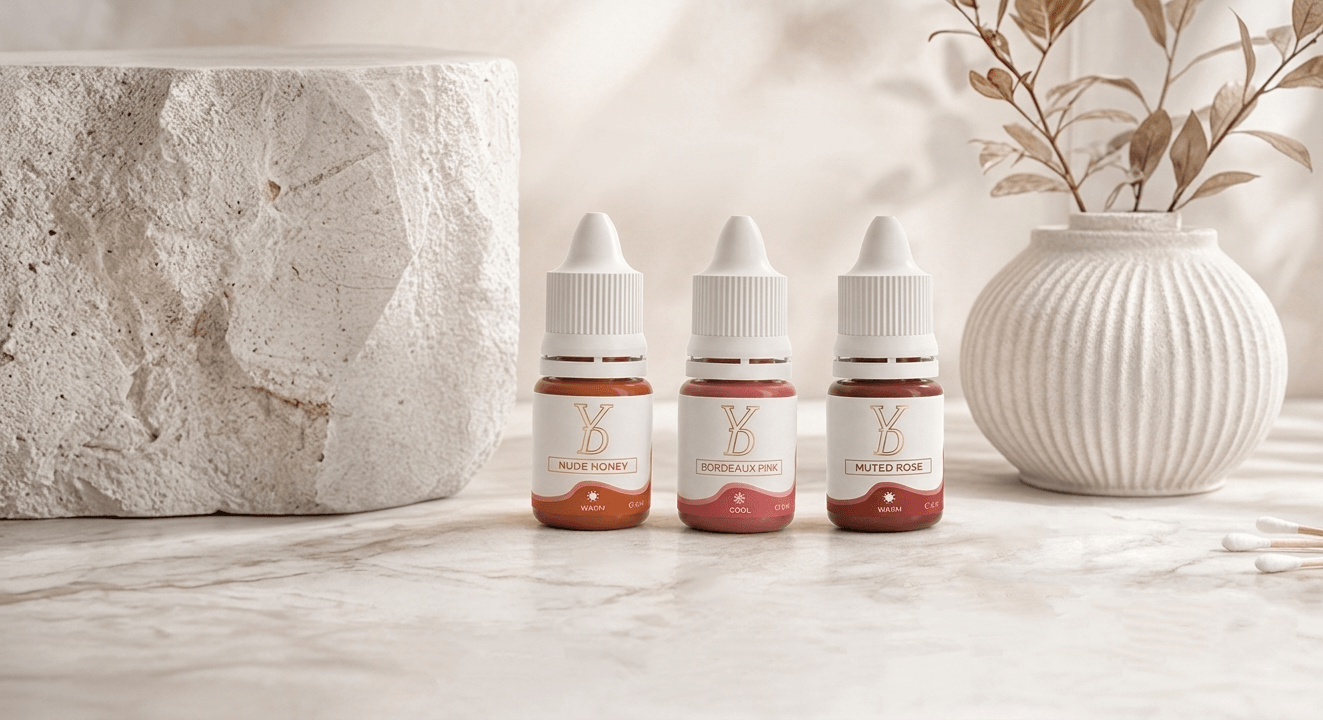
YDPMU NANO Organic Liquid Pigments — Balanced warm/cool formulas for predictable brown healing

Final Thoughts: Brown Healing Is Predictable — When You Understand It
Brown permanent makeup pigments are not unstable, faulty, or unreliable. They simply respond more visibly to pigment composition, skin behavior, implantation depth, and healing dynamics.
When artists understand these factors, brown pigments become one of the most natural and versatile color families in permanent makeup.
The key is not forcing brown to stay exactly as it looks on Day 1 — but designing results that heal beautifully, predictably, and responsibly over time.
Why Experienced Permanent Makeup Artists Rely on Fewer Pigments
How the Stratum Corneum Influences Brow Clarity in Permanent Makeup

FAQ
Why do my brown PMU brows look gray after healing?
Grayness in healed brown brows is usually caused by warm pigment particles fading faster than cool ones, pigment placed too deep where optical diffusion amplifies cool tones, or a pigment formula with insufficient warm balance. Choosing a warm-leaning brown and controlling implantation depth prevents this outcome.
Is it normal for brown PMU to look lighter after healing?
Yes. A 30–50% lightening after healing is completely normal. Fresh brown PMU appears richer because skin inflammation and surface moisture amplify color. As healing progresses, the true pigment balance is revealed — typically softer and more natural than the fresh result.
Why does the same brown pigment look different on different clients?
Skin undertone, oil level, and thickness all affect how brown pigment heals. Warm-undertoned skin may retain warmth better, while cool or neutral skin may allow cool components to dominate after healing. Skin assessment before pigment selection is essential for predictable brown results.
How can I prevent brown PMU from healing too cool or ashy?
Choose a pigment with a warm-dominant base, control implantation depth carefully, and avoid overworking the skin. A touch-up session at 6–8 weeks allows warmth and saturation to be refined after the initial healing reveals the true color balance.
What makes a brown PMU pigment “predictable”?
A predictable brown pigment has balanced warm and cool components that fade at similar rates, consistent particle size for even distribution, and a formula designed for stable long-term color. YDPMU NANO Organic Liquid Pigments are formulated with these principles for reliable brown healing results.