
Summary
Lip permanent makeup shows uneven color more easily than brows because lip skin is thinner, in constant motion during healing, and more sensitive to pigment variation — not because of poor technique or pigment quality alone.
Uneven color is one of the most common concerns in lip permanent makeup procedures. Clients often notice patchiness, lighter areas, or unexpected tone shifts after healing — issues that appear far less frequently in eyebrow permanent makeup.
This difference is not simply a matter of technique or pigment quality. In reality, lip permanent makeup and brow permanent makeup interact with the skin in fundamentally different ways. Understanding these differences helps artists set realistic expectations, plan safer procedures, and achieve more predictable long-term results.
Below, we explore three key reasons why lip permanent makeup shows uneven color more easily than brows.

Point 1: Lip Skin Structure Is Thinner and More Reactive
The skin of the lips is structurally different from the skin of the eyebrows.
| Feature | Lip Skin | Brow Skin |
|---|---|---|
| Epidermal thickness | Very thin | Thicker, more structured |
| Vascularity | High | Lower |
| Melanin protection | Less | More |
| Pigment depth margin | Narrow | More forgiving |
| Color uniformity after healing | More variable | More consistent |
Because of this, pigment implantation during lip permanent makeup occurs in a narrower margin of safety. Small variations in depth can lead to visible differences in color intensity once healed.
In contrast, brow skin is thicker and more forgiving. Minor inconsistencies in implantation depth are often less noticeable after healing, making brow permanent makeup appear more uniform.
This is why controlled depth and conservative passes are especially critical in lip permanent makeup.
How the Stratum Corneum Influences Brow Clarity in Permanent Makeup
Floating vs Burying Technique: How Implantation Depth Affects PMU Results

Point 2: Constant Movement Affects Lip Healing Uniformity
Unlike brows, lips are in near-constant motion.
Speaking, eating, facial expressions, and even unconscious lip movements create ongoing mechanical stress during the healing phase of lip permanent makeup. This movement can:
- Disrupt early pigment settling
- Affect scab formation and shedding
- Lead to uneven pigment retention across different areas
Some areas of the lips heal faster, while others experience more friction and moisture exposure. As a result, pigment may fade unevenly even when the procedure itself was performed consistently.
Eyebrows, by comparison, remain relatively static during healing, allowing pigment to stabilize more evenly.
How Long Does Permanent Makeup Last?

Point 3: Pigment Behavior Differs More Noticeably on Lips
Pigment behavior is another major factor.
Lip permanent makeup pigments are typically formulated to appear softer, more translucent, and more natural once healed. While this creates desirable aesthetic results, it also means:
- Subtle differences in saturation become more visible
- Fading patterns are easier to notice
- Color shifts can appear patchy rather than uniform
Additionally, lip tissue hydration, circulation, and individual skin chemistry influence how pigment ages over time. Even high-quality pigments cannot fully eliminate biological variability.
Uneven color does not always indicate poor pigment quality — it often reflects how living tissue responds to implanted color.
Technique or Pigment: What Truly Causes PMU Problems

Recommended Products for Lip PMU
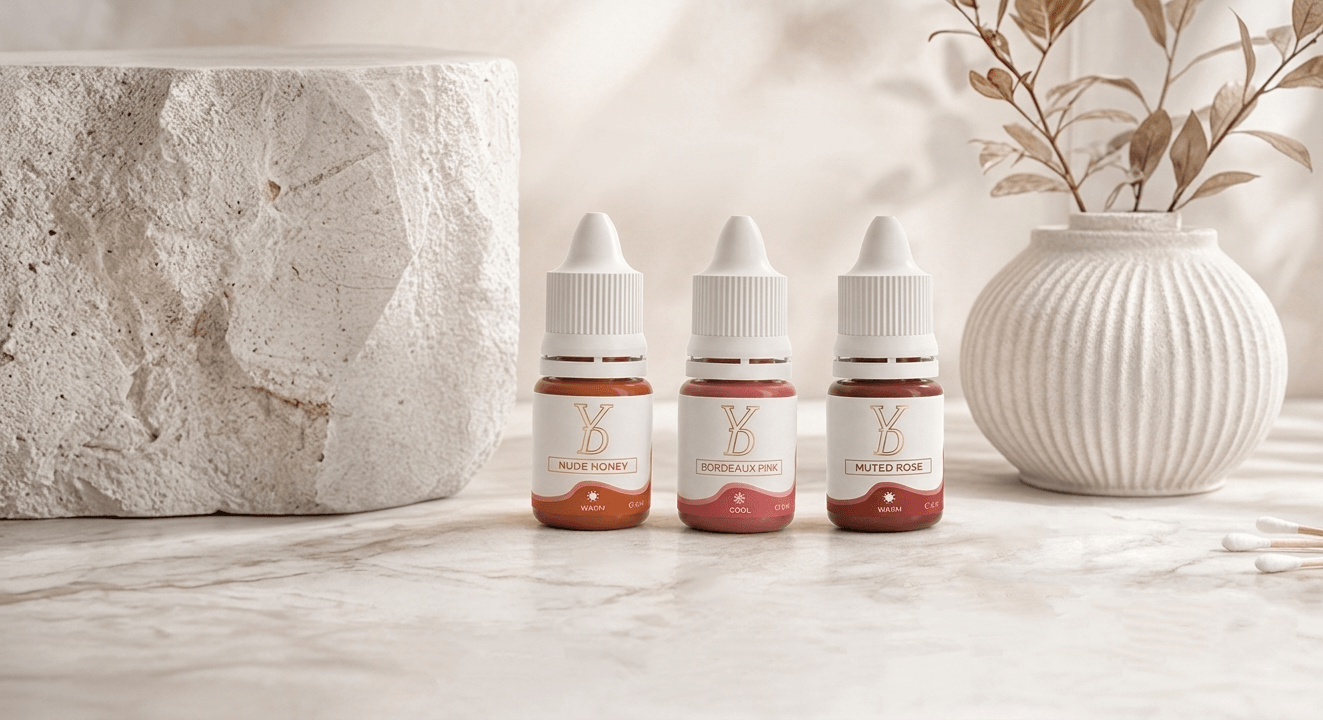
For more predictable lip color results, YDPMU lip pigment formulas are designed for controlled implantation and stable long-term color:
- YDPMU NEO Organic Lip Pigment Set — soft, natural tones with stable color retention
- YDPMU Dark Lip ALL-IN-ONE Set — formulated for deeper lip tones and neutralization
Conclusion
Uneven color appears more easily in lip permanent makeup than in brows because lips are biologically different — not because they are harder or riskier by default.
Thinner skin, constant movement, and more sensitive pigment behavior all contribute to less predictable healing outcomes. Recognizing these factors allows artists to work more conservatively, communicate more clearly with clients, and prioritize long-term skin health over immediate intensity.
Ultimately, professional lip permanent makeup is not about forcing perfect uniformity — it is about working responsibly within the limits of living skin.
How UV Exposure and Skincare Impact PMU Longevity
Machine, Needle, or Pigment: What Truly Shapes PMU Results
FAQ
Why does my lip PMU look patchy after healing?
Patchiness after lip PMU healing is common and usually caused by uneven pigment retention due to lip skin thinness, movement during healing, and variable moisture levels. A touch-up session at 6-8 weeks typically corrects uneven areas.
Is uneven lip PMU color a sign of bad technique?
Not necessarily. Even with perfect technique, lip skin biological variability — including circulation, hydration, and movement — can cause uneven color. It reflects how living tissue responds to implanted pigment, not always a technical error.
Why do brows heal more evenly than lips in permanent makeup?
Brow skin is thicker, less vascular, and remains relatively static during healing. This allows pigment to settle more uniformly compared to lips, which are thinner and in constant motion.
How many sessions does lip PMU usually need for even color?
Most clients require at least two sessions — an initial procedure and a touch-up at 6-8 weeks. Some clients with very thin or reactive lip skin may benefit from a third session for full color evenness.
What pigment properties help reduce uneven color in lip PMU?
Pigments with stable particle size, good skin adhesion, and formulas designed specifically for lip tissue — such as YDPMU NEO Organic Lip series — help minimize patchiness and support more consistent long-term color.