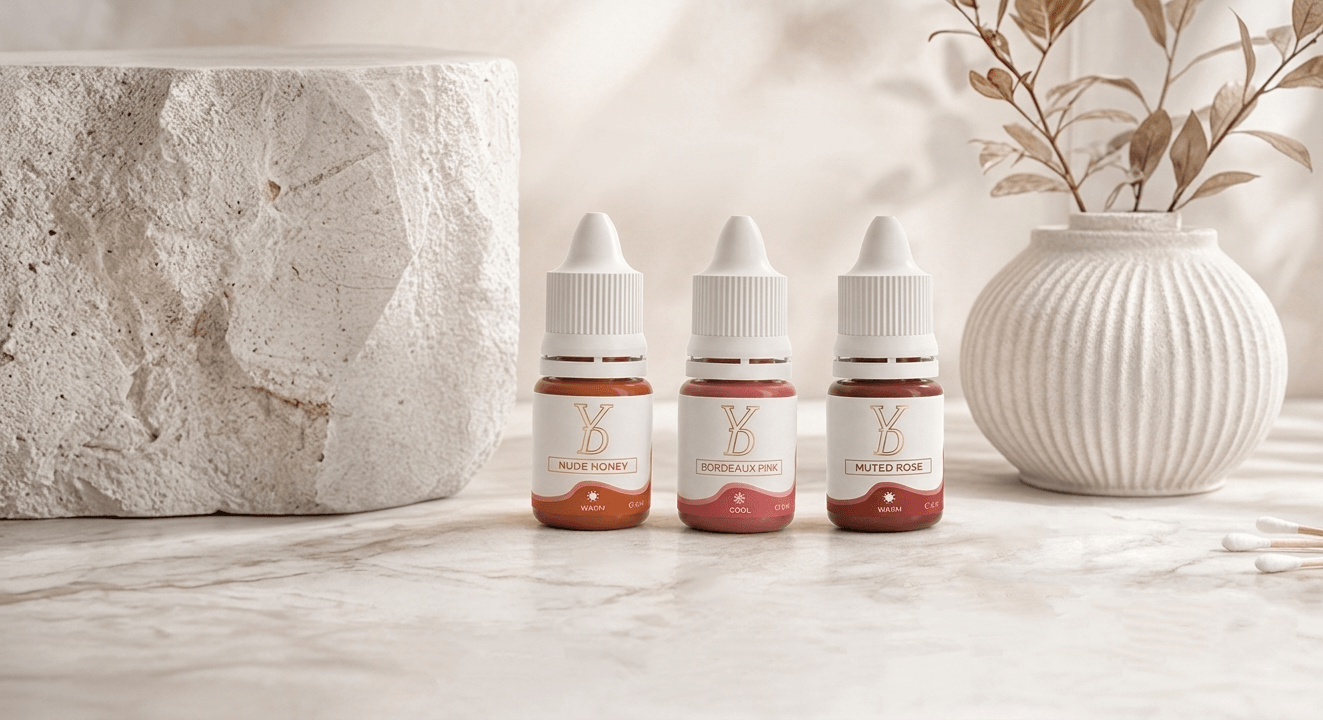

Permanent makeup pigment does not simply remain wherever it appears during the procedure. The fresh result is affected by surface pigment, moisture, redness, swelling and the temporary response of recently treated tissue. What remains visible after healing depends on a much larger system.
Implantation pattern, hand pressure, movement speed, cartridge configuration, pigment properties, treatment-area anatomy, inflammation, individual healing and aftercare can all influence the settled result.
This is why two clients treated with the same pigment and machine may heal differently—and why an immediately dark result does not prove that pigment has been placed effectively.
Artists sometimes describe their implantation style as “floating” or “burying.” These terms can be useful when discussing a lighter or more concentrated working approach, but they are not standardized anatomical measurements. They should never replace direct observation of the tissue or professional training.
Last reviewed: August 20, 2026
PMU Pigment Settlement: The Quick Framework
| Factor | What It Influences | What It Does Not Prove |
|---|---|---|
| Implantation pattern | Distribution, density, edge clarity and uniformity | That darker fresh work will retain better |
| Tissue response | Swelling, redness, fluid, inflammation and recovery | A fixed healing timeline for every client |
| Pigment properties | Color direction, opacity, flow and visible saturation | How the pigment will appear on every skin type |
| Technique | Pressure, spacing, overlap, passes and tissue interaction | The client’s biological response after treatment |
| Healing and exposure | How the treated area recovers and how color is viewed over time | That all visible fading is caused by shallow placement |
What Does It Mean for PMU Pigment to “Settle”?
“Settlement” is a practical PMU term rather than one single biological event. Artists commonly use it to describe the period in which the immediate treatment effects reduce and the longer-term visible result becomes easier to evaluate.
During this process:
- Temporary redness and swelling decrease.
- Surface residue and loosely deposited material are removed.
- The skin barrier recovers.
- Dryness or flaking may temporarily alter color visibility.
- The treated area becomes less reflective and less inflamed.
- The client’s natural skin or lip color again influences the visible result.
- The implanted distribution becomes easier to assess.
Settlement does not mean that every particle moves into one perfect layer or that the pigment becomes permanently fixed after a specific number of days. Skin remains biologically active, and tattoo pigment can continue to be affected by cellular activity, environmental exposure, skincare and future procedures.

Where Does Permanent Makeup Pigment Remain?
The skin is commonly described as having an epidermis, dermis and subcutaneous tissue. These layers contain additional structures and sublayers, and their thickness varies by body area and individual.
The epidermis continually renews. Material limited to superficial, shedding portions of the skin is unlikely to create lasting tattoo color. Persistent tattoo pigment is associated primarily with dermal tissue, where pigment may be found within cells such as macrophages and in extracellular locations.
However, this does not create one universal “correct depth” that can be measured with the same millimeter setting on every client.
Why a fixed millimeter number is unreliable
The relationship between the machine, cartridge and skin changes continuously during treatment. The number shown on a needle-exposure scale does not equal the amount of pigment implanted into tissue.
Actual interaction is also influenced by:
- Cartridge construction and membrane resistance
- Needle configuration and taper
- Machine stroke and movement characteristics
- Needle exposure
- Working angle
- Hand pressure
- Hand speed and movement pattern
- Skin stretch
- Tissue thickness, firmness and vascularity
- Number of contacts and repeated passes
Stroke length also should not be presented as implantation depth. Stroke describes a mechanical characteristic of the machine. It influences how the device drives the cartridge but does not independently determine where pigment remains in living tissue.
For the complete equipment framework, read Machine, Needle, Pigment or Technique: What Truly Shapes PMU Results?.
What Happens Immediately After a PMU Procedure?
A fresh PMU result includes more than retained pigment. Its appearance may be temporarily influenced by:
- Surface pigment remaining after wiping
- Redness and inflammation
- Swelling
- Moisture and lymphatic fluid
- Minor pinpoint bleeding
- The contrast created by freshly defined edges
- Lighting and camera exposure
These factors can make fresh work appear darker, brighter, warmer, cooler or more uniform than it will appear after recovery. The direction and size of the change vary by procedure, formula, skin and client.
There is no universal rule that every PMU result becomes 30%, 40% or 50% lighter. Fixed percentages may be useful as informal examples in a particular artist’s documented cases, but they should not be presented as biological guarantees.
Learn more in Why PMU Pigment Looks Different Before and After Healing.
How Healing Changes the Visible Result
Healing is a process rather than one fixed day-by-day schedule. Different clients and treatment areas may progress at different rates.
Early recovery
Immediately after treatment, the area may be red, swollen, tender or more intensely colored. These effects should gradually improve rather than continue worsening.
Surface recovery
As the surface barrier recovers, dryness, flaking or temporary unevenness may affect how the color is seen. Areas that look faint during this stage should not automatically be reworked.
Later visual settling
After surface recovery, the color may become easier to assess. Even then, the appropriate evaluation point depends on the treatment area, the client and the practitioner’s protocol.
Artists should avoid diagnosing final retention while the skin is visibly inflamed, flaking or otherwise still recovering. Adding pigment too early can make it difficult to distinguish incomplete healing from true pigment loss.
Review normal and concerning changes in PMU Healing Stages: What’s Normal and What’s Not.
Implantation Is a Pattern, Not Just a Depth
Artists often focus on how “deep” the needle is working. Depth matters, but it is only part of implantation.
A healed result also reflects:
- How evenly individual contacts were distributed
- How much adjacent movements overlapped
- Whether the same area received repeated passes
- Whether hand pressure changed across the design
- Whether the skin was stretched consistently
- How pigment flowed through the cartridge
- Whether the tissue response changed during the procedure
Two artists may work at a visually similar needle exposure yet create completely different implantation patterns because their hand speed, pressure, overlap and machine movement are different.
Why fresh saturation can be misleading
Surface staining can temporarily fill visual gaps. Swelling can make shapes appear smoother. Repeated wiping can also change how evenly pigment appears across the area.
A dark, uniform fresh result therefore does not prove that pigment has been distributed evenly within the tissue. Healed documentation is needed before judging the complete implantation pattern.

Too Superficial, Controlled or Excessive: A Better Framework
Instead of treating implantation as three precise horizontal lines, it is more useful to evaluate the behavior and outcome of the complete procedure.
| Working Pattern | Possible Observations | Important Limitation |
|---|---|---|
| Insufficient or inconsistent implantation | Irregular distribution, weak retention or localized gaps after healing | A light result does not prove that depth was the only cause |
| Controlled implantation | Purposeful distribution with an acceptable tissue response and room for healing | It does not guarantee identical retention on every client |
| Excessive or traumatic work | Increasing bleeding, swelling, tissue resistance, prolonged irritation or loss of edge control | Trauma can result from pressure, overlap, passes and time—not depth alone |
What Do “Floating” and “Burying” Mean in PMU?
Floating and burying are informal industry terms. Their meaning can differ between trainers, artists and regions.
One educator may use “floating” to describe light pressure and widely spaced movements. Another may use it to describe a faster hand movement, minimal overlap or a soft first pass.
Likewise, “burying” may be used to describe greater saturation, slower movement, closer spacing, more overlap or increased pressure. It should not automatically mean deliberately placing pigment into a fixed “mid-dermal” zone.
Because these terms are not standardized, artists should define the actual variables involved instead of using the label alone.
| Informal Term | What the Artist May Mean | What Should Still Be Documented |
|---|---|---|
| Floating | A lighter, faster, more open or lower-density working approach | Cartridge, machine setting, pressure, spacing, passes, skin response and intended finish |
| Burying | A slower, denser, more overlapping or higher-saturation approach | The same variables plus evidence that the tissue remained within an acceptable response |
Professional rule: describe what the hand, machine and cartridge are doing. Do not use “floating” or “burying” as substitutes for anatomical assessment.

Is Floating Always Gentler?
No. A movement described as floating may be gentle when the artist uses controlled pressure, appropriate spacing and limited repetition. But a fast or superficial-looking movement can still irritate the skin if it is repeated many times or performed with an unsuitable cartridge.
A lighter first pass also does not guarantee lower total trauma if the artist repeatedly returns to the same area while chasing immediate saturation.
Does Burying Produce Better Retention?
Not as a universal rule. Slower movement, closer spacing or greater overlap may create more visible density, but greater density is not automatically healthier or more stable.
If the tissue is overworked, the procedure can create more inflammation and a less predictable healing environment. Excessive placement may also reduce future correction options.
Retention should not be maximized at any cost. The professional goal is an appropriate healed result with controlled tissue response and enough flexibility for future maintenance.
Why More Trauma Does Not Necessarily Mean More Retention
Artists sometimes interpret bleeding or rapid darkening as evidence that the pigment is “going in.” Neither observation alone confirms effective implantation.
Increasing trauma can:
- Make it harder to see the true implantation pattern
- Increase swelling and temporary color intensity
- Change how pigment flows across the treated surface
- Make subsequent passes less controlled
- Prolong discomfort and recovery
- Increase the possibility of an undesirable healed texture or color pattern
Artists should stop evaluating success only by fresh darkness. Tissue response and healed evidence are more useful indicators.
How Pigment Properties Affect Settlement
Technique and skin do not act independently of the formula. Pigment viscosity, concentration, opacity and colorant composition can influence how the product flows and how the implanted pattern is perceived.
Viscosity and flow
A formula’s viscosity affects how it loads into and releases from a cartridge. However, “thicker” does not automatically mean stronger retention, and “thinner” does not automatically mean easier implantation. Compatibility with the cartridge and technique matters.
Opacity and concentration
A more opaque or concentrated shade may create strong visual coverage with fewer visible gaps. This can make the fresh result appear more complete, but it does not prove that the skin should receive additional passes or that long-term color will be more suitable.
Color composition
The visible healed color depends on the complete formula, implanted amount, natural skin or lip color, existing pigment, skin optics and exposure. Shade names such as warm, cool, organic, inorganic or hybrid cannot independently predict settlement or retention.
For color-change assessment, read Why PMU Pigments Change Color: Grey, Blue, Red, Brown and the Oxidation Myth.
How Skin and Treatment Area Change the Result
Brows, lips, eyelids and scalp are different treatment environments. They vary in visible pigmentation, movement, vascularity, oil exposure, surface texture and healing behavior.
Within one treatment area, clients may also differ because of:
- Previous PMU or removal procedures
- Scar tissue
- Active irritation or barrier disruption
- Skin texture and pore visibility
- Sun exposure
- Skincare products
- Health history and medications
- Individual inflammatory and healing response
Artists should avoid simple claims such as “oily skin pushes pigment out,” “thin skin always fades faster” or “mature skin retains less.” These descriptions are too broad to predict an individual result.
The client’s complete skin condition and treatment history are more useful than a single skin-type label.
How to Evaluate Pigment Settlement Professionally
1. Document the untreated area
Record natural color, texture, previous pigment and any asymmetry before beginning. Without a reliable starting image, healed comparisons may be misleading.
2. Record the complete procedure
Document the machine, cartridge, pigment, mixture, movement style, approximate number of passes and any significant tissue observations.
3. Use consistent photography
Compare results under similar lighting, camera settings, distance and angle. Bright ring lights, filters and automatic white balance can change the apparent color.
4. Wait until recovery allows meaningful evaluation
Do not diagnose pigment loss from an image taken during flaking, dryness or obvious inflammation. Evaluation timing should follow the procedure, tissue response and professional protocol.
5. Identify the pattern before planning a touch-up
Determine whether the visible issue is generalized lightness, localized gaps, color shift, blurred edges, shape imbalance or tissue change. These problems do not all require the same response.
6. Change one meaningful variable at a time
If additional treatment is appropriate, avoid simultaneously changing the machine, cartridge, pigment and complete technique. Controlled changes produce better evidence for future work.
When a Touch-Up May Not Be the Right Answer
A touch-up should not automatically be used whenever a healed result appears lighter than expected.
Further implantation may be unsuitable when:
- The tissue has not completed recovery.
- The existing pigment is already dense or dark.
- The color has shifted and requires a separate correction assessment.
- The shape is misplaced or excessively wide.
- There is visible migration or blurred color outside the intended area.
- The tissue shows persistent irritation, texture change or possible scarring.
- The client has symptoms requiring medical assessment.
In some situations, waiting, lightening, removal assessment, medical evaluation or leaving the area untreated may preserve more options than adding another layer of pigment.
Safety and Unusual Healing Signs
Permanent makeup intentionally disrupts the skin barrier. Practitioners should use appropriate infection-control procedures, single-use cartridges, safe pigment handling and sharps disposal in accordance with applicable local requirements.
Some redness, swelling or tenderness may occur after treatment, but symptoms should generally improve rather than become increasingly severe.
Clients should seek qualified medical care for symptoms such as:
- Spreading or worsening redness
- Increasing heat, swelling or pain
- Pus or unusual discharge
- Fever or systemic illness
- Blistering or a significant rash
- Persistent nodules or raised areas
- Any rapidly worsening or concerning reaction
These symptoms should not be treated as routine “pigment settlement.”
Frequently Asked Questions
How do PMU pigments settle in the skin?
The visible result develops as temporary inflammation, moisture and surface residue reduce and the skin barrier recovers. Longer-lasting tattoo pigment is associated primarily with dermal tissue, but its appearance depends on distribution, skin optics, formula, healing and exposure.
Is PMU pigment placed at the epidermal–dermal junction?
This phrase is often used in PMU education, but it should not be treated as one precise, universally measurable line. Skin structure varies by area and client, and machine settings or needle exposure do not directly measure the pigment’s final anatomical location.
What happens if PMU pigment is too superficial?
Material limited to renewing surface tissue may not remain visible. However, a light or patchy healed result can also involve spacing, implanted amount, inflammation, aftercare, tissue variation or other procedural factors. Appearance alone cannot prove the exact depth.
What happens if PMU is worked too aggressively?
Excessive pressure, overlap, repeated passes or prolonged working can increase trauma and make healing less predictable. Potential results include prolonged irritation, uneven retention, blurred edges, texture changes or unwanted color appearance.
What is the difference between floating and burying?
They are informal technique descriptions rather than standardized depth categories. Floating often describes lighter or more open movement, while burying may describe slower or denser implantation. Artists should define pressure, speed, spacing, passes and tissue response instead of relying on the terms alone.
Does burying pigment make it last longer?
Not necessarily. Denser implantation may create stronger visible saturation, but excessive work can increase trauma and reduce predictability. Appropriate retention depends on the complete procedure and the client’s healing response.
How much lighter should PMU become after healing?
No fixed percentage applies to every procedure, formula or client. Fresh work commonly looks different because of redness, swelling, surface pigment and moisture, but the degree of visible change varies.
How long does pigment take to settle?
There is no single universal day. Surface recovery and later visual settling vary according to the treatment area, procedure, client and healing response. Follow the practitioner’s protocol and avoid judging final retention while the area is still visibly recovering.
Can a touch-up fix poor pigment settlement?
A touch-up may refine suitable healed work, but it cannot safely solve every issue. Dense previous pigment, migration, incorrect shape, tissue changes or unresolved color problems may require a different approach.
Conclusion
PMU pigment settlement is not controlled by depth alone. It reflects the combined effects of pigment distribution, machine and cartridge behavior, artist technique, tissue response, healing and the way color is viewed through the client’s skin.
“Floating” and “burying” can be useful shorthand inside a clearly defined training system, but they should not be presented as universal anatomical zones or automatic formulas for soft versus long-lasting results.
Professional artists should document actual working variables, observe the tissue continuously and evaluate healed results before deciding what needs to change.
The goal is not maximum immediate darkness or maximum retention at any cost. The goal is controlled implantation, an appropriate healed result and enough flexibility to manage the work safely over time.
Professional References
- U.S. Food and Drug Administration: Tattoos & Permanent Makeup—Fact Sheet
- Baranska et al.: Unveiling Skin Macrophage Dynamics Explains Both Tattoo Persistence and Strenuous Removal
- Khunger et al.: Complications of Tattoos and Tattoo Removal
This article is intended for professional education and does not replace hands-on PMU training, manufacturer instructions, local regulations or medical advice.