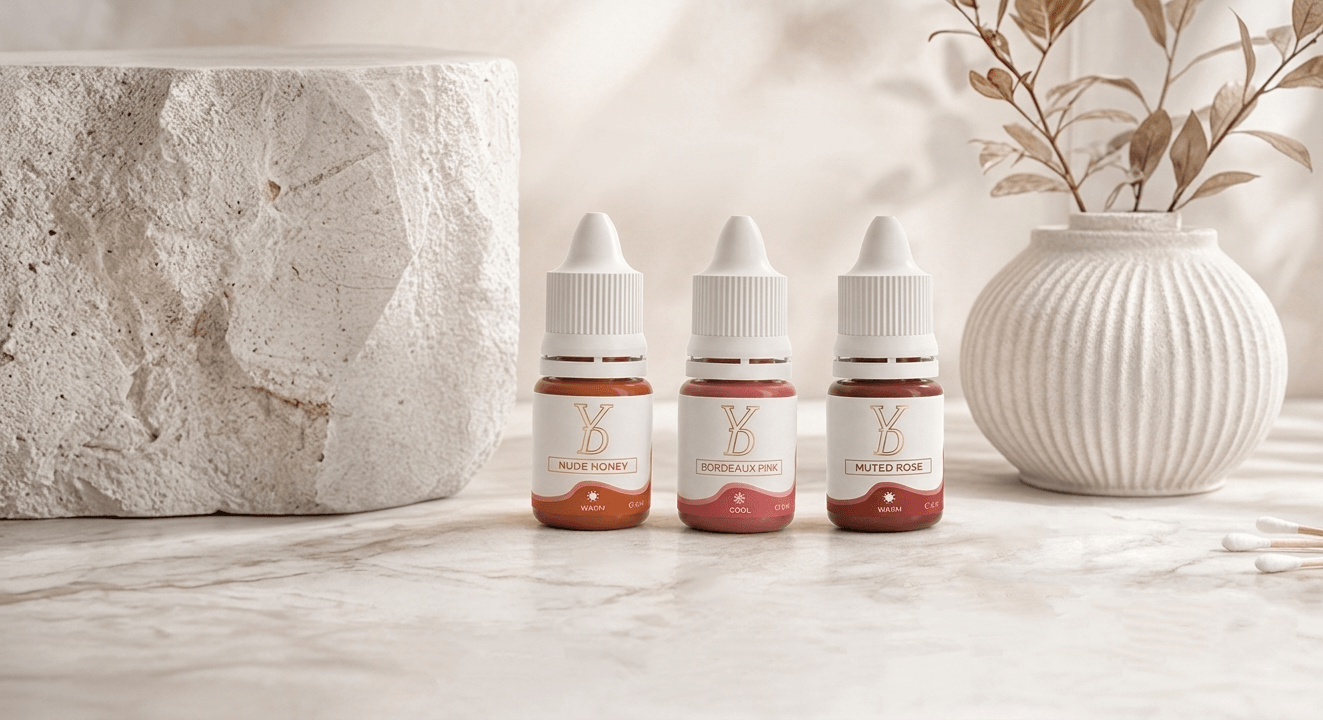

Organic, inorganic and hybrid are broad permanent makeup pigment formulation categories. They describe the types of colorants used in a formula, but they do not independently determine safety, healed color, retention, migration risk or suitability for a particular client.
The best PMU pigment is not selected by choosing the category that is described as the brightest, softest or longest-lasting. Professional selection requires artists to evaluate the exact shade, colorant composition, intended treatment area, client characteristics, technique, desired healed result and product-specific instructions.
This guide explains the practical differences between organic, inorganic and hybrid PMU pigments while correcting several common oversimplifications about particle size, color stability, retention and procedure suitability.
Last reviewed: August 10, 2026
Organic vs. Inorganic vs. Hybrid PMU Pigments: Quick Comparison
| Category | What it generally means | Possible shade characteristics | What the category does not guarantee |
|---|---|---|---|
| Organic | Contains organic colorants | Can support a broad range of colors, including vivid and highly concentrated shades | Brightness, small particle size, faster fading or suitability for every lip and eyeliner procedure |
| Inorganic | Contains inorganic colorants, which may include iron oxides and other mineral-based compounds | Can support earthy, muted, neutral and natural-looking color directions | Larger particles, longer retention, greater stability or suitability for every brow procedure |
| Hybrid | Combines organic and inorganic colorants within one formula | Can provide different balances of color directions depending on the exact formulation | Universal suitability, predictable retention or the same performance across all hybrid products |

Key point: These categories identify the general origin or chemical class of colorants. They are not complete performance rankings.
What Does “Organic” Mean in PMU Pigments?
In pigment chemistry, organic does not mean natural, plant-based or certified organic in the agricultural or cosmetic-marketing sense. It refers to a class of carbon-containing colorants.
Organic colorants are available in many different chemical families and color directions. They may be used to create reds, oranges, yellows, pinks, violets, blues, greens, browns and darker shades.
Because organic colorants can support a wide color range, they are commonly found in professional pigments intended for:
- Lip blush
- Dark-lip neutralization
- Brow procedures
- Eyeliner
- Color correction
- Other procedure-specific PMU applications
However, the presence of organic colorants does not automatically mean that the finished pigment will be bright, highly saturated or suitable for lips and eyeliner. The visible color and handling of a product depend on its complete formula, not only its category.
Common misunderstandings about organic pigments
The following statements should not be treated as universal facts:
- All organic pigments have smaller particles.
- All organic pigments heal brighter.
- All organic pigments fade faster.
- All organic pigments have a greater migration risk.
- Organic pigments are always best for lips and eyeliner.
- Organic pigments are unsuitable for natural brow results.
Actual performance depends on the exact colorants, concentrations, dispersion, carrier system, manufacturing process, pigment shade, implantation, treatment area and client.
What Does “Inorganic” Mean in PMU Pigments?
Inorganic PMU pigments contain inorganic colorants. Depending on the product, these may include iron oxides, titanium dioxide, carbon black, ultramarines or other permitted colorants.
Iron oxides are frequently associated with earthy color directions such as yellow, red, brown and black. This makes inorganic colorants useful in many brow, areola, scalp and corrective formulations, but their use is not restricted to one PMU procedure.
Inorganic colorants may be found in pigments intended for:
- Powder brows and ombré brows
- Machine hairstrokes
- Microblading
- Scalp micropigmentation
- Areola micropigmentation
- Camouflage procedures
- Eyeliner or corrective shades where the exact product is intended for that use
The term inorganic does not prove that a finished pigment will heal softly, remain more stable or last longer than a pigment containing organic colorants.
Common misunderstandings about inorganic pigments
The following claims are too broad to apply to every formula:
- All inorganic pigments have larger particles.
- Inorganic pigments cannot migrate.
- Inorganic pigments always fade more naturally.
- Inorganic pigments are more color-stable than organic pigments.
- Inorganic pigments always last longer.
- Inorganic pigments are automatically the best choice for brows.
Different inorganic colorants have different chemical and physical characteristics. A finished product must therefore be evaluated according to its exact composition and intended use.
What Are Hybrid PMU Pigments?
Hybrid PMU pigments contain a combination of organic and inorganic colorants. The term describes the presence of both colorant categories, but it does not identify a fixed percentage or standardized performance profile.
One hybrid product may contain a different balance of organic and inorganic colorants from another. Two products marketed as hybrid can therefore have different colors, concentrations, handling characteristics and intended procedures.
Hybrid pigments may be formulated for:
- Brows
- Lips
- Eyeliner
- Scalp micropigmentation
- Areola micropigmentation
- Color correction
- Multi-procedure professional pigment systems
The artist must still confirm whether the exact shade is intended for the planned treatment area. A range containing shades for several PMU procedures does not mean that every shade in that range is interchangeable across every procedure.
Common misunderstandings about hybrid pigments
Hybrid should not be interpreted as meaning:
- Safer than every organic or inorganic pigment
- More stable than every other formulation
- Suitable for every skin type
- Suitable for every PMU technique
- A guaranteed balance of brightness and longevity
- Less likely to change in appearance after healing
Hybrid is a formulation category—not a universal quality grade.
Formula Category Does Not Predict Pigment Quality
A well-designed PMU pigment cannot be evaluated by one front-label term. Professional quality depends on the complete product and how appropriately it is selected and used.

Artists and buyers should evaluate:
- The exact colorants and Colour Index numbers
- The complete ingredient list
- The shade’s intended treatment area
- Product consistency and dispersion
- Manufacturing and batch controls
- Packaging and traceability
- Expiration and storage information
- Supplied instructions and warnings
- Available product-specific safety documentation
- Requirements in the destination market
An organic, inorganic or hybrid label alone cannot establish whether a pigment is well manufactured, appropriately documented or suitable for a particular professional procedure.
Learn how to read PMU pigment labels, CI numbers and batch information.
Does Particle Size Determine Which PMU Pigment Is Best?
Particle size is frequently used in simplified comparisons between organic and inorganic pigments. Statements such as “organic particles are always smaller” and “inorganic particles are always larger” are unreliable because commercial pigment products involve more than the original colorant classification.
The characteristics of a finished dispersion may be influenced by:
- The individual colorant
- Primary particle characteristics
- Aggregation and agglomeration
- Surface treatment
- Grinding and dispersion
- Carrier composition
- Colorant concentration
- Storage and product handling
Artists should not use a general particle-size claim to predict retention, migration, implantation or safety. Those outcomes cannot be determined from organic or inorganic classification alone.
Which Type of PMU Pigment Lasts Longer?
There is no universal rule stating that inorganic PMU pigments always last longer than organic pigments, or that organic pigments always fade faster.
How long a PMU result remains visible can be affected by:
- The exact pigment shade and formulation
- The concentration and combination of colorants
- The treatment area
- Implantation depth and saturation
- Needle configuration and machine technique
- The client’s skin or tissue characteristics
- Previous PMU
- Healing response
- Skincare products and cosmetic procedures
- Sun and ultraviolet exposure
- Lifestyle and aftercare
- Touch-up and maintenance decisions
Different colorants within the same formula may also become less visible at different rates. This can change the apparent color direction over time without proving that the entire pigment category is unstable.
Artists should not promise one fixed retention period based solely on whether a pigment is organic, inorganic or hybrid.
Which Category Has the Best Color Stability?
Color stability is not a single characteristic that can be assigned to an entire pigment category.
When PMU changes in appearance, possible factors include:
- Changes in the visibility of individual colorants
- Natural skin or lip pigmentation
- Implantation that is too deep or too saturated
- Existing pigment beneath the new treatment
- Inflammation and early healing changes
- Sun exposure
- Skincare and cosmetic treatments
- The optical effect of tissue over the implanted pigment
- Client-specific healing and biological response
A brow that later appears red, grey, blue, warm or cool does not by itself prove that all pigments in the same formulation category will behave in the same way.
Does Formula Category Determine Migration Risk?
No. Migration or visible spreading should not be predicted from an organic, inorganic or hybrid label alone.
Possible contributing factors include:
- Implantation depth
- Excessive pressure
- Repeated passes
- High saturation
- Unsuitable machine or needle control
- Treatment-area anatomy
- Tissue condition
- The exact finished pigment formulation
Professional technique and treatment planning remain essential regardless of which pigment category is selected.
Are Organic, Inorganic or Hybrid Pigments Safer?
No category should automatically be described as the safest. Safety must be evaluated at the level of the exact finished product and its intended use.
Relevant considerations include:
- The specific colorants and other ingredients
- Impurities and applicable concentration limits
- Manufacturing controls
- Batch traceability
- Packaging integrity
- Storage and expiration
- Product instructions and warnings
- The intended professional procedure
- Practitioner hygiene and technique
- Requirements in the country where the product will be used
Terms such as organic, mineral-based, natural and hybrid should not replace product-specific safety documentation or destination-market review.
In the European Union, tattoo inks and permanent makeup mixtures are subject to applicable REACH restrictions. Buyers and practitioners remain responsible for confirming whether the exact product, shade, batch and intended use meet the requirements that apply in their location.
YDPMU product-specific REACH and safety documentation is available for eligible products and shades upon request. Availability should be confirmed for the exact product, shade, batch, intended use and destination market.
Review YDPMU Product Documentation Downloads.
How to Choose PMU Pigments for Brows
Brows are often associated with inorganic or hybrid pigments, but the formula category should not be the artist’s only selection criterion. Organic colorants can also be present in professional brow formulas.
Before selecting a brow pigment, evaluate:
- Natural brow hair color
- Skin-tone depth and visible undertone
- Existing brow PMU
- Desired healed intensity
- Whether the technique is microblading, machine hairstrokes, powder shading or a combination
- The exact shade composition and intended use
- The artist’s healed-results experience with the product
A natural brow result does not come from choosing an inorganic label alone. Shade selection, implantation, saturation, technique and client assessment all affect the final appearance.
Read the complete PMU Brow Pigment Selection Guide.
How to Choose PMU Pigments for Lips
Organic colorants are commonly found in professional lip pigments because they support many red, pink, orange, brown and violet color directions. However, this does not mean that every organic pigment is intended for lips or that an organic formula will always produce a brighter healed result.
Professional lip pigment selection should consider:
- Natural lip color
- Upper- and lower-lip pigmentation
- Warm, cool, brown, grey, blue or violet characteristics
- Existing lip PMU
- Tissue condition
- Client suitability
- The intended healed shade
- Whether neutralization and final-color implantation should be staged
- The exact product and shade instructions
Dark-lip neutralization should not be reduced to selecting any orange organic pigment. The correct direction depends on the visible lip base, color pattern, treatment plan and target result.
Read the YDPMU Dark-Lip Neutralization Guide.
Professional dark-lip shade planning
The YDPMU NEO Organic Dark Lip Neutralize range includes corrective and target-color options for trained artists. Each shade should be selected according to the visible lip base, client assessment and planned healed result.
How to Choose PMU Pigments for Eyeliner
Eyeliner selection should be based on whether the exact product and shade are specifically intended for professional eyeliner procedures.
Artists should not assume that every dark organic pigment, carbon-containing formula or black shade is suitable for eyeliner. Treatment-area anatomy, product concentration, implantation and professional technique must all be considered.
Before use, confirm:
- The product’s stated intended use
- The exact shade information
- Ingredients and Colour Index information
- Applicable instructions and warnings
- Product-specific documentation
- Destination-market requirements
Formula category alone cannot guarantee crisp healed retention or minimal spread.
How to Choose Pigments for SMP, Areola and Camouflage Procedures
Scalp micropigmentation, areola micropigmentation and skin camouflage have different treatment goals from brows, lips and eyeliner. Pigments for these procedures must be selected according to their exact intended use.
Scalp micropigmentation
Evaluate scalp condition, natural hair color, visible contrast, treatment plan, dilution requirements and practitioner technique. Do not choose an SMP pigment only because it is described as inorganic, organic or hybrid.
Areola micropigmentation
Areola shade selection requires individualized assessment by an appropriately trained practitioner. Post-surgical treatment may also require medical clearance and compliance with local professional requirements.
Skin camouflage
Camouflage selection requires careful evaluation of skin-tone depth, undertone, the treatment area, tissue condition and the desired result. A shade that appears similar in a bottle or digital chart may not produce the same appearance after implantation and healing.
Learn how to match professional skin camouflage pigments.
Does Skin Type Decide Which Formula Category to Use?
Skin characteristics are relevant to treatment planning, but statements such as “organic pigments are best for oily skin” or “inorganic pigments are best for dry or mature skin” are too broad.
Artists should assess:
- Oiliness and visible pore structure
- Skin thickness and elasticity
- Sensitivity and tissue condition
- Scarring or previous procedures
- Natural pigmentation
- Skincare and cosmetic-treatment history
- The selected PMU technique
- The exact pigment shade and formulation
The same broad skin type can respond differently between clients. Formula category should therefore be considered together with the complete client and procedure assessment.
Learn why there is no one-size-fits-all PMU pigment.
Can Organic and Inorganic PMU Pigments Be Mixed?
Do not assume that two pigments can be mixed simply because one is organic and the other is inorganic. Compatibility must be confirmed at the product level.
Mixing pigments can change:
- Visible color
- Colorant concentration
- Consistency and flow
- Implantation behavior
- Planned saturation
- Final healed appearance
Use only compatible professional pigments and follow the manufacturer’s applicable instructions. Record the exact products, shade names, batch information and mixing ratios used during each procedure.
A pre-formulated hybrid pigment is not automatically safer or more predictable than every artist-created mixture. It is still necessary to assess the exact finished product, shade and intended use.
Understanding Healed Color
Formula category is only one part of pigment selection. To understand how the color wheel, natural base color, undertone and corrective direction affect professional shade planning, read our Color Theory for PMU Artists Guide.
The color visible immediately after a PMU procedure is not necessarily the final healed color. Freshly treated tissue may appear darker, brighter, warmer or more saturated because of inflammation, moisture, lymph, surface pigment and temporary swelling.
During healing, dryness, flaking and new surface tissue may temporarily make the color appear uneven or faint. The appearance may continue to settle after these early surface changes.
No fixed healing percentage applies to all organic, inorganic or hybrid pigments. The final result can be affected by:
- The selected shade and complete formulation
- The client’s natural skin or lip color
- The treatment area
- Existing PMU
- Implantation depth and saturation
- Technique and repeated passes
- Individual healing response
- Aftercare
- Skincare and sun exposure
Statements such as “organic pigment always heals brighter,” “inorganic pigment always heals softer” or “hybrid pigment keeps the best characteristics of both” should not be presented as guaranteed outcomes.
Learn why PMU pigment looks different after healing.
How to Compare PMU Pigments Professionally

Step 1: Confirm the intended procedure
Determine whether the pigment and exact shade are intended for brows, lips, eyeliner, SMP, areola, camouflage or color correction.
Step 2: Review the exact shade
Do not judge a full pigment range from the behavior of one color. Different shades can contain different colorants and concentrations.
Step 3: Read the label and product information
Review the ingredients, CI numbers, shade name, batch information, expiration information, intended use, instructions and warnings.
Step 4: Assess the client
Consider natural pigmentation, undertone, skin-tone depth, tissue condition, existing PMU, treatment history and desired healed result.
Step 5: Select the technique
Hairstrokes, microblading, powder shading, lip blush, eyeliner, correction, SMP and camouflage require different treatment planning.
Step 6: Review healed results
Evaluate healed work produced with the exact pigment and technique whenever possible. Procedure-day photographs do not show the final result.
Step 7: Confirm documentation
Verify whether the exact product, shade, batch and intended use have the documentation required for the destination market.
Step 8: Document the treatment formula
Record the product, shade, batch, ratios, settings and treatment observations so the healed result can be evaluated accurately.
YDPMU Professional Pigment Systems
YDPMU provides different pigment systems so trained practitioners can select according to the treatment area, shade requirements, technique and professional treatment plan.
YDPMU NANO Organic Pigments
The NANO range contains organic liquid pigment options for professional PMU procedures. Artists should select each shade according to its intended treatment area and supplied product information rather than assuming that every organic shade will perform in the same way.
YDPMU NEO Organic Pigments
The NEO range includes organic color options for professional lip, brow, eyeliner and corrective planning. Individual shades are not automatically interchangeable across all procedures.
YDPMU Inocream Inorganic Pigments
The Inocream range provides inorganic pigment options for trained PMU practitioners. The exact shade, treatment area, technique and client must still be evaluated before use.
YDPMU Powder Hybrid Pigments
The Powder Hybrid Pigment System includes 34 selectable shades across several professional PMU procedure categories. The range includes options for brows, lips, eyeliner, SMP, areola and professional correction, depending on the selected shade.
Each purchase includes one 12ml bottle in the selected color. The 34 shades are not supplied together unless a separate bundle is specifically stated.
Explore the YDPMU Powder Hybrid Pigment System
Choose from 34 professional color options according to the intended procedure, client assessment and desired healed result.
For additional shade-planning support, visit the YDPMU Skin Tone and Pigment Matching Guide.
Common Myths About Organic, Inorganic and Hybrid Pigments

Myth: Organic means natural
In pigment chemistry, organic refers to a class of carbon-containing colorants. It does not automatically mean natural, plant-based or agricultural-organic.
Myth: Inorganic means chemical or unsafe
Both organic and inorganic pigments are chemical substances. Safety must be evaluated from the exact colorants, complete formula, manufacturing, documentation and intended use.
Myth: Organic pigments are always brighter
Some organic colorants can support vivid hues, but the healed appearance of a finished product depends on the exact shade, formula, implantation, client and treatment area.
Myth: Inorganic pigments always last longer
No universal retention ranking applies to the entire inorganic category. Longevity depends on the complete product and multiple treatment and client factors.
Myth: Hybrid pigments are always the best of both categories
Hybrid only means that organic and inorganic colorants are combined. It does not guarantee an ideal balance, universal suitability or superior performance.
Myth: Inorganic pigments cannot migrate
Migration risk cannot be eliminated by selecting one formula category. Implantation depth, saturation, technique, tissue and the exact finished product all matter.
Myth: Organic is for lips and inorganic is for brows
This is an oversimplification. Professional brow and lip products may contain organic, inorganic or combined colorants. The exact shade and intended use should guide selection.
Frequently Asked Questions
What is the main difference between organic and inorganic PMU pigments?
The difference relates to the chemical class of the colorants used. Organic pigments contain organic colorants, while inorganic pigments contain inorganic colorants. Hybrid pigments combine both. These classifications do not independently predict the complete performance of the finished product.
Are organic PMU pigments made from plants?
Not necessarily. In pigment terminology, organic generally refers to carbon-containing colorants. It should not be interpreted as meaning plant-based, natural or certified organic.
Are inorganic pigments made only from iron oxides?
No. Inorganic colorants may include iron oxides and other compounds. The exact colorants should be confirmed through the product’s ingredient and Colour Index information.
Are organic pigments brighter than inorganic pigments?
Some organic colorants can support vivid hues, while some inorganic colorants are associated with earthy or muted directions. However, brightness and healed appearance depend on the exact shade and finished formulation, not the broad category alone.
Do inorganic pigments last longer?
Not as a universal rule. Retention varies according to the exact formula, shade, treatment area, implantation, client characteristics, healing, lifestyle and aftercare.
Are inorganic pigments more stable?
No broad category-level guarantee can be made. Color behavior depends on the exact colorants, finished formulation, client, treatment area, implantation and environmental factors.
Are organic pigments more likely to migrate?
Migration cannot be predicted from organic classification alone. Technique, depth, saturation, tissue condition and the exact product must also be considered.
Are hybrid PMU pigments suitable for every skin type?
No. Hybrid is a formulation category, not proof of universal suitability. The exact shade, procedure, product information, client characteristics and technique must still be assessed.
Which pigment category is best for brows?
No single category is automatically best for every brow procedure. Select the exact product and shade according to natural hair color, skin, existing PMU, technique, desired healed intensity and product instructions.
Which pigment category is best for lips?
Professional lip formulas frequently contain organic colorants, but category alone is not enough. Natural lip color, existing pigmentation, desired result, client suitability and the exact shade must be evaluated.
Can organic and inorganic pigments be mixed?
Only mix pigments when the specific products are compatible and the combination follows the applicable instructions. Record the exact shades, batches and ratios because mixing can alter color, concentration, handling and healed appearance.
Is a hybrid pigment safer than mixing pigments myself?
Hybrid classification does not automatically establish greater safety. Evaluate the exact finished formula, intended use, product documentation and applicable instructions.
Can I choose a pigment based on its bottle color?
No. Bottle color, digital charts and screen images are selection references only. Review the shade information, CI numbers, intended use, client assessment and healed-result experience before treatment.
Does REACH documentation apply to every shade in a range?
Documentation should be confirmed for the exact product, shade, batch, intended use and destination market. Do not assume that one document automatically applies to every color or product in a range.
Which type of PMU pigment is safest?
No organic, inorganic or hybrid category is automatically the safest. Safety depends on the exact ingredients, impurities, manufacturing, documentation, packaging, intended use, practitioner technique and applicable local requirements.
Conclusion
Organic, inorganic and hybrid are useful pigment-classification terms, but they should not be used as shortcuts for predicting brightness, softness, stability, migration, safety or longevity.
Organic pigments are not automatically brighter or faster fading. Inorganic pigments are not automatically softer, safer or longer lasting. Hybrid pigments do not automatically provide the best characteristics of both categories or suit every client and procedure.
The most reliable professional approach is to evaluate the exact pigment shade, colorants, intended use, documentation, treatment area, technique, client and desired healed result.
Use formula category as one piece of product information—not as the final selection decision.
Explore YDPMU Professional PMU Pigments
References and Further Reading
- YDPMU: Color Theory for PMU Artists
- YDPMU: How to Read a PMU Pigment Label
- YDPMU: Why PMU Pigment Looks Different After Healing
- YDPMU: Why There Is No One-Size-Fits-All PMU Pigment
- U.S. Food and Drug Administration: Tattoos and Permanent Makeup Fact Sheet
- European Union: REACH restriction concerning tattoo inks and permanent makeup