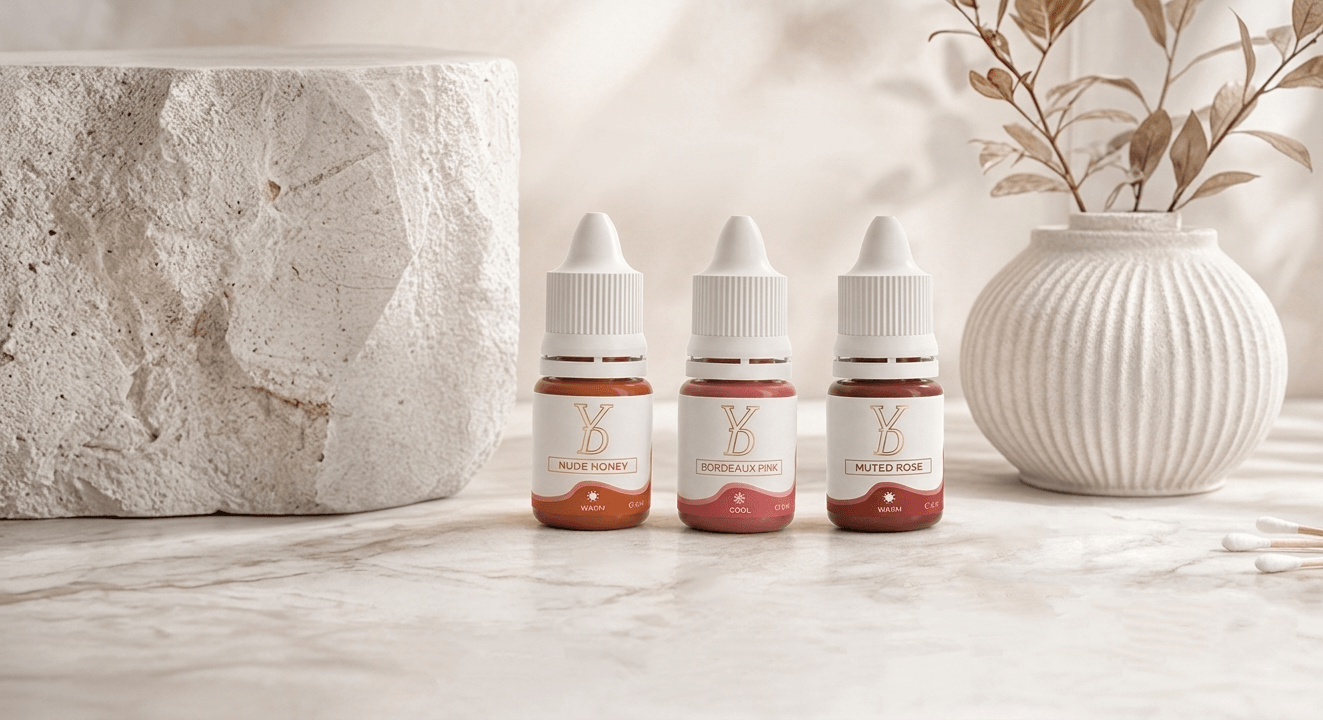

Color theory helps permanent makeup artists evaluate how a selected pigment may interact with natural skin or lip color, existing PMU and the intended healed result. It is a professional decision-making framework—not a fixed formula that guarantees the same outcome for every client.
Effective pigment selection requires more than matching warm skin with warm pigment, assuming cool pigment is automatically more stable or choosing the opposite color on a color wheel. Artists must also assess the treatment area, natural pigmentation, existing pigment, shade composition, technique, implantation, healing history and product instructions.
This guide explains how trained PMU artists can use the color wheel, complementary colors, undertone, skin-tone depth and healed-result planning without relying on oversimplified color rules.
Last reviewed: August 24, 2026
Professional reminder: Color theory supports pigment selection, but it cannot replace client assessment, product-specific training, manufacturer instructions, healed-result documentation or compliance with the regulations that apply in your market.
PMU Color Theory: Quick Decision Framework
| Assessment | What to Evaluate | Why It Matters |
|---|---|---|
| Treatment area | Brows, lips, eyeliner, SMP, areola or corrective work | Each area has different anatomy, natural color and healed-result requirements. |
| Natural base | Skin, lip color, brow hair and visible undertone | Implanted pigment is viewed through and alongside the client’s natural color. |
| Existing PMU | Color, saturation, depth, shape, age and condition | Not every unwanted color is suitable for another layer of pigment. |
| Pigment shade | Mass tone, undertone, Colour Index information and intended use | A shade name alone cannot predict its healed behavior. |
| Technique | Hairstrokes, microblading, shading, lip blush or correction | Implantation and saturation affect how the healed color is perceived. |
| Target result | Desired tone, intensity and acceptable maintenance | Fresh procedure color is not the final healed color. |
Key principle: The color wheel identifies relationships between colors. It does not select the final pigment for the artist.
1. Understanding the Color Wheel in Permanent Makeup
The traditional color wheel organizes colors according to their visual relationships. It helps artists describe whether a shade leans warm, cool or neutral and identify the approximate complementary direction of an unwanted color.
The basic color groups include:
- Primary colors: red, yellow and blue
- Secondary colors: orange, green and violet
- Tertiary colors: combinations positioned between adjacent primary and secondary colors
In professional PMU planning, the color wheel can help an artist:
- Describe the dominant direction of an existing color
- Compare warm and cool characteristics within a pigment range
- Identify a possible corrective color direction
- Plan controlled mixtures using compatible pigments
- Communicate color-selection decisions to clients and students
However, pigment implanted into living tissue does not behave like paint mixed on white paper. Natural pigmentation, tissue translucency, temporary inflammation, previous PMU, implantation, saturation, healing and environmental exposure all influence the color that remains visible.

2. How Complementary Colors Are Used in PMU Correction
Complementary colors sit opposite one another on a traditional color wheel. When compatible colorants are combined in controlled proportions, one direction may reduce the visual dominance of another.
In PMU, this principle provides a starting point for correction. It does not mean that applying an opposite color automatically produces a natural brown, beige or pink result.
| Visible Unwanted Direction | Possible Corrective Direction | What Must Still Be Assessed |
|---|---|---|
| Red or pink-red brows | A compatible muted green or olive direction may be considered. | Hue, saturation, depth, shape, tissue condition and target color |
| Blue or blue-grey brows | A compatible warm orange direction may be considered. | Whether the pigment is too deep, too dense or unsuitable for more implantation |
| Violet or purple brows | A compatible yellow or yellow-orange direction may be considered. | Exact violet direction, intensity and desired healed shade |
| Grey or ashy brows | A suitable warm corrector may be considered. | Whether the appearance relates to color selection, depth, saturation or aged PMU |
| Cool, blue or violet lip characteristics | A suitable warm corrective shade may be considered. | Natural lip pattern, tissue condition, client suitability and final target color |
A corrector may reduce an unwanted visual direction, but the healed result depends on the existing color, corrector composition, application, saturation and healing response.
Correction is not always the correct next step. Dense, excessively dark, deeply implanted, misplaced or scarred PMU may require removal, lightening, medical assessment or postponement rather than additional pigment.

Read the complete YDPMU dark lip neutralization and color correction guide.
3. Skin Undertone Is Only One Part of Pigment Selection
Skin undertone describes the relatively subtle color direction visible beneath the surface appearance of the skin. Common categories include warm, cool, neutral and olive, but real clients do not always fit neatly into a single group.
Undertone can inform pigment selection, but it should not be treated as an automatic matching rule. Choosing a warm pigment simply because a client appears warm—or selecting a cool shade because a client appears cool—may produce an unsuitable result when other factors are ignored.
| Observed Direction | Possible Characteristics | Professional Approach |
|---|---|---|
| Warm | Yellow, golden or peach characteristics | Compare compatible warm, neutral and controlled cool-neutral options against the client’s natural features and target result. |
| Cool | Pink, red or blue characteristics | Determine whether the selected shade needs warmth, neutrality or a controlled cool direction for the treatment area. |
| Neutral | No strongly dominant warm or cool direction | Select according to natural color, target result, technique and the exact pigment shade. |
| Olive | Green, yellow-green or muted characteristics | Evaluate warmth carefully without assuming every olive client needs the same modification. |
Undertone should be assessed together with:
- Skin-tone depth
- Natural brow hair or lip color
- Existing PMU
- Surface redness or temporary inflammation
- Lighting conditions
- Recent tanning or cosmetic products
- Skincare and treatment history
- The selected shade’s actual color direction
- The intended healed intensity
Surface redness, tanning, foundation, tinted skincare and unsuitable lighting can distort visual assessment. Whenever possible, evaluate clean skin before drawing, numbing or beginning the procedure and document the untreated base under consistent neutral lighting.

4. Warm, Cool and Neutral Describe Direction—not Performance
Warm, cool and neutral are useful descriptions of visible color direction. They are not quality grades and do not independently determine whether a pigment will heal evenly, remain visible for a particular period or produce a stable result.
| Color Description | Common Visible Characteristics | What It Does Not Prove |
|---|---|---|
| Warm | A relative lean toward yellow, orange, peach, red or warm brown | That the shade is brighter, less stable or more likely to fade |
| Cool | A relative lean toward blue, violet, green, ash or cool brown | That the shade is softer, safer or more color-stable |
| Neutral or balanced | No strongly dominant warm or cool direction in the comparison | That the pigment is universal or suitable for every client |
| Muted | Reduced visible intensity or chroma | That the formula contains less colorant or must heal lighter |
Color temperature is relative. A brown may look warm beside an ash brown but comparatively neutral beside an orange-brown. Artists should compare shades within the actual pigment system instead of treating every “warm brown,” “cool taupe” or “neutral brown” as identical.
Why can warm colors look stronger immediately after treatment?
A freshly treated area may appear brighter, warmer, darker or more saturated because of temporary redness, inflammation, moisture, surface pigment and lighting. These procedure-day effects do not demonstrate that warm pigments inherently reflect more light, fade faster or heal less predictably.
Are cool pigments more stable than warm pigments?
Not as a universal rule. Long-term color behavior depends on the exact colorants, concentrations, complete formulation, storage, treatment area, implantation, saturation, client characteristics, UV exposure, skincare, aftercare and previous PMU.
Professional rule: Use warm, cool, neutral and muted to describe color direction. Do not use those words alone to predict quality, safety, retention or healed stability.
5. How Skin-Tone Depth Changes Visible Pigment Color
Undertone and skin-tone depth are related but different assessment points. Two clients may have a similar undertone while having very different levels of visible natural pigmentation.
The healed color is influenced by the selected pigment and by the tissue through which the pigment is viewed. Consequently, one shade may appear different across clients even when the same bottle, machine and application plan are used.
Lighter skin tones
Contrast and subtle temperature shifts may be more noticeable on lighter skin. A shade that is too dark, warm or cool may appear visually prominent. This does not mean that every pigment will automatically heal brighter on every lighter-skinned client.
Medium skin tones
Medium-depth skin varies widely in undertone, redness, pigmentation and treatment history. Artists should not assume that a pigment will appear “true to bottle” simply because the client falls within a broad medium category.
Deeper skin tones
Natural pigmentation can influence how light, muted or cool shades are perceived on deeper skin. This does not mean that the darkest or most saturated pigment should automatically be selected. Excessive contrast or density can still produce an unsuitable healed result.
For every skin-tone depth, the decision should consider the treatment area, natural base, target result, pigment composition, technique and the artist’s documented healed results.
6. Organic, Inorganic and Hybrid Are Not Color-Performance Rankings
Organic, inorganic and hybrid describe broad formulation categories. They do not independently determine whether a pigment is suitable for a client or how it will heal.
- Organic pigments contain organic colorants. They can support many color directions, but the category does not mean every organic shade is bright, highly saturated or fast fading.
- Inorganic pigments contain inorganic colorants, which may include iron oxides and other mineral-based compounds. The category does not guarantee softer healing, longer retention or greater stability.
- Hybrid pigments combine organic and inorganic colorants. Hybrid does not mean universally balanced, safer or suitable for every procedure.
The behavior of a finished pigment depends on the exact colorants, concentrations, carrier system, dispersion, manufacturing process, shade, storage, treatment area, implantation and client.
Keep the subjects separate: Color theory explains relationships between colors. Formula classification describes the broad types of colorants used. Neither one independently predicts the healed result.
Compare organic, inorganic and hybrid PMU pigments.
Artists should also review the ingredient list, Colour Index information, intended treatment area, batch details, expiration, storage instructions and supplied documentation.
Learn how to read a PMU pigment label, CI numbers and batch information.
7. Applying Color Theory to Brow Pigment Selection
Brow pigment selection should create an appropriate relationship between the client’s natural features, brow hair, skin, existing PMU, technique and desired healed appearance.
Before choosing a brow shade, evaluate:
- Natural brow hair color and density
- Skin-tone depth and visible undertone
- Existing pigment or previous removal
- Planned hairstroke, microblading, shading or combination technique
- Desired healed depth and intensity
- The exact pigment shade and intended application
- The artist’s healed-result experience with that shade
Avoid fixed rules such as “always choose one or two levels lighter.” The appropriate depth depends on the actual shade system, hair contrast, technique, natural base and intended result.
Likewise, warm pigment does not automatically belong on warm skin, and cool pigment does not automatically belong on cool skin. The artist may need to balance the combined influence of natural skin color, brow hair, existing PMU and the selected pigment.
When correcting old brow PMU
Identify the dominant visible color, but also assess saturation, depth, shape, scarring and tissue condition. A faint unwanted hue requires a different plan from pigment that is dark, dense or deeply implanted.
Do not cover every red brow with green or every grey brow with orange without first determining whether additional implantation is appropriate.
Read the complete PMU brow pigment selection guide.
Correction-Specific Brow Pigment Planning
When a suitable, fully healed brow displays a visible blue, blue-grey, violet, cool-grey, red or orange undertone, the practitioner may need a correction-specific pigment system rather than an ordinary target brow shade.
The YDPMU 5-Color Brow Color Correction Pigment Set organizes five Powder Hybrid shades into distinct professional roles:
- Vivid Orange: positioned for clearly visible blue and blue-grey undertones
- Golden Blend: adds controlled yellow-gold warmth to selected violet, purple and cool undertones
- Olive Brown: positioned for visible red and red-orange brow correction
- Copper Brown: provides warm copper-brown transition for selected cool-grey, ashy or green-leaning cases
- Cafe Brown: supports final muted natural-brown refinement and custom blending
These shade roles are not universal formulas. The artist must assess existing saturation, apparent depth, migration, scarring, tissue condition and previous correction history before deciding whether additional pigment is appropriate.
For a more detailed explanation of unwanted healed brow colors, read Why PMU Pigments Change Color: Grey, Blue, Red and Brown.
8. Applying Color Theory to Lip Pigment Selection
Lip pigment selection must account for the client’s natural lip color as well as the intended healed shade. Natural lips may show pink, red, brown, blue, violet, grey or uneven characteristics in different combinations.
Before choosing a lip pigment or corrector, assess:
- Natural upper- and lower-lip color
- Whether pigmentation is uniform, patterned or localized
- Warm, cool, brown, grey, blue or violet characteristics
- Previous lip PMU
- Tissue condition and healing history
- Client suitability and relevant contraindications
- The intended healed color and intensity
- Whether neutralization and target-color application should be staged
Not every dark lip requires an orange or peach corrector. “Dark” describes color depth; it does not identify one undertone. Warm-brown, cool-brown, blue-violet, grey and uneven lips may require different correction plans.
Some clients may not be suitable for immediate neutralization. Others may require conservative staged sessions with healed-result evaluation between appointments. Artists should not promise that one corrector or one session will create a predetermined pink or light result.
Professional dark-lip shade planning
The YDPMU NEO Organic Dark Lip Neutralize range includes corrective and target-color options for trained artists. Each shade should be selected according to the visible natural base, tissue assessment, procedure plan and desired healed result.
Explore the YDPMU 10-Color Dark Lip Neutralize Set.
9. Why Procedure-Day Color Is Not the Final Color
PMU commonly changes in appearance during healing, but no fixed percentage applies to every pigment, client or treatment area.
Immediately after treatment, the color may appear darker, brighter, warmer or more saturated because of:
- Fresh pigment at the treatment site
- Temporary redness and inflammation
- Lymph, moisture or minor surface bleeding
- Swelling
- Surface pigment residue
- Procedure-room lighting and photography conditions
During recovery, dryness, flaking and newly formed surface tissue may temporarily make the area appear uneven, muted or faint. The visible color may become clearer as the tissue settles.
Statements such as “all PMU is a fixed percentage darker immediately after treatment” or “all lip blush heals a fixed percentage lighter” should not be used as universal promises.
The healed appearance may be influenced by:
- The selected shade and complete formulation
- Natural skin or lip pigmentation
- Implantation depth and saturation
- Technique and repeated passes
- Treatment-area anatomy
- Individual healing response
- Aftercare and skincare
- Sun and ultraviolet exposure
- Previous PMU and corrective work
Evaluate the result only after the appropriate healing period for the procedure and in accordance with applicable professional and product guidance.
Learn why fresh and healed PMU brows look different.
10. A Safer Professional Color-Selection Workflow
Step 1: Confirm procedure and product suitability
Begin with the treatment area. Confirm that the selected product and shade are intended for the planned brow, lip, eyeliner, SMP, areola or corrective procedure.
Step 2: Assess the untreated base
Evaluate natural color before drawing, numbing or beginning treatment. Use clean skin and consistent neutral lighting whenever possible.
Step 3: Document previous PMU
Record the visible color, density, depth, shape, age and condition of previous work. Decide whether correction, removal, lightening, postponement or no additional treatment is the safest next step.
Step 4: Define the intended healed result
Agree on a realistic target color and intensity with the client. Use healed examples where available and explain that digital charts, screen colors and fresh procedure photos cannot guarantee an identical result.
Step 5: Review the exact pigment shade
Check the shade name, intended use, ingredients, CI numbers, batch information, expiration, instructions and available documentation. Do not rely solely on bottle-front color, online photographs or broad marketing categories.
Step 6: Select a correction direction when necessary
Use the color wheel to identify a possible corrective direction, then adjust the plan according to the intensity and condition of the existing color. Avoid over-correcting or adding pigment to unsuitable old PMU.
Step 7: Record the treatment formula
Document the exact product line, shade names, batch information, mixing ratios, treatment area, technique, machine settings and procedure observations. This makes healed-result evaluation and later adjustments more reliable.
Step 8: Evaluate healed results before changing the plan
Do not judge the final color during early swelling, flaking or temporary surface changes. Allow appropriate healing before deciding whether the client needs additional saturation, color adjustment, maintenance or no further treatment.
11. Should PMU Pigment Selection Change with the Season?
Seasonal beauty trends may influence the colors clients request, but the season should not automatically determine which pigment an artist implants.
A client may prefer warmer, richer or deeper shades during autumn and winter, or softer and brighter colors during spring and summer. These are style preferences—not universal pigment-selection rules.
Professional pigment selection should continue to prioritize:
- The client’s natural skin or lip color
- Visible undertone and skin-tone depth
- Natural brow hair and facial contrast
- Existing PMU
- The intended healed result
- The exact pigment formula and shade
- Treatment area and technique
- The client’s healing and treatment history
Why “winter requires warmer pigment” is unreliable
A colder season does not automatically make every client’s undertone cooler, nor does it mean every client needs a warmer pigment. Indoor heating, reduced sun exposure, temporary dryness, recent tanning and changes in skincare may alter surface appearance, but these factors must be assessed individually.
Warm pigment should not be added simply to prevent a result from becoming grey or ashy. Unwanted healed color may involve shade composition, existing PMU, implantation depth, saturation, tissue optics, sun exposure, skincare and the visibility of individual colorants over time.
Does winter improve pigment retention?
Winter does not guarantee stronger retention or more predictable healing. Reduced sun and heat exposure may make aftercare easier for some clients, while dry air, indoor heating, illness, travel, clothing friction or unsuitable skincare may create different challenges.
Retention is influenced by the complete pigment formulation, treatment area, technique, implantation, saturation, client biology, healing response, aftercare, skincare and environmental exposure. The calendar season alone cannot predict the result.
How artists can use seasonal trends responsibly
Seasonal trends can be used during consultation to discuss aesthetic preferences. For example, a client may request a muted rose lip, rich neutral brown brow or warmer overall look. The artist should translate that preference into an appropriate healed-result plan rather than copying a trend color directly.
| Seasonal Consideration | How to Use It | What to Avoid |
|---|---|---|
| Client color preference | Discuss the desired mood, intensity and healed appearance. | Implanting a trend shade without considering the natural base |
| Seasonal surface changes | Assess clean skin under consistent lighting and document temporary changes. | Confusing dryness, redness or tanning with permanent undertone |
| Lifestyle and environment | Discuss travel, sun exposure, skincare and realistic aftercare conditions. | Promising that one season automatically produces better retention |
| Trend forecasting | Use trends as consultation inspiration while planning a wearable healed result. | Treating short-term fashion as a universal PMU formula |
Bottom line: A client’s seasonal preference may change. The professional assessment framework should not.
12. Common PMU Color Theory Mistakes
Treating undertone charts as fixed prescriptions
Undertone charts are educational aids. They do not replace assessment of the natural base, treatment area, skin-tone depth, hair, previous PMU, exact shade, technique and target result.
Assuming complementary colors guarantee neutral brown
The result depends on the specific pigments, proportions, existing color, saturation, implantation and healing. Opposite colors do not automatically create the same neutral shade in every situation.
Correcting color without assessing saturation or depth
A brow may appear blue-grey because pigment is deeply implanted or densely saturated. Adding orange pigment cannot remove the underlying depth, density or unsuitable shape.
Choosing pigment only by formula category
Organic, inorganic and hybrid labels do not independently establish whether a shade is appropriate, safe, stable or suitable for the intended procedure.
Using one corrector for every dark lip
Dark lips can have warm-brown, cool-brown, grey, blue, violet or uneven characteristics. Corrective shade selection must be based on the visible base rather than color depth alone.
Promising a fixed healed percentage
Healing changes vary between treatment areas, techniques, shades, formulations and clients. A fixed lightening or retention percentage should not be presented as a guaranteed result.
Mixing unrelated pigment systems without confirming compatibility
Mixing may change color, concentration, viscosity, implantation behavior and healed appearance. Use compatible products and follow the relevant product instructions.
Choosing a shade from a screen image alone
Screen calibration, lighting, photography, editing and display settings can change how a pigment appears online. Digital color charts support comparison but do not replace physical evaluation and product-specific knowledge.
Frequently Asked Questions
What is color theory in permanent makeup?
PMU color theory is the professional use of color relationships to support pigment selection, shade comparison, correction planning and healed-result assessment. It includes the color wheel, complementary directions, natural base color, skin undertone and the interaction between existing and selected pigment.
Should warm skin always receive warm pigment?
No. Undertone is only one part of pigment selection. The artist must also consider natural hair or lip color, skin-tone depth, previous PMU, the exact pigment shade, technique and intended healed result.
Are cool PMU pigments more stable than warm pigments?
Not as a general rule. Warm and cool describe color direction. Stability depends on the exact colorants, complete formulation, shade composition, storage, implantation, treatment area, client characteristics, healing, skincare and environmental exposure.
Which color corrects red PMU brows?
A compatible muted green or olive direction may help reduce certain red appearances, but it is not suitable for every red brow. Saturation, depth, shape, tissue condition and the target result must be assessed before adding pigment.
Which color corrects blue or grey eyebrows?
A compatible warm direction may be considered for some blue or grey brows. Deeply implanted, dense or excessively dark pigment may require removal or lightening rather than another corrective layer.
Do orange and blue always create a natural brown?
No. The interaction depends on the specific colorants, proportions, existing color, saturation, implantation and healing. Complementary colors may reduce each other’s visual dominance, but they do not guarantee one predetermined result.
Do all dark lips need an orange corrector?
No. Dark lips may show warm brown, cool brown, blue, violet, grey or mixed patterns. A corrective direction should be selected only after evaluating the visible base, tissue condition and client suitability.
Can dark-lip neutralization and final lip color be completed in one session?
That decision depends on natural pigmentation, tissue condition, product instructions, practitioner assessment and technique. Some clients may require staged sessions and healed-result evaluation before the final color is added.
Are inorganic pigments more color-stable than organic pigments?
Not as a universal rule. Color behavior depends on the exact colorants, complete finished formulation, selected shade, implantation, treatment area, client and healing conditions.
Are hybrid pigments suitable for every skin type and technique?
No. Hybrid is a formulation category, not proof of universal suitability. The exact shade, intended procedure, product information and individual client must still be evaluated.
How much lighter will PMU pigment heal?
No single percentage applies to every pigment or procedure. Visible change varies according to treatment area, shade, formulation, technique, implantation, natural pigmentation, healing and aftercare.
Should PMU artists choose warmer pigments in winter?
Not automatically. Seasonal preferences may influence the result a client requests, but pigment selection should still be based on the natural base color, undertone, skin-tone depth, treatment area, previous PMU, exact shade and desired healed result.
When should healed PMU color be evaluated?
Follow the appropriate healing schedule for the treatment and applicable professional guidance. Avoid judging final color during early swelling, flaking, dryness or temporary surface changes.
Conclusion
Color theory is an essential PMU planning tool, but it should not be reduced to fixed formulas such as warm skin equals warm pigment, orange corrects every dark lip or complementary colors always produce natural brown.
A professional color decision combines the color wheel with treatment-area assessment, natural base color, undertone, skin-tone depth, previous PMU, exact shade information, technique and the desired healed result.
Seasonal trends may help clients communicate an aesthetic preference, but they should not override individualized pigment selection. The most reliable approach is to assess each client carefully, use compatible procedure-specific pigments, document the treatment formula and evaluate the result after appropriate healing.
References and Further Reading
- YDPMU: Organic vs. Inorganic vs. Hybrid PMU Pigments
- YDPMU: How to Read a PMU Pigment Label
- YDPMU: Fresh vs. Healed PMU Brows
- YDPMU: Dark Lip Neutralization and Color Correction Guide
- U.S. FDA: Tattoos and Permanent Makeup Fact Sheet
- European Union: REACH restriction concerning tattoo inks and permanent makeup