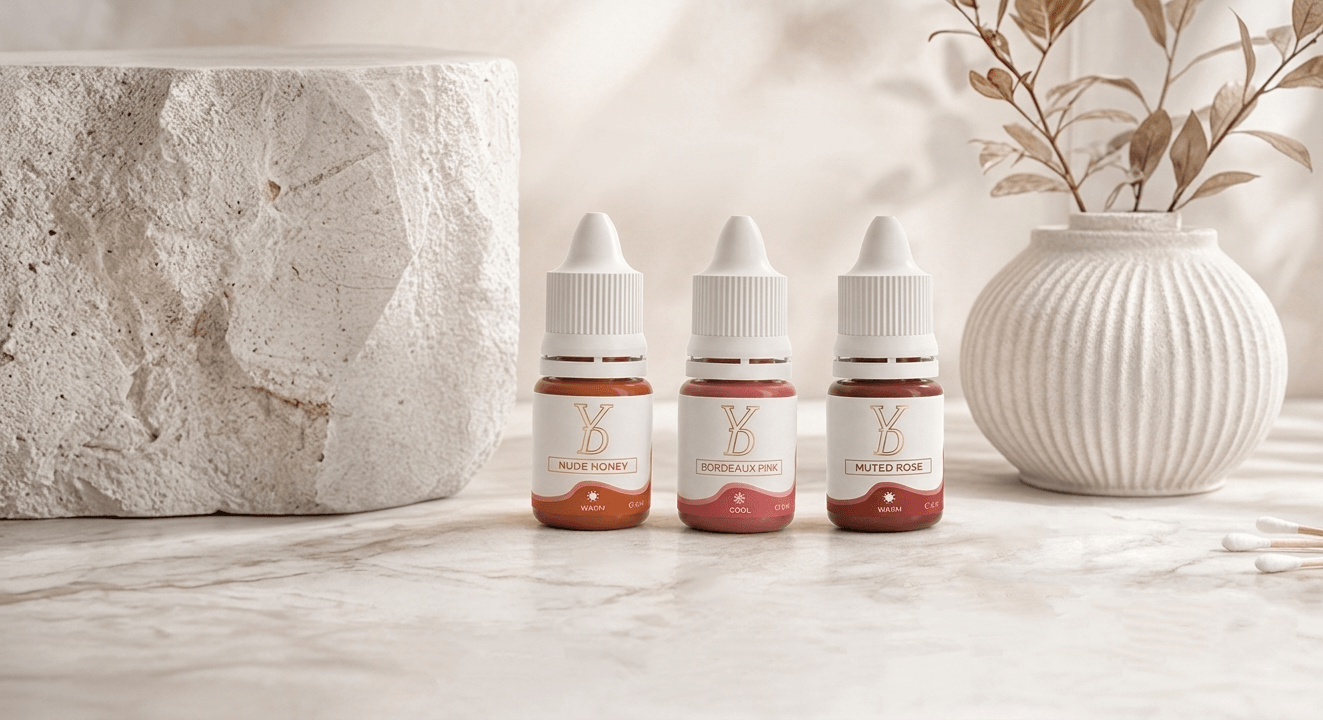

To read a PMU pigment label, first verify the exact product and shade, intended use, batch or lot number, ingredients, warnings, dates and product-matched documentation. If essential information is missing or does not match the bottle, pause before use and contact the supplier.
A label supports product identity and traceability. It does not, by itself, prove that a pigment is suitable for every procedure, client or destination market.
This guide explains nine practical checks professional PMU artists, trainers, studios and buyers should complete before using a pigment bottle.
Quick Answer: What Should You Check on a PMU Pigment Label?
Before use, confirm:
- The exact brand, product series, shade and volume
- The intended use and procedure category
- The batch or lot number
- The expiry information and packaging condition
- The ingredient list
- Warnings and instructions for use
- Requirements for the destination market
- Whether supporting documents match the exact product
- Whether the pigment has been recorded in the studio’s traceability system
If essential information is missing, unreadable or inconsistent with the product documentation, pause before use and contact the supplier.

Why Reading the Label Matters
A professional pigment check serves three different purposes:
| Purpose | What the Label Helps Confirm |
|---|---|
| Product identity | Which series, shade and bottle is being used |
| Traceability | Which batch was used for a specific procedure |
| Use information | Intended application, warnings, dates and handling instructions |
The label cannot independently guarantee healed color, retention, individual suitability or the absence of adverse reactions. These also depend on the exact formulation, shade, treatment area, client characteristics, artist technique, healing response and aftercare.
1. Confirm the Exact Product Identity
Start with the basic information:
- Brand name
- Product or series name
- Shade name or shade code
- Bottle volume
- Formula or product category, where stated
Do not rely only on the color visible through the bottle. Similar shades may belong to different series, volumes or procedure categories.
The bottle, outer packaging, order record and product page should describe the same product. A mismatch may indicate that the wrong product was supplied, the outer packaging was changed or the documentation belongs to a different item.
For mixed studio inventories, record both the shade and series. Writing only “Brown” or “Red” in a client record is not enough to identify the product later.
2. Verify the Intended Use
A pigment should be evaluated according to its stated intended use, not only its color.
Check whether the product information identifies it for permanent makeup, cosmetic tattooing or another defined purpose. Then confirm the intended procedure category, such as:
- Brows
- Lips
- Eyeliner
- Scalp micropigmentation
- Skin camouflage
- Areola pigmentation
A pigment that looks suitable in the bottle is not automatically appropriate for every treatment area.
In the European Union, mixtures placed on the market for tattooing purposes must carry the statement:
“Mixture for use in tattoos or permanent make-up”
This statement identifies the intended use required by the EU restriction. It should not be interpreted as a product approval certificate or a guarantee of suitability for every procedure.
3. Find and Record the Batch or Lot Number
The batch or lot number connects an individual bottle to a defined production batch.
This information becomes important when:
- Requesting product-specific documentation
- Investigating a packaging or performance concern
- Checking whether a notice applies to a particular batch
- Reviewing which product was used for a client
- Managing stock rotation across a studio or academy
Under the EU tattoo-ink restriction, suppliers must mark the mixture with a reference number that uniquely identifies the batch.
Before the procedure, record the batch number in the client or treatment record. A photograph of the bottle label can provide additional traceability, but it should not replace a searchable written record.
If the batch number is missing, damaged or unreadable, do not invent one or copy a number from another bottle.
4. Check Dates, Seal and Packaging Condition
Review all available date and packaging information before opening the bottle.
Check for:
- Expiry or best-before information
- Opening or in-use instructions, where provided
- Tamper evidence
- Cap and nozzle condition
- Leakage, swelling, cracking or visible damage
- Unusual separation that does not respond to the manufacturer’s stated mixing instructions
Follow the product’s own storage and handling instructions. General advice such as “store in a cool place” should not replace the conditions given for the exact product.
Studios should also record the date a bottle was first opened. Do not use a pigment beyond its stated expiry or in-use period.
An intact seal is only one packaging check; it does not replace manufacturing controls or product-specific information. The U.S. FDA has reported microbial contamination in some sealed tattoo-ink bottles and recommends controls intended to help manufacturers and distributors prevent contamination.
5. Read the Ingredient List Correctly
An ingredient list helps identify substances used in the formulation. It should not be treated as a simple performance ranking.
For mixtures placed on the EU market for tattooing purposes, ingredients must be listed using the applicable common ingredient name or, where necessary, other specified chemical identifiers. They are listed in descending order by weight or volume at the time of formulation.
When reviewing ingredients:
- Check that the ingredient information belongs to the exact shade
- Do not assume every shade within a series has an identical colorant composition
- Do not confuse an ingredient name with a finished-product approval
- Do not predict healed color from one ingredient alone
- Do not assume “organic,” “inorganic” or “hybrid” creates a universal safety or performance ranking
These terms may describe aspects of colorant chemistry or commercial positioning, but they do not guarantee retention, fading behavior or individual suitability.
What Do CI Numbers Mean on a PMU Pigment Label?
CI means Colour Index, a standardized identification system for colorants. A CI number can help identify which colorants are listed in a pigment shade, but it does not describe the complete finished formula.
One shade may contain several CI-listed colorants, and the same CI number may appear in products with different carriers, concentrations and overall formulations.
A CI number alone does not prove regulatory compliance, product safety, healed tone, retention or suitability for a particular procedure. Read it together with the complete ingredient list, intended use, batch information and product-specific documentation.

6. Review Warnings and Safety Instructions
Read every warning before use, including information printed on the outer box or supplied in separate instructions.
Under the EU restriction, relevant label information may include:
- The additional designation “pH regulator”
- A nickel statement where the specified condition applies
- A chromium (VI) statement where the specified condition applies
- Safety instructions not already required under other applicable labeling rules
The required information must be clearly visible, legible and indelible. It must also be provided in the applicable official language unless the destination market allows otherwise.
Under the EU tattoo-ink restriction, the person performing the procedure must provide the client with the information marked on the package or included in the instructions for use before the pigment is used. This information requirement should not be presented as a product approval or certification.
Small packaging does not make the information optional. When space is limited, certain information may be supplied in accompanying instructions, while the intended-use statement must remain on the mixture.
Never cover the original label with a studio sticker in a way that hides the batch number, dates, ingredients or warnings.

7. Confirm the Destination Market
“Professional pigment” is not one universal regulatory category.
Requirements may differ between:
- The European Union
- The United States
- The United Kingdom
- Individual states, provinces or local jurisdictions
- Other destination markets
In the EU, REACH restricts specified substances in tattoo inks and permanent makeup and establishes related labeling requirements. It does not provide a blanket product approval badge.
In the United States, the FDA considers tattoo and permanent-makeup inks to be cosmetics. The pigments used in the inks are color additives subject to premarket approval; however, the FDA states that none is approved for injection into the skin. The tattooing procedure itself is generally regulated by state and local authorities.
For this reason, phrases such as “FDA approved pigment,” “approved worldwide” or “fully certified for every market” should not replace verification of the exact product and destination.
Artists, distributors and buyers should confirm current requirements for their own market before ordering or using a product.
8. Match the Supporting Documents to the Product
A label and a document serve different purposes.
| Information Source | What It Can Help Confirm | What It Does Not Automatically Prove |
| Bottle label | Identity, batch, ingredients, dates and warnings | Universal suitability or performance |
| SDS | Hazard communication, handling and product information | That every market requirement has been met |
| Laboratory report | Results for the tested sample and test scope | Results for untested shades or batches |
| Product declaration | A supplier’s statement about a defined product | Independent approval by a regulator |
| Instructions for use | Intended use, handling and warnings | Suitability for every client or technique |
Before relying on a document, check:
- Product name
- Shade or product range covered
- Batch number, where applicable
- Manufacturer or supplier identity
- Issue date
- Test method or document scope
- Destination market
- Whether the document is current

An SDS is not a “safety certificate.” A laboratory report for one shade should not automatically be presented as proof for every shade in a series.
Product-specific REACH and safety documentation may be available for eligible YDPMU formulas and shades. The exact shade, batch, intended use and destination market should be confirmed when requesting documents.
9. Create a Studio Traceability Record
The final check happens before the pigment is used on a client.
Record:
- Brand and product series
- Shade name or code
- Batch or lot number
- Expiry information
- Date first opened
- Supplier or order reference
- Procedure date
- Relevant client or treatment record
For custom mixtures, record every shade and its batch number rather than writing only the final mixed color.
Training academies should teach this process alongside color theory and machine technique. Traceability is part of professional product management, not an administrative task reserved for large clinics.
What a PMU Pigment Label Cannot Tell You
A label cannot tell an artist exactly how the pigment will heal on an individual client.
Healed results may be influenced by:
- The treatment area
- Existing lip or skin undertone
- Previous pigment in the skin
- Shade selection and mixing
- Cartridge configuration
- Machine and working configuration
- Hand speed, angle and pressure
- Tissue response
- Healing and aftercare
Claims such as “never turns grey,” “guaranteed retention,” “hypoallergenic” or “safe for all skin types” should be treated cautiously unless their scope and supporting evidence are clearly defined.
No pigment eliminates the need for client assessment, appropriate training or continuous tissue evaluation.
When Should You Stop and Contact the Supplier?
Pause before using the bottle if:
- The product or shade cannot be identified
- The intended use is unclear
- The batch number is missing or unreadable
- The bottle has expired
- The cap, seal or packaging is damaged
- Required warnings or instructions are unavailable
- The bottle and documentation describe different products
- A laboratory report does not cover the shade or sample being discussed
- Destination-market information cannot be confirmed
Do not use another bottle’s documentation to fill a gap.
How YDPMU Product Information Should Be Checked
When reviewing a YDPMU pigment, match the product series, shade, volume and batch information across the bottle, product page and any supplied documentation.
Artists and buyers can:
- Browse all YDPMU pigment collections
- Review the exact product page before ordering
- Confirm the intended procedure category
- Request product-specific information for eligible formulas
- Contact YDPMU with the exact shade, batch and destination market
Documentation for one YDPMU formula, shade or batch should not automatically be applied to a different product.
For broader procedure-risk information, read Is Permanent Makeup Safe?.
Frequently Asked Questions
What information should be on a PMU pigment label?
The label should clearly identify the product and provide the information required for its intended use and destination market. This may include the shade, batch number, ingredients, dates, warnings and instructions. EU requirements for mixtures used in tattooing include a specific intended-use statement, unique batch reference and ingredient information.
Does an SDS prove that a pigment is safe?
No. An SDS communicates defined product and hazard information. It is not a universal safety certificate, product approval or guarantee of individual suitability.
Is an EU REACH label the same as certification?
No. REACH establishes chemical restrictions and related requirements. The presence of required labeling does not mean that an EU authority has issued a blanket approval certificate for the product.
Are PMU pigments FDA approved in the United States?
The FDA states that no color additives are approved for injection into the skin, including for tattoos and permanent makeup. Artists and sellers should therefore avoid presenting a PMU pigment as “FDA approved.”
Can the label predict how a pigment will heal?
No. The label helps identify and trace the product. Healed tone, retention and fading also depend on the shade, treatment area, client, technique, tissue response and aftercare.
Should every bottle used in a mixture be recorded?
Yes. Record the product name, shade and batch number of every bottle used. This preserves traceability if the final treatment color was created by mixing several shades.
Conclusion
Professional pigment selection begins before the bottle is opened.
A readable label, unique batch number, clear intended use, relevant warnings and product-matched documentation allow artists and buyers to make more informed decisions. These checks do not guarantee a specific healed result, but they improve traceability, reduce avoidable uncertainty and support more responsible studio practice.
Choose pigments by the exact product, procedure, client and market—not by a broad marketing claim.
References
- European Union: Commission Regulation (EU) 2020/2081
- U.S. FDA: Tattoos & Permanent Makeup Fact Sheet
- U.S. FDA: Tattoo Ink Microbial-Contamination Guidance
- U.S. FDA: Color Additives and Cosmetics Fact Sheet
Last reviewed: July 24, 2026