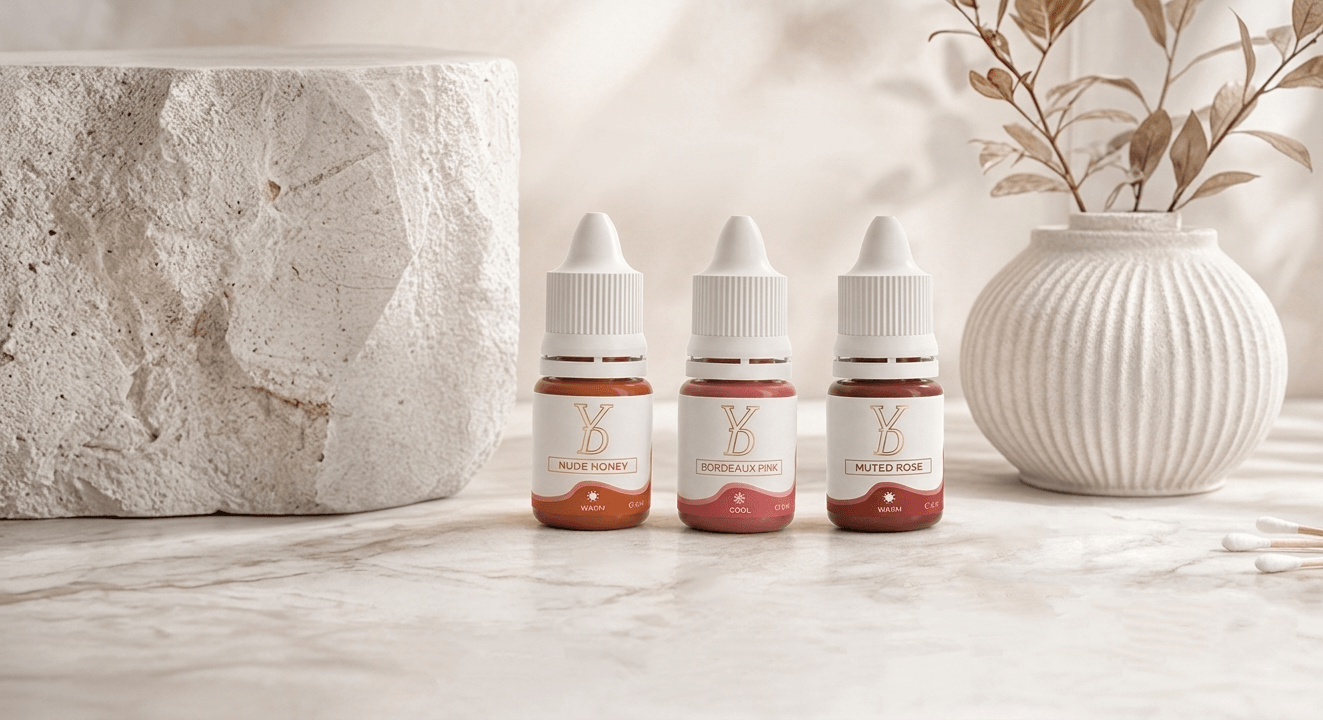

Dark lip neutralization is a professional permanent makeup color-correction service for lips that appear naturally brown, purple, blue-grey, cool, muted or uneven. The goal is not to bleach the lips or cover every dark area with one strong orange. It is to assess the visible lip color, choose a controlled amount of corrective warmth, allow the tissue to heal and then decide whether neutralization, refinement or an aesthetic lip shade is appropriate next.
Because natural lip color, previous pigment, tissue condition, healing response and artist technique all affect the result, no single corrector formula or session count works for every client. This guide brings together the practical color logic, common myths, suitability checks and healing decisions that artists need before planning a dark-lip service.
Professional-use note: This article is educational information for trained PMU professionals. It is not a medical diagnosis or a universal treatment protocol. Follow the product label, local regulations, infection-control requirements and your scope of practice.
Quick Answer: How Does Lip Color Correction Work?
Lip color correction begins by identifying whether the visible concern comes from natural lip pigmentation, previous lip PMU, uneven distribution, active irritation or an unfinished healing stage. When treatment is appropriate, the artist selects controlled corrective warmth within a known pigment system, documents the first-session objective and reassesses only after healing. The final aesthetic shade may be planned separately because neutralization and lip-blush color are not always the same step.
What Is Dark Lip Neutralization?
Dark lip neutralization uses corrective pigment to balance a visible cool or deep lip tone before, or sometimes instead of, adding a target lip-blush color. In basic color theory, warmth can visually counterbalance cool blue, grey or violet. In real PMU work, however, the artist is not correcting a flat color swatch. The visible lip is a combination of natural melanin, vascular color, surface condition, previous procedures and the way light passes through healing tissue.
That is why a corrector should be selected from an assessment rather than from a rigid chart. Two clients may both describe their lips as “brown,” yet one may show a muted cool-brown base while the other shows warm brown with darker areas around the border. Their first-session strategy may not be the same.
Artists who need a broader foundation can review the YDPMU color theory guide for PMU artists. It explains complementary colors, undertones and why healed color cannot be predicted from the bottle color alone.
Dark Lip Neutralization vs Lip Color Correction
The terms are often used interchangeably, but lip color correction is the broader category. Dark lip neutralization usually refers to balancing a naturally deep, cool, muted or uneven visible lip base. Lip color correction may also describe the assessment of unwanted color remaining from a previous lip tattoo.
| Visible situation | Primary question | Planning direction |
|---|---|---|
| Natural dark or cool lip base | What visible undertone and distribution are present? | Evaluate suitability and controlled corrective warmth |
| Previous healed lip PMU | What color, saturation and shape remain? | Decide whether correction is realistic or lightening/removal advice is needed |
| Lip blush still healing | Is the apparent grey, pale or patchy stage temporary? | Wait for an appropriate healed assessment before correcting |
| New, symptomatic or unexplained discoloration | Is the concern outside PMU scope? | Postpone and refer to an appropriate licensed healthcare professional |
This distinction prevents artists from treating every dark, grey or uneven-looking lip as a simple color-wheel problem. A correction plan should begin only after the source and stage of the visible color have been clarified as far as the artist’s scope allows.
Why Lips Can Look Dark or Uneven
Lip color varies naturally between people and across different areas of the same lips. Melanin distribution can create a deeper border, darker upper lip or patchy-looking tone without indicating a problem. Acquired changes can also occur. Repeated irritation, inflammation, lip licking or reactions to products may be associated with post-inflammatory color change. Previous PMU can add another layer of red, grey, violet or brown that must be distinguished from the natural lip base.
The vermilion also differs from ordinary facial skin. It has a thinner-looking surface and lacks the same oil-gland structure found in surrounding skin, so dryness, hydration and irritation can change how the color appears. The Cleveland Clinic overview of lip anatomy provides useful background on the vermilion and variation in natural lip color.
If the lips show active inflammation, sores, unexplained new discoloration, persistent burning, scaling, swelling or another change outside the artist’s scope, postpone the procedure and refer the client to an appropriate licensed healthcare professional. For example, DermNet notes that pigmented contact cheilitis can produce brown-black lip discoloration following an irritant or allergic reaction. PMU should not be used to diagnose or conceal an unresolved condition.

Dark Lip Assessment Before Choosing a Corrector
A useful consultation separates what the artist can observe from what still needs clarification. Photograph the lips in neutral, consistent light without lipstick, tinted balm or a color filter. Review both lips as a whole, then compare the center, body, corners and vermilion border. Ask about previous PMU, recent irritation, recurring lesions, sensitivities, medications and relevant medical history according to your local consent and screening requirements.

| Assessment area | What to record | Why it matters |
|---|---|---|
| Visible color | Cool violet, blue-grey, neutral brown, warm brown or mixed areas | Guides the direction and amount of corrective warmth |
| Distribution | Even, border-dominant, upper-lip dominant, patchy or asymmetric | Shows where density may need to be controlled rather than applied uniformly |
| Previous PMU | Color, age, saturation and visible migration or scarring | Old pigment may change the correction plan or make the client unsuitable |
| Tissue condition | Dryness, cracking, irritation, active lesions or texture changes | Unhealthy or actively irritated tissue should not be worked |
| Client goal | More even natural appearance, warmer base or later aesthetic shade | Neutralization and final lip color are not always the same stage |
How Corrector Color Logic Works
The starting principle is simple: a visibly cool lip generally needs warmth. The practical decision is more complex because “warmth” can mean different orange, coral, peach, red-orange or modifying tones at different strengths. The correct choice depends on the dominant visible undertone, the depth and distribution of that undertone, the pigment system, previous pigment and the artist’s intended first-session objective.
Use an undertone chart as a question guide, not a prescription. A violet-dominant lip may require a different balance of warmth from a muted brown lip. A mixed blue-brown lip may need a layered plan rather than one dense pass. A previously tattooed grey lip must be assessed differently from a naturally cool lip. Product instructions and healed examples from the same pigment system are more useful than copying an isolated recipe from another brand.

The YDPMU NEO Organic Dark Lip Neutralize Set in 6 ml and the 12 ml professional set provide ten shades for trained artists who need more than one level of corrective warmth. Choose and mix only within the product instructions and your professional training; the existence of several correctors does not mean every client needs multiple colors.
A Color Wheel Supports Reasoning; It Does Not Supply a Recipe
A complementary-color relationship can help the artist understand why warmth may visually balance coolness. It cannot determine the exact bottle, ratio, saturation or session plan. Those decisions must account for the strength of the visible base, the finished formulation, previous pigment, the artist’s technique and the intended healed result.
When creating a custom mixture, record every shade, product line, lot number and mixing ratio. “Orange corrector” is not enough information to reproduce or evaluate a healed result.
Why One Formula Does Not Work for Every Dark Lip
A common shortcut is “dark lip equals orange.” This ignores both undertone and depth. If the chosen corrector is too weak for the visible coolness, the healed change may be limited. If it is unnecessarily strong or applied with excessive density, the lips may heal brighter or warmer than intended. If the natural lip contains several different zones, uniform saturation can exaggerate rather than reduce the visual difference.
The artist also has to separate color selection from implantation. Changing pigment strength cannot compensate for unstable hand speed, unsuitable cartridge choice, repeated passes or working compromised tissue. For a deeper explanation of this distinction, see the lip blush needle protrusion and implantation guide. It explains why a visible needle setting does not by itself prove implantation depth.
A Controlled Dark Lip Neutralization Workflow

- Screen suitability. Complete the required consultation, consent and health screening. Do not proceed over active lesions, inflammation, significant cracking or unexplained changes.
- Document the untreated baseline. Use consistent lighting and include close photographs of the center, body, corners and border.
- Identify the dominant visible undertone. Record whether the lips appear mainly violet, blue-grey, brown, mixed or affected by previous pigment. Avoid diagnosing the biological cause.
- Define the first-session objective. Decide whether the goal is a conservative warmth test, broader neutralization or correction of a specific zone. Do not promise the final aesthetic shade in the same step when the healed base is unknown.
- Select pigment within one known system. Follow the manufacturer’s shade guidance and document the exact formula, lot information and amount used.
- Control implantation variables. Use an appropriate sterile, single-use cartridge and a technique matched to the tissue response. Stop if the tissue response indicates that continuing would be unsafe or unnecessarily traumatic.
- Give written aftercare and warning signs. Clients should know what normal early color change may look like and when to contact the artist or seek medical advice.
- Assess only after healing. Compare the healed result with the baseline under similar lighting before choosing the next corrector or aesthetic shade.
How Many Sessions Does Lip Neutralization Need?
There is no responsible universal number. Some lips show a useful shift after one session; others require staged neutralization and reassessment. Previous pigment, visible undertone, tissue response, chosen density and the client’s goal all influence whether another session is appropriate. “Multiple sessions may be needed” is a realistic planning statement. “Every client needs two or three sessions” is not.
A new session should not be scheduled merely because the lips look pale, patchy or unexpectedly cool during early healing. Temporary darkening, flaking and a visually light or uneven phase can occur before the color settles. Use the PMU healing stages guide to help explain peeling, light scabbing and the ghosting phase without promising an identical timeline for every person.

Neutralization Versus the Final Lip Blush Color
Neutralization and aesthetic lip blush answer different questions. Neutralization asks, “What corrective warmth is needed to balance the current base?” Aesthetic color selection asks, “What shade and finish suit the healed base and the client’s goal?” On some lips those decisions may overlap. On others, the artist should wait for the corrected base to heal before selecting a nude, rose, berry or other target shade.
For clients interested in a gradient finish, the Ombré Lip Blush technique and color guide explains how controlled pigment density creates the visual transition. A gradient technique should not be used to disguise an unsuitable or unresolved dark-lip condition.
Can Corrector and Final Lip Color Be Used in the Same Session?
There is no universal yes-or-no rule. In some professionally assessed cases, the artist may work within a product system and treatment plan that combines controlled correction with an aesthetic color direction. In other cases—especially where the visible base is deep, mixed, previously tattooed or difficult to predict—the healed neutralization result should be reviewed before selecting the next shade.
The decision should not be based on a fixed recipe or a desire to finish the result in one appointment. Continuing to add color after the procedural endpoint has been reached can increase tissue stress without making the healed color more predictable.
Why Lip Color Correction Can Heal Grey, Muddy, Orange or Uneven
An unexpected healed color does not prove that one pigment category or corrector shade is defective. Several variables can produce a grey, muted, overly warm or uneven appearance:
- The natural base or previous pigment was misidentified.
- The corrector direction or strength did not match the visible color.
- Too much density was built in one zone or across the complete lip.
- Previous cool or saturated lip pigment continued to influence the result.
- Different formulas were mixed without confirmed compatibility.
- Implantation, overlap or tissue response varied across the treatment area.
- The result was judged during peeling, ghosting or another unfinished healing stage.
- Lighting, camera processing or tinted products changed the comparison.
Correction should begin with a healed comparison under similar lighting. Identify whether the main problem is color direction, remaining saturation, distribution, shape or tissue condition before adding more pigment. If the lips remain heavily saturated or the correction pathway is unclear, further implantation may not be the appropriate next step.
For a focused guide to temporary and persistent unevenness, read Why Does Lip Blush Heal Patchy?.
Common Myths About Dark Lip Neutralization
Myth 1: Neutralization bleaches or medically lightens the lips
PMU adds pigment; it does not remove melanin or treat the biological cause of pigmentation. Corrective warmth can change the visible color balance, but it should not be marketed as skin lightening or a cure for hyperpigmentation.
Myth 2: Stronger orange creates a better result
More warmth is not automatically more accurate. The useful amount depends on what is visible, the selected pigment system and the density implanted. An overly strong choice can create an unnecessarily bright healed result.
Myth 3: Every dark lip needs the same number of sessions
Session count is a planning estimate, not a guarantee. The artist should use the healed result—not a preset package—to decide whether further neutralization is justified.
Myth 4: A color chart replaces a consultation
A chart cannot identify active irritation, previous pigment, mixed undertones or contraindications. It supports visual reasoning but does not replace client history, tissue assessment, consent or professional judgment.
Myth 5: Any dark area can be covered with PMU
New, changing, symptomatic or unexplained discoloration should be assessed by a qualified healthcare professional. An artist should not diagnose it or use pigment to conceal it. The U.S. FDA also notes that permanent makeup is a form of tattooing and that adverse reactions and infections have been reported; review the FDA tattoos and permanent makeup fact sheet as part of broader safety education.
What to Record for a More Repeatable Result
Consistent documentation is more valuable than relying on memory. Record the visible undertone and distribution, product line, exact shade or mix, lot number, cartridge, machine, relevant settings, technique, number of passes, tissue observations, immediate photographs, aftercare supplied and healed photographs. When comparing sessions, keep lighting and camera processing as consistent as possible.
This record helps the artist distinguish a color-selection problem from an implantation, healing or photography problem. It also makes future adjustments more defensible: change one clearly identified variable, document it and compare the healed result.
Key Takeaways
- Dark lip neutralization balances visible color; it does not bleach lips or treat the cause of pigmentation.
- Assess natural color, previous pigment, distribution, tissue condition and client goals before selecting a corrector.
- Orange, coral, peach and other warm tones are tools, not fixed one-to-one prescriptions.
- Do not promise a universal session count or judge the result during early peeling and ghosting.
- Postpone work on active, symptomatic or unexplained lip changes and refer beyond the artist’s scope.
- Use healed documentation from the same pigment system to guide the next decision.
Frequently Asked Questions
What color is used to neutralize dark lips?
Artists generally use controlled warm correctors such as orange, coral, peach or related modifying tones, but the exact choice depends on the dominant visible undertone, depth, distribution, previous pigment and the specific pigment system. There is no universal formula for every dark lip.
How many sessions does dark lip neutralization take?
There is no fixed number. Some clients show a useful change after one healed session, while others may need staged correction. The next step should be based on the fully assessed healed result rather than a preset promise.
Is dark lip neutralization the same as lip blush?
No. Neutralization primarily balances a dark or cool visible base. Lip blush primarily adds an aesthetic tint or finish. A client may need neutralization before the final lip-blush shade is selected, although the plan varies by case.
Can lip neutralization lighten natural lip color?
It can make the visible color appear warmer or more balanced by adding corrective pigment, but it does not remove melanin or medically lighten the tissue. Artists should avoid presenting PMU as bleaching or treatment for hyperpigmentation.
When should an artist postpone dark lip neutralization?
Postpone when the lips show active lesions, inflammation, significant cracking, swelling, persistent burning, scaling or new and unexplained discoloration. Follow local screening rules and refer the client to an appropriate licensed healthcare professional when the concern is outside PMU scope.
Can the final lip-blush color be applied during the neutralization session?
Sometimes, but not as a universal protocol. The decision depends on the visible base, previous pigment, selected product system, tissue response and treatment plan. When the healed base is difficult to predict, assess the neutralization result before choosing the final aesthetic shade.
Why can lip color correction heal muddy or grey?
Possible reasons include an incorrectly assessed base, insufficient or mismatched corrective direction, excessive density, previous cool pigment, incompatible mixtures, uneven implantation or judging the lips before healing is complete. Assess the healed color, distribution, saturation and tissue condition before deciding on another procedure.
References and Further Reading
- Cleveland Clinic: Lips
- DermNet: Pigmented Contact Cheilitis
- U.S. Food and Drug Administration: Tattoos and Permanent Makeup Fact Sheet
- YDPMU: Color Theory for PMU Artists
- YDPMU: Why Does Lip Blush Heal Patchy?
- Current YDPMU NEO Dark Lip Neutralize product labels and product-specific instructions
Last reviewed: August 19, 2026