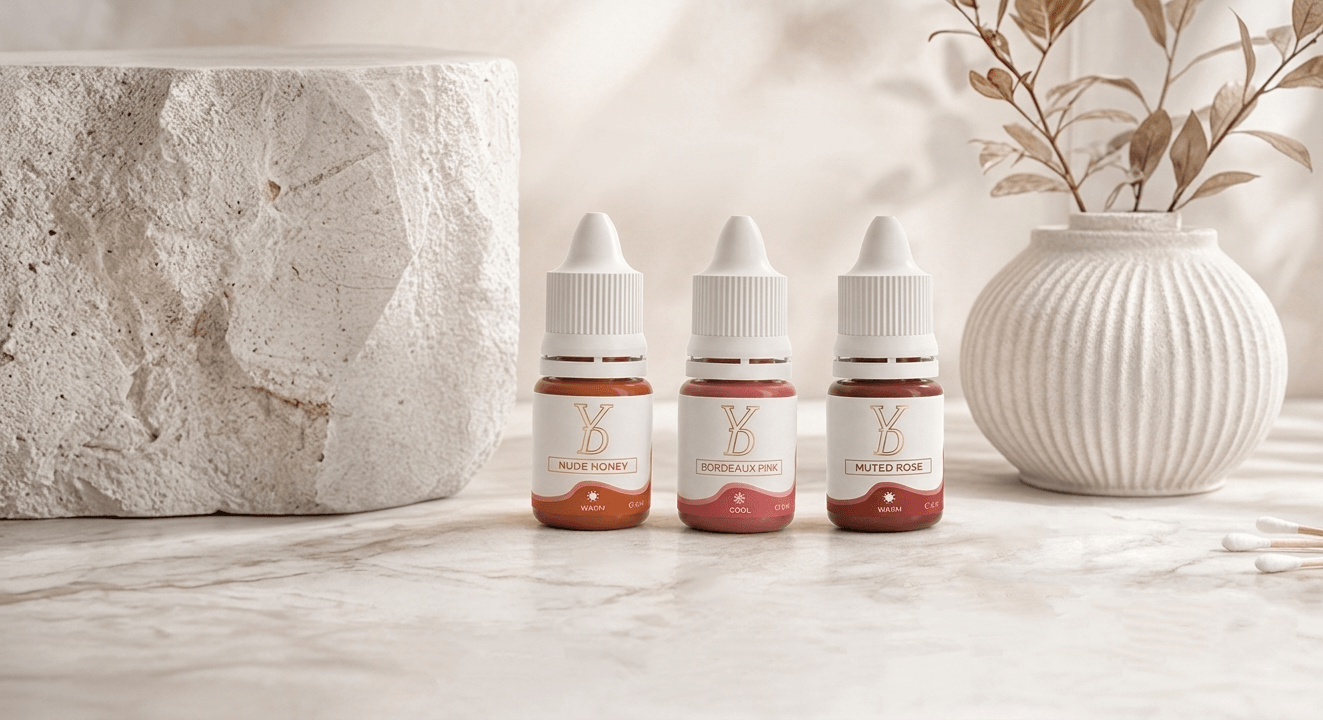

Choosing a permanent makeup pigment is not simply a matter of finding the closest bottle color, the most concentrated formula or one shade that appears versatile. Professional selection requires the artist to match the exact product, shade and handling characteristics to the procedure, technique, treatment area, client assessment and intended healed result.
A pigment suitable for powder brow shading is not automatically the best choice for machine hairstrokes. A direct lip shade is not automatically a neutralizer, and a black pigment intended for eyeliner should not be assumed suitable for scalp micropigmentation. Likewise, a highly concentrated pigment is not automatically unsafe for a beginner, while a lower-concentration pigment is not automatically forgiving.
This guide explains how trained PMU artists can match pigments to hairstrokes, powder brows, lip blush, eyeliner, SMP, skin camouflage and corrective work—while correctly evaluating formulation, saturation, retention, handling, documentation and storage.
Last reviewed: August 19, 2026
Quick Answer: How Do You Match a PMU Pigment to a Technique?
Start by confirming that the exact pigment and shade are intended for the planned treatment area. Then evaluate the client’s natural coloring, existing pigment, desired healed appearance, planned technique and the product’s handling instructions.
The most important checks are:
- Confirm the intended procedure and treatment area.
- Assess the client’s natural color, undertone and existing PMU.
- Define the intended healed result—not only the fresh result.
- Match the pigment’s handling characteristics to the technique.
- Check the exact shade, label, batch and product documentation.
- Test the selected system during controlled professional practice.
- Store and prepare the bottle according to its product-specific instructions.
Important: Organic, inorganic and hybrid are formulation descriptions, not universal technique rankings. No formula category automatically guarantees better retention, safer application or suitability for every client.
PMU Pigment Technique-Matching Overview
| Procedure or technique | Main pigment-selection priorities | Common selection mistake |
|---|---|---|
| Machine hairstrokes | Controlled flow, line visibility, appropriate brow shade and compatibility with the artist’s machine-and-cartridge system | Selecting only by color without testing line behavior |
| Microblading | Procedure-specific suitability, controlled handling, skin assessment and intended healed softness | Assuming every brow pigment performs identically in manual and machine techniques |
| Powder or ombré brows | Buildable saturation, shade balance, smooth pixel distribution and desired healed intensity | Choosing an overly dark shade to compensate for uncertain retention |
| Lip blush | Natural lip color, undertone, target shade, existing PMU and intended healed saturation | Choosing from bottle color alone |
| Dark-lip neutralization | Existing lip pigmentation, dominant cool characteristics, neutralization stage and long-term treatment plan | Treating neutralization as a one-step color-covering procedure |
| Eyeliner | Exact treatment-area suitability, controlled saturation and intended eyeliner tone | Using a black pigment without confirming its intended procedure |
| Scalp micropigmentation | Scalp-specific formulation, dot appearance, dilution or shade system and compatibility with the treatment plan | Using eyeliner black as an automatic substitute for SMP pigment |
| Skin camouflage | Skin-depth match, undertone match, stable comparison method and professionally planned test area | Matching only to surface brightness |
| Existing PMU correction | Identification of the unwanted color, remaining saturation, skin condition and realistic correction pathway | Adding a target brown directly over an unresolved grey, blue, red or orange result |

Why Technique Matching Matters
Each PMU technique creates a different pattern of pigment placement. Hairstrokes require controlled line formation. Powder brows rely on graduated pixel density. Lip blush covers a broader treatment area with layered color, while SMP depends on individual dots that must remain visually appropriate for the scalp.
The pigment is only one part of the system. Final performance may also be affected by:
- The exact pigment and shade
- Viscosity and dispersion behavior
- Machine and cartridge configuration
- Hand speed, angle and movement pattern
- Implantation depth and saturation
- The treatment area
- Skin or lip condition
- Previous permanent makeup
- Healing response and aftercare
A pigment cannot compensate for an unsuitable technique, excessive saturation, incorrect depth or an incomplete client assessment.
Why There Is No One-Size-Fits-All PMU Pigment
No single pigment, shade or formula can be assumed to work equally well for every procedure, client and technique. The same bottle may look different when it is used to create a fine line, a soft pixel, a scalp dot or a broad lip wash. The client’s natural coloring and existing PMU also change what is visible after healing.
| Variable | Why the pigment decision changes | What to confirm |
|---|---|---|
| Treatment area | Brows, lips, eyelids, scalp and camouflage areas have different visual goals and tissue characteristics | The exact product and shade are intended for that procedure |
| Technique | Lines, pixels, dots and broad shading distribute color differently | Handling is compatible with the planned machine, cartridge and movement |
| Natural base | Skin undertone, lip pigmentation, hair color and scalp appearance affect the visible result | The shade plan starts from the client’s existing color |
| Existing PMU | Remaining grey, blue, red, orange or dense pigment can alter the target color | Correction, lightening or removal is considered before adding color |
| Desired healed result | A translucent lip wash, crisp hairstroke and dense eyeliner require different endpoints | The target is defined after healing, not only immediately after treatment |
| Product system | Colorants, carrier, dispersion, concentration and instructions vary between finished products | Selection is based on the exact label and documentation, not a broad category alone |
This is also why universal recipes are unreliable. A fixed shade, dilution, voltage, needle or number of passes cannot be transferred safely to every product and client without product-specific training and assessment.
For the color relationships behind undertone, modifiers and healed color planning, read Color Theory for PMU Artists: The Complete Guide.
1. Pigments for Machine Hairstrokes
Machine hairstrokes depend on controlled line production. The artist should evaluate how the selected pigment works with the exact cartridge, machine configuration, hand movement and practice surface.
When comparing a pigment for hairstroke work, observe:
- Whether the line begins and ends cleanly
- Whether pigment flow remains consistent through curves
- Whether repeated passes make the line expand excessively
- Whether the selected shade provides an appropriate healed brow tone
- Whether the formula can be prepared according to its supplied instructions
Do not assume that a thinner pigment automatically produces finer healed strokes. Likewise, a more concentrated or thicker-looking pigment does not automatically provide better retention. The result comes from the interaction between the finished formula, cartridge, movement, implantation and client.
Artists evaluating YDPMU options for fine brow work can review the YDPMU NANO Organic Liquid Pigment range, then confirm the exact shade and intended procedure before use.
For a focused discussion of retention in this technique, read How to Improve Pigment Retention in Hairstroke Brows.
2. Pigments for Powder and Ombré Brows
Powder and ombré techniques use repeated pixels or shading movements to build a soft gradient. Pigment selection should support controlled layering rather than forcing full saturation in one pass.
Evaluate:
- The client’s natural brow hair color
- Skin undertone and visible surface characteristics
- Existing brow pigment
- The desired healed intensity
- Whether the front, body and tail require different saturation control
- How the pigment behaves when layered during controlled practice
Do not choose a shade several levels darker simply because fresh PMU is expected to soften during healing. An unnecessarily dark starting shade combined with excessive saturation can create a result that remains too heavy after healing.
YDPMU systems that artists can evaluate for powder and ombré brow work include:
The appropriate choice depends on the exact shade, product instructions, technique and intended healed appearance—not only whether the formula is described as hybrid or inorganic.
3. Pigments for Lip Blush
Lip pigment selection begins with the client’s natural lip color, not the target shade alone.
Assess:
- Overall natural lip color
- Cool, warm or mixed characteristics
- Differences between the upper and lower lip
- Uneven pigmentation
- Previous lip PMU
- Desired healed transparency or saturation
- Whether neutralization is required before the target color
The visible pigment in the bottle is not a reliable preview of the final healed lip color. Natural lip pigmentation, tissue response, selected shade, saturation, healing and aftercare all influence the result.
Artists can compare lip-specific shades within the YDPMU NEO Organic Pigment collection. The exact shade should still be confirmed for its intended use and the client’s treatment plan.
Natural or Nude Lip Results
A natural nude result should not be created by selecting the palest bottle available. If a shade is too light or insufficiently balanced for the natural lip, the healed result may appear weak, uneven or disconnected from the surrounding complexion.
Instead, compare:
- The depth of the natural lip
- The client’s preferred healed intensity
- Warm, neutral or cool shade direction
- Whether the natural lip requires correction before a nude target shade
4. Pigments for Dark-Lip Neutralization
Dark-lip neutralization is a corrective color-planning process. It should not be reduced to the instruction “apply orange over dark lips.”
A professional assessment should consider:
- The depth and distribution of natural pigmentation
- Whether the dominant appearance is cool, brown, violet, grey or mixed
- Differences between the lip border and central lip
- Previous procedures or scarred areas
- The client’s target color
- Whether treatment should be divided into neutralization and target-color stages
More pigment or a brighter corrector does not automatically create faster neutralization. Technique, tissue response, saturation and the healing result must be evaluated before the next session is planned.
For this procedure, review the YDPMU NEO Organic Dark Lip Neutralization Set — 10 Colors, 6ml or the 12ml professional set.
For the complete assessment and healing framework, read Dark Lip Neutralization: Color Selection and Healing Guide.
5. Pigments for Eyeliner
Eyeliner pigments should be selected by exact treatment-area suitability. A pigment’s dark appearance or black shade name does not automatically mean it is intended for use around the eyes.
Confirm:
- The exact product and shade
- The stated intended procedure
- Label information and supplied warnings
- Applicable destination-market requirements
- The intended healed eyeliner color
Avoid using an SMP black, mixing black or brow modifier as eyeliner unless the exact product information specifically permits that use.
6. Pigments for Scalp Micropigmentation
SMP creates a visual pattern of hair-follicle impressions. Pigment choice must be integrated with dot size, spacing, needle configuration, scalp characteristics, existing hair and the client’s treatment plan.
Artists should assess:
- The exact SMP pigment system
- The client’s hair and scalp appearance
- The intended healed density
- Whether the product system provides modifiers or dilution instructions
- How dots behave during controlled practice
An eyeliner pigment should not be treated as an automatic alternative to an SMP-specific product simply because both appear black in the bottle.
Review the YDPMU Professional SMP Pigment System for product-specific shade, modifier and use information.
7. Pigments for Skin Camouflage
Skin camouflage requires a closer match than selecting “light,” “medium” or “dark.” Both skin depth and undertone must be considered.
A camouflage assessment may include:
- Overall skin depth
- Warm, cool, neutral, olive or mixed characteristics
- Differences between the target area and surrounding skin
- How lighting changes the apparent match
- Whether the area is stable and suitable for treatment
- A professionally planned test area and healed evaluation
A shade that looks correct immediately after application may not represent the final integrated result. Artists should avoid selecting a color based only on fresh redness or a single surface reading.
The YDPMU Skin Camouflage Pigment system provides procedure-specific shades for professional comparison.
For the complete SK-01–SK-20 selection process, read How to Match Skin Camouflage Pigments.
8. Pigments for Existing PMU Color Correction
Correction begins by identifying what remains in the skin. The artist should distinguish between:
- Grey or blue brows
- Red or orange brows
- Green or violet shifts
- Uneven saturation
- An unsuitable original shape
- A result that may require lightening or removal before color correction
Do not place the desired final brown directly over every unwanted color. Corrector selection depends on the visible color, remaining saturation, skin condition and realistic treatment pathway.
For multi-directional brow correction, artists can review the YDPMU 5-Color Brow Correction Pigment Set, which provides separate shades for different correction and finishing needs.
For a detailed explanation of grey, blue, red, green and violet color changes, read Why PMU Pigments Change Color and How Correction Is Planned.
Does Organic, Inorganic or Hybrid Determine the Best Technique?
No. These terms help describe the types of colorants used in a formulation, but they do not establish a universal rule such as:
- Organic pigments are always best for lips.
- Inorganic pigments are always best for brows.
- Hybrid pigments are suitable for every procedure.
- Organic pigments always retain longer.
- Inorganic pigments never migrate.
Two pigments in the same broad category can use different colorants, carriers, concentrations and manufacturing processes. Even shades within one series may have different colorant combinations.
The exact shade, finished formulation, intended use, product instructions and professional technique are more useful than a broad formula label alone.
For a chemistry-focused comparison, read Organic vs. Inorganic vs. Hybrid PMU Pigments.
What Determines PMU Pigment Retention?
No responsible pigment guide can promise one retention period for every client, shade or procedure. Visible longevity is affected by several interacting factors.
| Factor | How it may affect the result | What the artist should evaluate |
|---|---|---|
| Exact pigment and shade | Different finished formulations and colorant combinations may behave differently | Product-specific information rather than category assumptions |
| Treatment area | Brows, lips, eyelids and scalp have different anatomical and healing characteristics | Procedure-specific pigment suitability |
| Implantation | Insufficient, excessive or inconsistent implantation can affect visibility and healed appearance | Depth, saturation, overlap and tissue response |
| Technique | Lines, pixels, dots and broad shading distribute pigment differently | Machine, cartridge and movement control |
| Client characteristics | Natural pigmentation, skin condition and individual healing can influence the result | Complete consultation and treatment-area assessment |
| Previous PMU | Remaining color may alter the visible healed result | Color, depth, saturation and shape of existing work |
| Lifestyle and skincare | Sun exposure and some skincare routines may affect visible fading | Relevant client history and realistic expectations |
| Healing and aftercare | Individual healing and aftercare behavior can affect the apparent result | Clear instructions and healed-result evaluation |

What Does Pigment Saturation Mean in PMU?
The word saturation is often used for several different ideas. Separating them prevents misleading comparisons:
- Color saturation describes how vivid or muted a color appears.
- Pigment concentration or color strength describes how much visible color a finished product can build under defined conditions.
- Procedural saturation describes how much pigment is placed in the treatment area through the artist’s implantation pattern, overlap and endpoint.
A dark-looking or opaque bottle does not reveal the complete concentration, healed behavior or treatment-area suitability of the finished formula. Compare exact products through their instructions, documentation, controlled practice and healed work rather than appearance alone.
Are Highly Saturated PMU Pigments Risky for Beginners?
Not automatically. A more concentrated or faster-building pigment can make each movement visually consequential, but concentration alone does not cause tissue damage, migration or poor healing. Problems arise when the product, technique, implantation, endpoint and artist’s training do not match.
A lower-concentration pigment is not automatically safer. An inexperienced artist may repeatedly work the same area trying to make the fresh color look stronger. Conversely, a trained artist using a concentrated pigment within a familiar, procedure-specific system may build the intended result with controlled placement.
The practical question is not “Is this pigment too powerful for beginners?” It is “Has the artist been trained to use this exact system for this procedure, and can they recognize the correct endpoint without relying on a fixed number of passes?”
Why More Pigment Is Not Always Better
Adding more passes, increasing overlap or selecting a darker shade does not guarantee better long-term retention. Excessive procedural saturation may increase tissue stress and can create an overly dense healed result. There is no universal pass count that is appropriate for every product, technique or client.
The objective is controlled, appropriate implantation—not maximum pigment density. The artist should respond to the treatment area, product instructions, visual build and tissue response rather than complete a predetermined number of passes.
What Should New PMU Artists Evaluate Instead?
- Procedure-specific training and supervised practice
- Whether the exact pigment and shade are intended for the treatment area
- Predictable handling with the selected machine and cartridge
- Clear label, batch, instructions and supporting documentation
- Controlled practice with one variable changed at a time
- A conservative endpoint based on placement and tissue response
- Consistent treatment records and healed-result review
Beginners do not need a universally “weak” pigment. They need an appropriate, documented product system and enough structured practice to understand how quickly it builds in their chosen technique.
Why Fresh Color Cannot Predict Final Retention
Immediately after treatment, color may appear darker, brighter or warmer because of surface pigment, inflammation and temporary tissue changes. During healing, the visible result may soften or appear temporarily uneven.
Evaluate retention only after the appropriate healing period. Do not judge final color from procedure-day photographs alone.
How to Test Pigment and Technique Compatibility
Professional practice should isolate variables. If the artist changes the pigment, machine, cartridge, voltage, hand speed and practice surface at the same time, it becomes difficult to understand what caused the result.
Use a controlled comparison process:
- Select one intended technique.
- Confirm the exact pigment and shade.
- Use the same machine and power configuration.
- Use the same cartridge configuration.
- Keep the practice surface consistent.
- Maintain the same movement pattern and hand speed.
- Change only one variable at a time.
- Repeat the test instead of judging from one line, pixel or dot.
- Record the product, shade, batch and configuration.
Practice results do not duplicate living tissue, but controlled testing can help the artist understand pigment handling and equipment interaction before professional use.
PMU Pigment Storage and Preparation
Storage instructions should come from the exact product label and supplied documentation. A general blog recommendation cannot replace product-specific conditions.
Before Opening
- Confirm the product name, shade and bottle volume.
- Check the batch or lot number.
- Review expiry or best-before information.
- Inspect the seal, cap, nozzle and bottle condition.
- Confirm that the label and documentation match the exact product.
After Opening
- Record the date first opened.
- Keep the original label readable.
- Close the bottle according to the supplied instructions.
- Prevent the nozzle from contacting contaminated surfaces.
- Dispense pigment using professional hygiene procedures.
- Do not pour unused pigment back into the original bottle.
- Follow the stated storage temperature, light and handling requirements.

Separation and Shaking
Some pigment dispersions may show visible settling or separation during storage. This does not automatically mean that a bottle is defective, and it also does not mean that every separated bottle is suitable for continued use.
Follow the manufacturer’s stated mixing or shaking instructions. Stop and contact the supplier when:
- The bottle is expired.
- The packaging is damaged or leaking.
- The label or batch number is unreadable.
- The pigment does not return to its expected consistency after the instructed preparation.
- There is an unexplained change in odor, texture or appearance.
- The bottle and supporting documents do not match.
Read the complete PMU Pigment Separation and Storage Guide for a more detailed bottle-assessment process.
Label, Batch and Documentation Checks
Technique compatibility does not replace product traceability. Before professional use, record:
- Brand and product series
- Exact shade name or code
- Batch or lot number
- Expiry information
- Date first opened
- Procedure category
- Supplier or order reference
- Every shade and ratio used in a custom mixture
A label or SDS does not independently guarantee a particular healed color, retention period or suitability for every client.
Use the 9-Point PMU Pigment Label Guide to check product identity, CI numbers, batch information, warnings and product-matched documents.
YDPMU Pigment Systems by Professional Use
| YDPMU system | Professional use to evaluate | Selection reminder |
|---|---|---|
| NANO Organic Liquid Pigments | Procedure-specific brow, lip and eyeliner options depending on the selected shade | Confirm the intended use of the exact shade |
| NEO Organic Pigments | Lip, brow and procedure-specific color systems, including dark-lip options | Separate direct lip-color selection from neutralization planning |
| POWDER Hybrid Pigments — 34 Shades | Brows, lips, eyeliner, SMP, areola and correction options depending on shade | The 34-shade range does not make every shade interchangeable |
| Inocream Inorganic Pigments | Procedure-specific inorganic pigment options | Do not assume formula category alone predicts retention |
| YDPMU SMP Pigments | Scalp micropigmentation color planning | Use the SMP system according to its exact instructions |
| Skin Camouflage Pigments | Professional skin-depth and undertone matching | Use healed test-area evaluation where professionally appropriate |
Explore all YDPMU professional pigment systems
Common PMU Pigment-Matching Mistakes
- Selecting by bottle color alone
- Choosing by “organic,” “inorganic” or “hybrid” alone
- Using the same black pigment for eyeliner and SMP without confirming intended use
- Treating dark-lip neutralization as direct color coverage
- Applying the target brown directly over every unwanted brow color
- Using a darker shade to compensate for uncertain technique
- Assuming more passes always produce better retention
- Assuming a highly concentrated pigment is automatically unsafe or that a lower-concentration pigment is automatically beginner-friendly
- Following a universal pass count instead of evaluating placement, product behavior and tissue response
- Expecting one pigment or shade to work for every treatment area and client
- Mixing unrelated pigments without confirming compatibility
- Failing to record every shade and batch used in a mixture
- Using expired, damaged or unidentified pigment
Professional Pigment Selection Checklist
Before using a pigment, confirm:
- Is the exact shade intended for this procedure?
- Have the treatment area and client characteristics been assessed?
- Has existing PMU been identified?
- Is the desired healed result realistic?
- Does the pigment suit the planned technique and equipment system?
- Have controlled practice results been reviewed?
- Are the label, batch, dates and packaging acceptable?
- Do supporting documents match the exact product?
- Are mixing, storage and preparation instructions available?
- Have all products and batches been recorded?
Frequently Asked Questions
Which PMU pigment is best for hairstrokes?
There is no single pigment that is best for every hairstroke artist or client. Select a brow-specific shade and evaluate its line behavior with the exact machine, cartridge, hand movement and practice system being used.
Which pigment is best for powder brows?
Choose a brow-specific pigment that supports the intended shade, healed intensity and controlled layering method. Hybrid, inorganic and organic categories should not replace exact product and shade assessment.
Can the same pigment be used for brows, lips and eyeliner?
Only when the exact product and shade are identified as suitable for those procedure categories. A multi-procedure range does not mean every individual shade is appropriate for every treatment area.
Are highly saturated PMU pigments unsafe for beginners?
Not by definition. Risk depends on whether the exact product, procedure, technique, endpoint and artist’s training match. A faster-building pigment may require precise control, but a lower-concentration product can also be overworked when the artist repeatedly implants color to chase a stronger fresh result.
Is a less concentrated pigment automatically easier to use?
No. Concentration is only one characteristic of a finished formula. Flow, dispersion, viscosity, equipment interaction, shade, treatment-area suitability and the artist’s technique also affect handling. Evaluate the exact system through training, product instructions and controlled practice.
Is there one recommended number of passes for every PMU pigment?
No. Pass count alone does not describe depth, overlap, pressure, movement or tissue response. Follow product-specific training and stop at the appropriate procedural endpoint instead of applying a universal number.
Do organic PMU pigments last longer?
Not automatically. Retention depends on the complete formulation, shade, treatment area, implantation, technique, client characteristics, healing, lifestyle and aftercare.
Are inorganic pigments always better for brows?
No. Inorganic colorants are used in many brow products, but the category alone does not guarantee a better healed result. Evaluate the exact shade, finished formulation, intended use and client.
Can eyeliner pigment be used for SMP?
Do not assume so. Eyeliner and scalp micropigmentation are different procedure categories. Use a product identified for the intended treatment area and follow its supplied instructions.
How should PMU pigments be stored?
Follow the storage conditions on the exact product label and instructions. Keep the label readable, record the opening date, avoid nozzle contamination and do not use expired or damaged bottles.
Does visible separation mean a pigment has expired?
Not necessarily. Some dispersions can settle during storage, but the pigment should be assessed according to its product-specific preparation instructions, expiry information, packaging condition and expected consistency.
Can two PMU pigment brands be mixed?
Do not assume compatibility. Mixing can change color, concentration, viscosity and handling. Mix only products that are compatible, suitable for the same procedure and permitted by the applicable instructions.
What information should be recorded for a custom pigment mixture?
Record every product name, shade, batch number and mixing ratio. Writing only the final color name is not enough for traceability.
Conclusion
The best permanent makeup pigment is not determined by one formula label, one bottle color, one concentration claim or one retention promise.
Professional selection connects the exact pigment and shade with the treatment area, client assessment, existing color, technique, equipment system, intended healed result and product instructions. Retention must then be evaluated as the result of the whole procedure—not as a property guaranteed by the word organic, inorganic or hybrid.
Choose by product, procedure, client and technique, and maintain complete label, batch, storage and treatment records throughout the process.
Browse YDPMU Professional PMU Pigments
References and Further Reading
- U.S. Food and Drug Administration: Tattoos and Permanent Makeup Fact Sheet
- U.S. Food and Drug Administration: Tattoo Inks
- EUR-Lex: Regulation (EU) 2020/2081 on Substances in Tattoo Inks and Permanent Makeup
- YDPMU: Color Theory for PMU Artists
- YDPMU: Organic vs. Inorganic vs. Hybrid PMU Pigments
- Current product labels, instructions and product-specific YDPMU documentation