
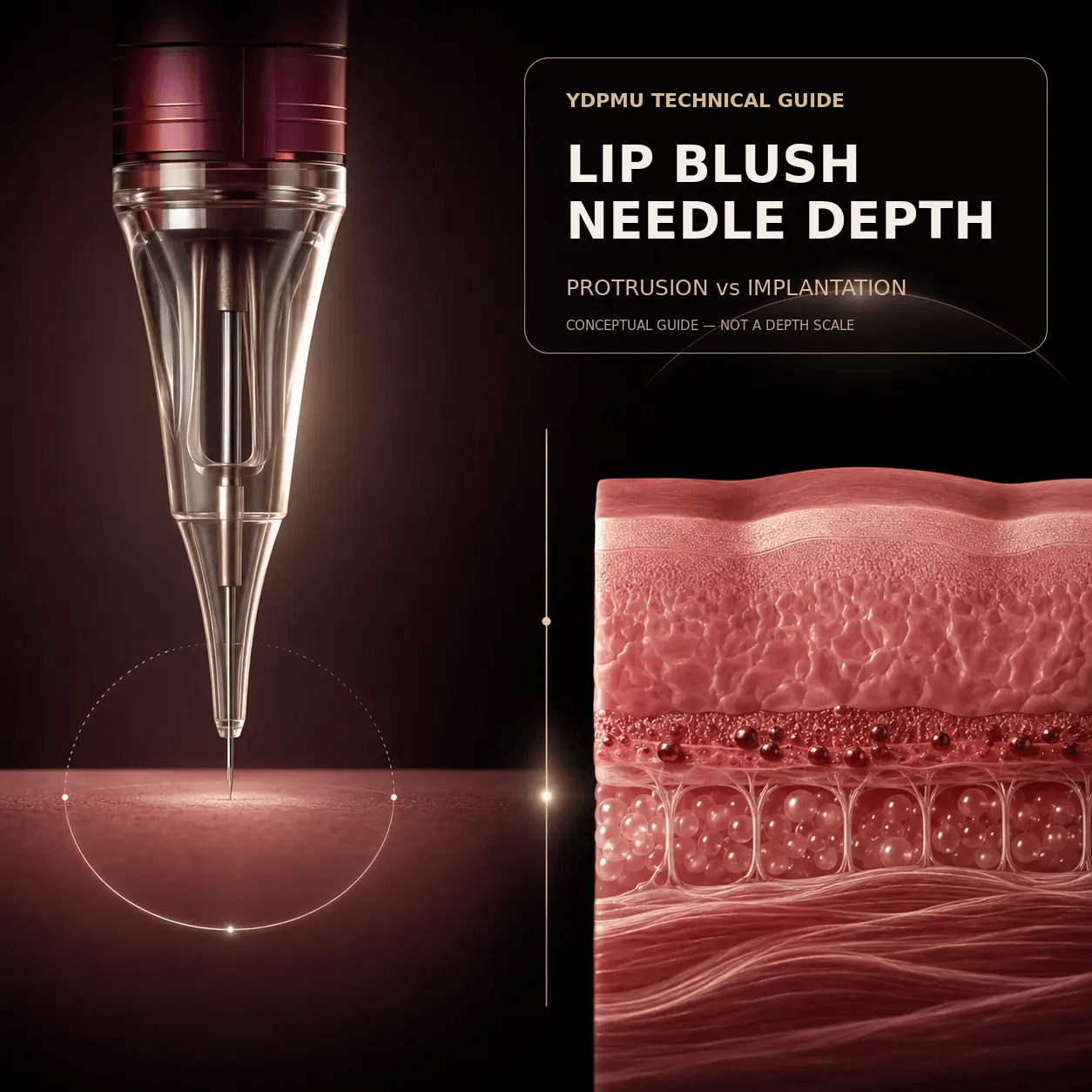
Lip blush needle depth guide comparing needle protrusion with implantation depth
Lip Blush

Lip Blush Needle Depth Guide: Protrusion vs Implantation

Lip blush needle depth cannot be defined by one universal millimetre value. This guide explains protrusion, implantation depth, stroke and tissue assessment.
YDPMU as official sponsor at the WORLDS PMU & Microblading Championship Semi Final USA Miami 2026 event backdrop
Brand News

YDPMU at the World PMU & Microblading Championship USA: Behind the Scenes with the Official Sponsor

YDPMU served as an official brand sponsor of the World PMU & Microblading Championship USA 2026 in Miami. This article shares event highlights, professional machines presented by YDPMU, current...
Guide explaining why permanent makeup pigment turns grey over time due to pigment composition, implantation depth, and natural fading
Color Theory

Why Does Permanent Makeup Pigment Turn Grey Over Time?

Permanent makeup pigment can turn grey over time due to pigment composition, implantation depth, skin type, and natural fading. Learn why this happens and how professional artists prevent unwanted ...
Diagram showing why permanent makeup appears darker immediately after treatment and becomes lighter during the healing process
Color Theory

Why Does Permanent Makeup Look Too Dark Immediately After Treatment?

Permanent makeup looks darker immediately after treatment due to concentrated pigment, skin inflammation, and the healing layer. Learn why this is normal and when the final colour stabilises.
pmu-touch-up-timing-pigment-stability
Healing Process

How Long Should You Wait Before Permanent Makeup Touch-Up?

The ideal waiting period before a permanent makeup touch-up is 6–8 weeks after the initial procedure. Learn how healing, skin type, and treatment area affect touch-up timing for the best long-term ...
Diagram comparing floating and burying techniques in permanent makeup, showing how implantation depth affects pigment stability in the dermis
Color Theory

Floating vs Burying Technique in Permanent Makeup: How It Affects Pigment Stability

Floating and burying are two core implantation techniques in permanent makeup. Learn how each affects pigment depth, trauma level, and long-term retention — and when to use each for optimal results.
Illustration showing how UV exposure and skincare routines influence permanent makeup pigment longevity using layered halo and abstract symbols
Guide

How UV Exposure and Skincare Impact Permanent Makeup Pigment Longevity

UV exposure and daily skincare habits are two of the biggest factors affecting permanent makeup pigment longevity. Learn which ingredients to avoid, how to protect treated areas, and how to make yo...
Educational illustration explaining why there is no one-size-fits-all pigment in permanent makeup
Color Theory

Why There Is No One-Size-Fits-All Pigment in Permanent Makeup

There is no universal pigment in permanent makeup because skin biology, implantation technique, and pigment behaviour all interact differently for every client. Learn why professional pigment selec...
Minimalist balance icon illustrating technique and pigment as key factors influencing permanent makeup problems
Color Theory

Technique or Pigment: What Truly Causes Permanent Makeup Problems?

Most permanent makeup problems are not caused by technique or pigment alone — they result from a mismatch between the two. Learn how technique, pigment, and skin biology interact to determine PMU o...