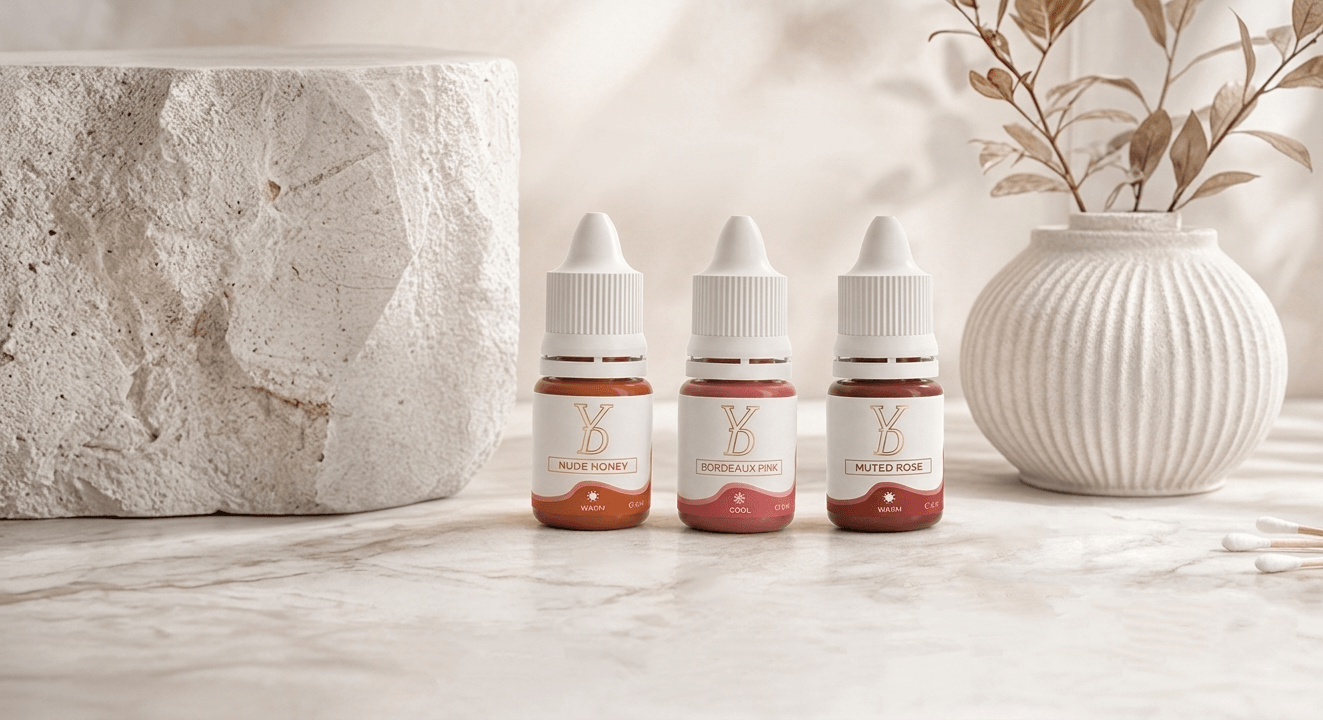

Permanent makeup pigment colors are generally categorized into warm tones and cool tones. Choosing the right undertone is one of the most important factors in achieving natural-looking, long-lasting results.
The wrong undertone choice can lead to unwanted color shifts such as ashiness, redness, or premature fading.
Quick Definition:
Warm PMU colors contain yellow, orange, or red undertones and create a warmer healed result.
Cool PMU colors contain blue, green, or grey undertones and create a more neutral or ashy healed result.

What Are Warm PMU Colors?
Warm pigments include tones such as peach, red-brown, caramel, and warm nude shades.
Key characteristics:
- Heals slightly warm or soft reddish-beige
- Better color retention on cool or olive skin
- Helps neutralize bluish or ashy undertones
- Common in lip blush and correction work
Warm tones are often used to add softness and vitality to the face. For lip blush applications, the YDPMU NEO Organic Desire Lip Blushing Pigment Set covers warm roses, corals, and berries — ideal for cool and neutral undertone clients.

What Are Cool PMU Colors?
Cool pigments include pink-brown, taupe, soft ash brown, and neutral beige tones.
Key characteristics:
- Heals more muted and neutral
- Suitable for warm or reddish skin tones
- Helps balance overly warm undertones
- Common in natural brow and soft lip results
Cool tones tend to create more makeup-neutral results. To understand how warm and cool pigments behave differently after healing, read Why Warm Pigments Appear More Vibrant While Cool Pigments Stay More Stable in Permanent Makeup.
Skin Undertone Explained
Your skin undertone determines how pigment will heal over time. This is the most important factor in pigment selection. To understand how skin type affects how pigment settles and heals, see Why Permanent Makeup Pigment Looks Different After Healing.
Cool undertone: Pink or blue skin base. Veins appear blue or purple. Best matched with warm pigments.
Warm undertone: Yellow or golden skin base. Veins appear greenish. Best matched with cool or neutral pigments.
Neutral undertone: Balanced between warm and cool tones. Veins appear blue-green. Compatible with both pigment types.

Warm vs Cool PMU Colors — Quick Comparison
| Factor | Warm Pigments | Cool Pigments |
|---|---|---|
| Undertone | Yellow / orange / red | Blue / green / grey |
| Healed result | Warm glow | Neutral or ashy tone |
| Skin compatibility | Cool or olive skin | Warm or reddish skin |
| Risk if mismatched | Redness | Ashiness |
| Long-term stability | Moderate | Higher on neutral skin |

How to Choose the Right PMU Color
The safest way to choose pigment is based on undertone correction logic:
- If your skin looks pale or cool → choose warm pigments
- If your skin looks reddish or warm → choose cool pigments
- If your skin is neutral → choose balanced pigments
Decision Rule (Undertone Matching):
Cool skin → Warm pigments
Warm skin → Cool pigments
Neutral skin → Balanced pigments
The goal is not matching skin color, but balancing undertones. For a deeper understanding of how color selection works across techniques, read Color Theory for PMU Artists: The Complete Guide.

Common Mistakes in Pigment Selection
- Choosing color based only on personal preference
- Ignoring skin undertone entirely
- Using too cool a pigment on cool skin (causes ashiness)
- Using too warm a pigment on warm skin (causes redness)
These mistakes often lead to unnatural healed results. If brow pigment has already shifted to an unwanted tone, see Why Do PMU Brows Turn Red, Blue, Green or Violet? The Science Behind Color Shifts.

Pigment Stability Matters
Even with correct undertone selection, pigment quality affects long-term results. Low-quality pigments may shift into grey, blue, or orange tones regardless of initial color choice.
YDPMU pigment systems are designed to maintain stable undertones after healing, ensuring predictable color retention across warm and cool applications. The YDPMU NEO Organic Lip Pigment — 25 Shades covers both warm and cool tones with no-color-shift formulation and 2+ year retention. For correction and neutralization work, the NEO Organic Liquid Pigment Mixture Set includes anti-darkening correctors for both warm and cool adjustments.
To understand how pigment oxidation affects color over time, read Do Permanent Makeup Pigments Oxidize Over Time?
Quick Comparison Summary
Fair / cool skin → warm pigments
Medium / warm skin → cool pigments
Neutral skin → balanced pigments
Correction work → warm pigments
Best choice → always based on undertone, not preference
Key Takeaways
- Warm PMU colors → yellow, orange, red undertones
- Cool PMU colors → blue, green, grey undertones
- Undertone matching → most important selection factor
- Wrong undertone → ashiness, redness, or flat results
- Pigment quality → affects long-term color stability regardless of tone、

FAQ
How do I know my undertone for PMU?
Blue or purple veins indicate a cool undertone. Green veins indicate a warm undertone. A mix of both indicates neutral undertone.
Can I mix warm and cool pigments?
Yes. Experienced artists often mix tones to achieve more balanced healed results, especially for neutral undertone clients.
What happens if I choose the wrong undertone?
The result may heal too ashy, too red, or too flat depending on the imbalance between pigment and skin undertone.
Are warm pigments more natural?
Not necessarily. Natural results depend on undertone matching, not pigment temperature. Both warm and cool pigments can look natural when correctly matched.
Do cool pigments turn grey over time?
They can, especially if the pigment quality is low or the undertone is mismatched. Stable pigment systems reduce this risk significantly.
Final Thoughts
Warm and cool PMU colors are not about preference — they are about skin harmony.
When correctly matched to skin undertone, both warm and cool pigments can create natural, balanced, and long-lasting results.
The key to successful PMU color selection is understanding undertone correction, not just choosing a shade.