
Opening Summary
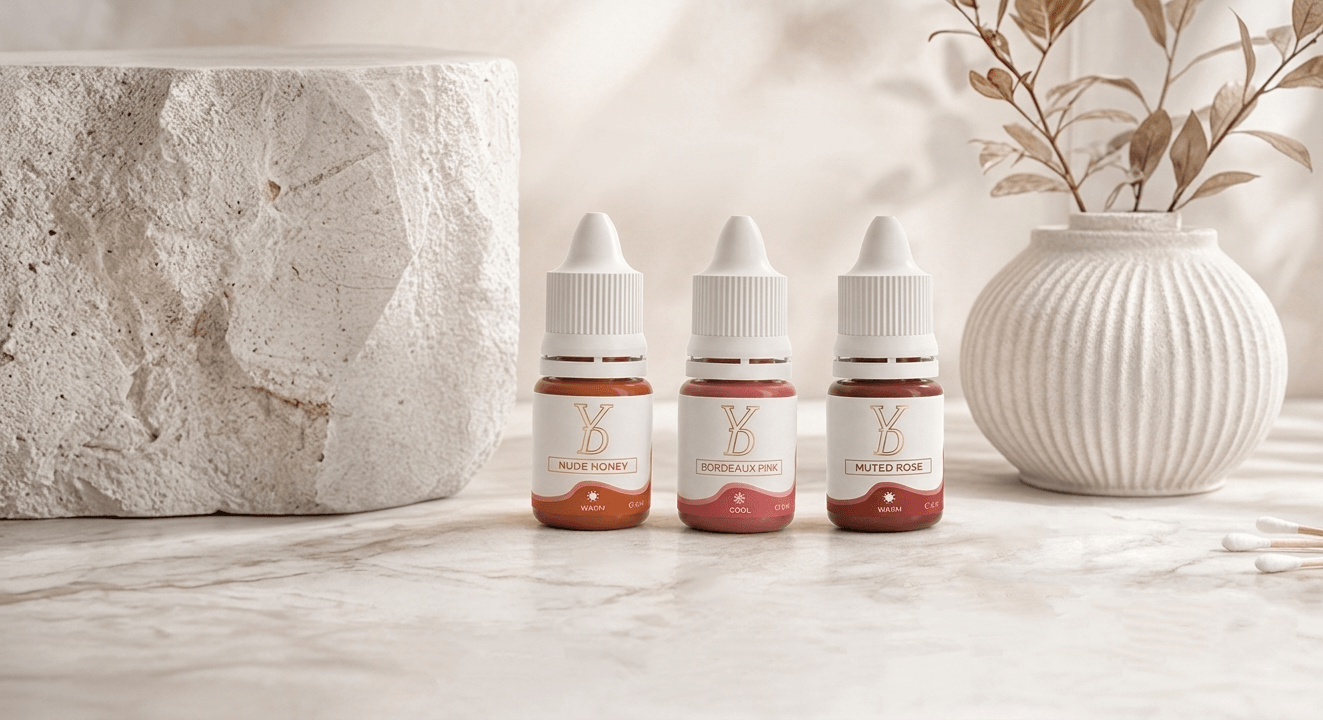
Warm pigments appear more vibrant in permanent makeup because they reflect light and interact with the skin's natural red undertones, while cool pigments absorb light and resist biological interference — making them more stable over time.
In permanent makeup procedures, pigment temperature plays a crucial role in how color appears and how long it lasts. Many artists notice that warm pigments tend to look brighter and more vivid immediately after implantation, while cool pigments often heal more softly but maintain stability over time.
This difference is not accidental. It is closely related to skin biology, pigment formulation, and how color interacts with light and tissue. Understanding these factors helps permanent makeup professionals make more predictable pigment choices and achieve better long-term results.

Point 1|How Skin Biology Amplifies Warm Pigments
Warm pigments—such as reds, oranges, and warm browns—naturally reflect more light. When implanted during permanent makeup procedures, these pigments often appear more saturated due to how light interacts with the skin's surface and underlying blood flow.
The skin contains capillaries that add a natural red undertone, especially in areas with higher vascular activity. Warm pigments blend with this undertone, enhancing brightness and vibrancy. As a result, they often appear stronger immediately after treatment.
However, this same interaction can also make warm pigments more reactive during healing. Increased circulation and inflammatory response may accelerate pigment breakdown or shifting if formulation and depth are not carefully controlled.
For warm-toned brow work, the YDPMU Powder Brow Pigment – Amber Brown is formulated to balance vibrancy with controlled healing behavior.

Point 2|Why Cool Pigments Offer Greater Color Stability
Cool pigments—such as ash browns, cool taupes, and gray-based tones—absorb light rather than reflect it. This optical behavior makes them appear softer on the skin, but also contributes to greater long-term stability.
From a biological perspective, cool pigments are less influenced by redness and blood flow beneath the skin. They resist visual distortion caused by inflammation and post-procedure healing, which is why they are often favored for clients with sensitive or reactive skin.
In permanent makeup, stability is closely tied to particle composition and dispersion. Many cool pigments are formulated with controlled particle size, allowing them to remain evenly distributed during epidermal turnover and healing.
For cool-toned brow enhancement, the YDPMU NANO Organic Liquid Pigment – Ash Brown offers consistent healed results with minimal color shift.

Point 3|Pigment Formulation Matters More Than Color Temperature Alone
While color temperature is important, pigment formulation ultimately determines how a color behaves in permanent makeup applications. Factors such as carrier solution, particle coating, and organic versus inorganic balance all influence color retention.
Warm pigments that are poorly stabilized may fade unevenly or shift over time. Meanwhile, well-formulated cool pigments can retain clarity and consistency for years. This is why professional pigment systems focus not only on hue, but also on compatibility with skin biology.
For predictable results, permanent makeup professionals should consider skin type, treatment area, and healing behavior—not just the visual appeal of a pigment bottle color. See also: Organic vs. Inorganic Permanent Makeup Pigments and Why Brown Pigments Heal Differently Than Expected.

Final Summary|Choosing the Right Pigment for Predictable Results
Warm pigments appear more vibrant because they reflect light and interact strongly with skin undertones, while cool pigments stay more stable due to their optical and biological neutrality. Neither is inherently better—the key lies in choosing the right pigment for the right skin and technique.
By understanding how pigment temperature, skin biology, and formulation work together, permanent makeup professionals can achieve clearer healed results, longer color retention, and higher client satisfaction.
For deeper reading, explore: Why There Is No One-Size-Fits-All Pigment in Permanent Makeup and Why Experienced PMU Artists Rely on Fewer Pigments.

FAQ|Warm vs. Cool Pigments in Permanent Makeup
Why do warm pigments look darker immediately after a PMU procedure?
Warm pigments reflect more light and interact with the skin's natural red undertones from capillary activity. This amplifies their perceived saturation right after implantation. The color typically softens by 30–40% during the healing process.
Are cool pigments better for sensitive skin?
Generally yes. Cool pigments are less reactive to inflammation and blood flow, making them more predictable on sensitive or reactive skin types. They tend to heal more consistently with less color distortion.
Will warm pigments fade faster than cool pigments?
Not necessarily — formulation quality matters more than color temperature. A well-formulated warm pigment can retain color as long as a cool one. However, poorly stabilized warm pigments are more prone to uneven fading or color shifting due to their higher reactivity with skin biology.
Can I mix warm and cool pigments to get a neutral tone?
Yes, this is a common professional technique. Mixing a warm and cool pigment can neutralize undertones and create a more balanced, skin-compatible result. Always test on a color ring first to predict the healed outcome.
How does skin undertone affect which pigment temperature to choose?
Clients with warm or olive undertones often suit warm pigments well, as the colors harmonize naturally. Clients with cool or pink undertones may benefit from cool pigments to avoid an overly red or orange healed result. Always assess undertone before selecting pigment temperature.