
Quick answer: Lip blush can look patchy because different areas of the lips do not always recover, shed surface material or display color at exactly the same rate. Early unevenness may be temporary, especially while the lips are dry, peeling or visually muted. However, patchiness should not automatically be dismissed as normal. The timing, tissue condition, symptoms, starting lip color, technique and final healed appearance must all be considered.
The correct response is usually observation first—not immediate correction. Artists should wait until the lips reach their normal healed-review stage before deciding whether an area represents temporary surface change, true pigment loss, uneven saturation, an undertone issue or a condition that requires referral rather than additional PMU.
Professional scope: This article is educational and does not replace hands-on permanent makeup training, local licensing requirements, product instructions, medical advice or an in-person assessment by a qualified professional.
Lip Blush Healing Timeline at a Glance
There is no single healing calendar that applies to every client. The following ranges describe commonly observed stages, not guaranteed deadlines.
| Approximate stage | What the client may see | How to interpret it |
|---|---|---|
| First 1–3 days | Brighter or darker color, swelling, tenderness and strong definition | Fresh color and swelling do not represent the final healed result |
| Early surface healing | Dryness, tightness, light crusting, flaking and visible patchiness | Different zones may shed and recover at different rates |
| After visible peeling | Color may look very light, cloudy, incomplete or uneven | The surface is still changing, so retention should not be judged too early |
| Healed-review stage | The color is softer and the true distribution is easier to evaluate | The artist can assess residual pigment, symmetry, undertone and genuine gaps |

For a more detailed observation sequence, read the Lip Blush Healing Day-by-Day Guide. The artist’s written protocol should take priority over a general online timeline.
What Does “Patchy Lip Blush” Actually Mean?
“Patchy” is a visual description, not a diagnosis. It can refer to several different situations:
- some areas are still dry or covered by attached surface material;
- different lip zones are peeling at different times;
- newly recovered surface tissue temporarily changes visible contrast;
- the natural lip base is darker or cooler in certain areas;
- pigment density was not built evenly across the treatment area;
- friction, picking or irritation disrupted part of the healing surface;
- previous PMU, scarring or tissue differences affected the result;
- true healed pigment retention differs from one zone to another.
These situations may look similar in a photograph but require different responses. An early light area does not automatically mean that pigment is missing, and persistent unevenness does not automatically mean that the solution is to add more of the original color.

Why Do Lips Show Uneven Color More Easily Than Brows?
Lip and brow PMU should not be judged as if they were performed on identical tissue. The visible lip includes the vermilion, which differs from the surrounding facial skin and does not contain the same oil and sweat glands. Natural lip color can also vary substantially between clients and across different areas of the same lips.
The lips are also exposed to frequent movement, moisture and friction from speaking, eating, drinking and normal facial expression. These factors can make temporary unevenness more noticeable during recovery.
| Assessment factor | Lip blush | Brow PMU |
|---|---|---|
| Natural color | May contain uneven red, brown, grey, mauve or violet influence | Assessed through facial skin, hair and previous brow pigment |
| Movement | Frequent movement during speaking, eating and expression | Generally less movement during routine healing |
| Moisture and friction | Regular contact with saliva, food, drinks and lip movement | More affected by skincare, cleansing, oil and external friction |
| Visual structure | A broad field of color makes small density differences noticeable | Hair, shading patterns and natural brow density can visually break up differences |
This does not mean that lip PMU is automatically unsafe or unpredictable. It means artists must assess the lips as their own treatment area instead of applying brow assumptions to lip tissue.
Seven Reasons Lip Blush May Look Patchy
1. Different Areas Recover at Different Rates
The lips do not always dry, flake or normalize uniformly. The center, corners, upper lip, lower lip and border may show different surface changes at the same time. A temporarily lighter section may therefore reflect its current healing stage rather than the final amount of visible pigment.
2. Dryness, Flaking and Attached Surface Material
Light crusting, dryness and flaking can interrupt the way light reflects from the lips. Some zones may look darker because dry material is still attached, while recently shed areas may look brighter, paler or less saturated.
Clients should not pull, scratch or remove attached flakes. Premature removal can irritate the area and make the result more difficult to assess.
3. Uneven Natural Lip Pigmentation
Lips are rarely one perfectly uniform starting color. A client may have a darker border, cooler corners, a lighter center, previous discoloration or different tones between the upper and lower lips.
If the starting base was uneven, the same decorative pigment may not heal with identical visible color in every area. Dark, brown, grey or blue-violet influence may require a separate neutralization strategy rather than simply increasing the density of a pale target shade.
4. Coverage and Cumulative Saturation
A lip result is influenced by cumulative coverage—not just the pigment bottle selected. Pass count, overlap, hand movement, pressure, machine response and tissue reaction can cause one section to receive more visible saturation than another.
The goal is controlled and appropriate coverage, not maximum saturation. Repeatedly working an area to force immediate uniformity can increase tissue stress without guaranteeing a more even healed result.
5. Implantation and Technique Variables
Very superficial placement may heal faintly, while excessive depth or trauma may contribute to blur, unwanted tone, scarring or an unpredictable result. There is no universal millimetre value that guarantees correct lip implantation.
Visible needle protrusion is also not the same as the depth reached inside living tissue. Artists must evaluate the machine, cartridge, angle, stretch, hand movement and tissue response together. Read the Lip Blush Needle Depth Guide for a fuller explanation.
6. Aftercare, Friction and Irritation
Picking, rubbing, repeated touching, inappropriate products and failure to follow the artist’s area-specific instructions can interfere with surface recovery. However, artists should avoid blaming every uneven result on the client. Technique, tissue behavior, starting pigmentation and aftercare can overlap.
Aftercare should follow the written instructions provided for the individual procedure. Avoid copying a universal social-media routine that may conflict with the artist’s protocol or product labeling. See What Not to Do After Lip Blush or Brow Tattoo.
7. Previous PMU or Tissue Changes
Residual pigment, previous correction attempts, scars, texture changes and repeated implantation can influence how a new layer appears. Before treating previously tattooed lips, document the existing hue, density, shape and distribution.
A weak-looking zone does not always need more pigment. The artist must determine whether the apparent gap is caused by the surface, the natural lip base, old color or true uneven retention.
Temporary Patchiness vs Persistent Uneven Retention
| Observation | Possible interpretation | Appropriate response |
|---|---|---|
| Uneven color while the lips are dry or peeling | Temporary surface-healing difference | Follow aftercare and avoid judging final retention |
| Color looks very light shortly after peeling | Temporarily reduced visible contrast | Continue observation until the normal healed review |
| A clear gap remains after the artist’s healed-review period | Possible uneven retention or coverage | Assess residual pigment and tissue before considering refinement |
| The color is present but looks grey, brown, purple or too cool | Undertone or color-planning issue rather than a simple gap | Use color-correction assessment instead of automatically repeating the original shade |
| Worsening pain, heat, spreading redness, pus, fever, rapidly increasing swelling, blisters or open sores | Not a routine cosmetic color concern | Stop cosmetic troubleshooting and seek appropriate medical assessment |
When Is Patchiness Not “Just Healing”?
Mild tenderness, dryness, flaking and temporary unevenness can occur during routine recovery. However, timing alone should never be used to dismiss symptoms.
Prompt professional or medical assessment may be appropriate when the client develops:
- pain that becomes stronger instead of improving;
- redness or swelling that spreads or rapidly worsens;
- increasing heat around the treatment area;
- pus, unusual discharge or a strong odor;
- fever, chills or feeling systemically unwell;
- open sores, grouped blisters or a suspected cold-sore outbreak;
- marked itching, widespread rash or another suspected reaction;
- persistent tissue changes that cannot be explained by normal surface recovery.
Clients with a history of cold sores should discuss lip procedures and appropriate prevention with a qualified healthcare professional before treatment. PMU artists should not diagnose an infection, prescribe medication or advise a client to stop prescribed medicine.
How Should an Artist Assess Patchy Lip Blush After Healing?
Once the surface has recovered and the artist’s normal review point has been reached, evaluate the result systematically.
- Check the tissue first. Confirm that the lips are calm and free from unresolved irritation, sores or abnormal texture.
- Compare consistent photographs. Review the untreated, mapped, fresh and healed lips under similar lighting.
- Map the remaining pigment. Identify true gaps, dense areas and differences between the upper lip, lower lip, border, corners and center.
- Separate hue from saturation. Determine whether the problem is missing color, insufficient density or an unwanted undertone.
- Review the natural base. Check whether the apparent patch follows pre-existing darker or cooler lip pigmentation.
- Review the procedure record. Consider pigment formula, shades, mixture, lot information, cartridge, machine settings and technique notes.
- Assess previous PMU. Identify residual color, old outlines, migration, scarring or previous corrective work.
- Decide whether more implantation is appropriate. A touch-up should improve the result without unnecessarily overloading the tissue.
Can Patchy Lip Blush Be Corrected?
Many healed lip blush irregularities can be refined, but the correct option depends on the cause. “Add more pigment” is not a complete correction plan.
Option 1: Controlled Touch-Up
A touch-up may be appropriate when the tissue is healthy, the remaining color direction is suitable and clearly defined areas have healed lighter than intended. The artist can rebuild coverage gradually while avoiding already-saturated zones.
Option 2: Color Adjustment
If pigment is visible but the healed tone is too cool, grey, brown, purple or otherwise unsuitable, the artist must evaluate color relationships before adding another shade. The solution may involve a compatible warm adjustment or a staged correction plan rather than simply repeating the original pigment.
Use the principles in the PMU Color Theory Guide and assess the visible healed base—not only the bottle color.
Option 3: Staged Refinement
When different lip zones require different levels of correction, the safest visual plan may be gradual. A dense border, cool corners and a light center should not necessarily receive the same mixture or cumulative coverage.
Option 4: Do Not Add More Pigment Yet
Additional implantation may be inappropriate when the lips are not fully recovered, the result already contains substantial saturation, the shape is unsuitable, the pigment has migrated, the tissue appears compromised or the cause of the unevenness is unclear.
In these situations, further assessment, correction planning, removal consultation or medical referral may be more appropriate than a routine touch-up.

How to Reduce the Risk of Patchy Lip Blush
Before the Procedure
- Photograph the natural lips in consistent, neutral lighting.
- Identify uneven natural pigmentation, cool areas, darker borders and previous PMU.
- Screen for active sores, broken skin, marked irritation and other reasons to postpone.
- Ask about relevant medical history, medications, allergies, cold sores and previous reactions within the artist’s permitted scope.
- Explain that the fresh result, peeling appearance and healed color will look different.
- Agree on a realistic healed target instead of promising an exact bottle color.
During the Procedure
- Work within the artist’s training and the instructions for the selected equipment.
- Control the number of variables changed at one time.
- Build coverage gradually instead of forcing immediate opacity.
- Monitor tissue response rather than relying on one voltage or protrusion number.
- Record the pigment formula, shade, mixture, lot and equipment used.
- Avoid repeatedly working one difficult area simply because it appears lighter during the procedure.
After the Procedure
- Provide clear written, area-specific aftercare instructions.
- Tell the client not to pick, scratch or pull attached flakes.
- Explain which temporary visual changes may occur.
- Provide a clear route for reporting unexpected symptoms.
- Set a healed-review point without promising that every client will recover on the same day.
- Evaluate the healed result before scheduling automatic additional implantation.
Common Mistakes When Responding to Patchy Lip Blush
- Judging the result during peeling: The surface is still changing and may hide the true color distribution.
- Calling every gap “ghosting”: Some light areas are temporary, but others may represent genuine uneven retention.
- Assuming every uneven result is poor technique: Tissue behavior, starting pigmentation, aftercare and previous PMU can contribute.
- Blaming every uneven result on aftercare: The artist should also review coverage, trauma, color planning and documentation.
- Adding the original shade automatically: A color-direction problem requires different reasoning from a simple saturation gap.
- Using a fixed touch-up date as permission to work: The calendar does not replace assessment of the tissue and residual pigment.
- Ignoring warning signs: Pain, heat, spreading redness, discharge or systemic symptoms should not be treated as a routine color problem.

A Better Way to Explain Patchy Healing to Clients
Instead of promising that every light area will “come back,” an artist can say:
Your lips may look uneven while different areas recover and the surface changes. This does not automatically show the final pigment distribution. Follow the written aftercare, contact us if symptoms worsen, and allow us to assess the healed tissue and remaining color before deciding whether refinement is needed.
This explanation reassures the client without promising a perfect result or dismissing symptoms that may require attention.
Frequently Asked Questions
Why does my lip blush look patchy after a few days?
Different lip zones may dry, flake and recover at different rates. Attached surface material and recently shed areas can also display color differently. Early patchiness may therefore be temporary, but the tissue condition and later healed result still need to be assessed.
Does patchy lip blush mean the pigment has disappeared?
Not necessarily. A light-looking area during surface healing does not prove that no pigment remains. Once the lips have recovered, the artist can compare photographs and assess the actual residual color.
Will all patchy areas become even on their own?
No guarantee can be made. Some early unevenness becomes less noticeable as the surface normalizes, while other areas remain lighter because of coverage, tissue response, natural pigmentation or aftercare-related disruption.
Is patchy lip blush always caused by poor technique?
No. Technique is one possible factor, but uneven natural lip color, movement, moisture, friction, previous PMU, surface healing and individual tissue response can also influence the appearance.
When can lip blush be judged accurately?
It should be judged after the surface has recovered and at the healed-review point established by the artist. A fixed online timeline should not replace an in-person assessment.
Does every client need a lip blush touch-up?
No universal rule applies. A refinement session may be useful when the healed result has genuine gaps or insufficient desired saturation, but additional pigment should be based on tissue condition, residual color and the client’s goal—not automatically performed because a certain number of weeks has passed.
Can uneven lip color be corrected with the same pigment?
Sometimes, but not always. If the issue is simply insufficient coverage and the remaining hue is suitable, the same or a compatible shade may be appropriate. If the healed result has an unwanted undertone, color-correction logic may be needed instead.
When should a client seek medical advice?
Worsening pain, spreading redness, increasing heat or swelling, pus, fever, open sores, grouped blisters or a rapidly worsening reaction should not be managed as ordinary patchiness. The client should seek appropriate medical assessment.
Final Takeaway
Patchy lip blush is not one single problem. During early healing, uneven appearance may come from dryness, flaking, surface recovery and changing visible contrast. After healing, persistent irregularity may reflect natural lip pigmentation, uneven coverage, technique, aftercare, previous PMU or a color-direction issue.
The safest professional sequence is:
- protect the healing tissue;
- observe rather than judge too early;
- recognize symptoms that require medical assessment;
- evaluate the true healed color and residual pigment;
- choose touch-up, color adjustment, staged correction or no further implantation according to the actual finding.
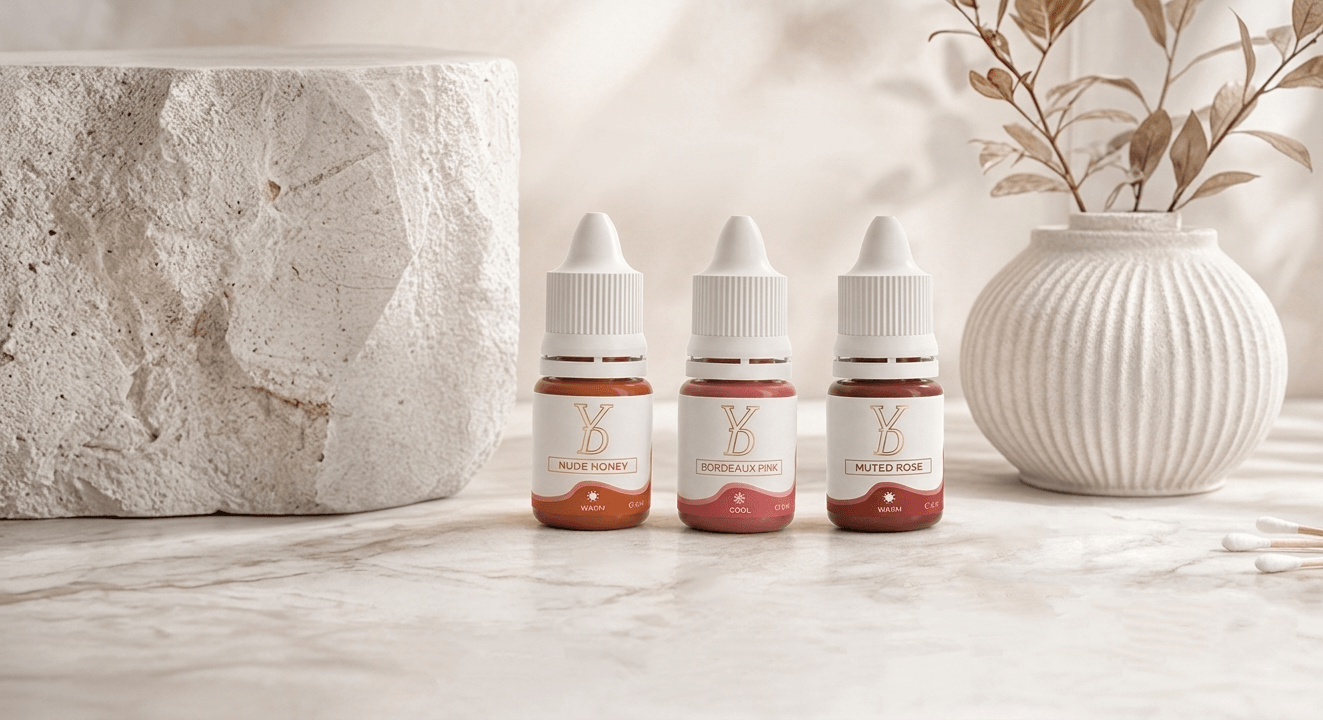
For professional pigment options, explore YDPMU Pigments for Lips. Product selection and use should follow the label, professional training and destination-market requirements.
Sources and Further Reading
- Cleveland Clinic: Lip Anatomy
- U.S. FDA: Tattoos & Permanent Makeup Fact Sheet
- American Academy of Dermatology: Tattoo Skin Reactions
- YDPMU: PMU Healing Stages Day by Day
- YDPMU: Lip Blush Needle Depth Guide
- YDPMU: Color Theory for PMU Artists
Last reviewed: August 19, 2026.
This article is intended for professional education and general client communication. It does not replace medical advice, local regulations, product instructions or an in-person assessment by a qualified professional.