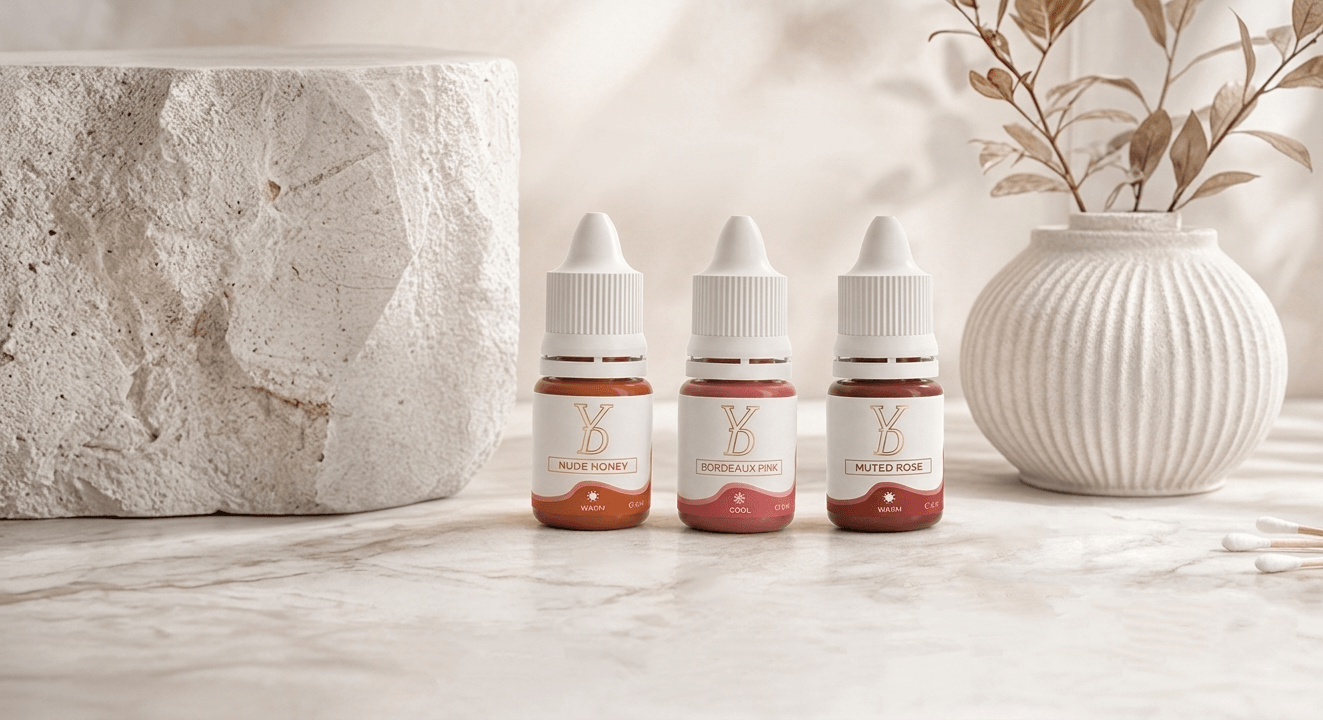

PMU pigment can separate when colorant particles settle within the liquid carrier during storage. Some visible separation may be a normal physical property of a pigment dispersion and may be corrected by mixing the bottle according to the manufacturer’s instructions.
However, separation should never be used as the only test of whether a pigment is suitable for use.
Before using a bottle, verify its identity, batch number, expiry information, packaging condition and storage history. Shake or mix it only as directed. If the pigment remains unusually inconsistent, the bottle is damaged, essential information is missing or contamination is suspected, stop using it and contact the supplier.
This guide explains how professional PMU artists, academies and studios should evaluate separation, prepare pigment bottles, reduce contamination risks and decide when a bottle should be replaced.
Quick Answer: Is It Normal for PMU Pigment to Separate?
Some settling or separation may occur because a PMU pigment is a dispersion containing colorants and liquid components with different physical properties.
A bottle that has been stored without movement may show:
-
A clearer liquid layer near the top
-
Denser color at the bottom
-
A visible boundary between settled pigment and carrier
-
Uneven color before the bottle is mixed
This does not automatically mean the pigment has expired or become contaminated.
The important question is whether the pigment returns to the appearance and consistency described by the manufacturer after correct mixing—and whether the bottle passes all other checks.
Separation should be assessed together with:
-
Product and shade identity
-
Batch or lot number
-
Expiry and in-use information
-
Packaging integrity
-
Storage conditions
-
Manufacturer instructions
-
Changes from the product’s normal appearance
-
Relevant product or recall notices
When in doubt, do not attempt to repair an uncertain bottle by adding water, thinner or pigment from another product.
Why Do PMU Pigments Separate?
PMU pigments are not simply colored water. A finished formulation may contain colorants, a liquid carrier and other ingredients used to support properties such as dispersion, flow, viscosity or stability.
The colorant particles do not dissolve in the same way that sugar dissolves in water. They remain dispersed throughout the liquid. During storage, gravity and differences in particle or liquid properties may allow some components to settle or redistribute.
The amount and appearance of separation can vary according to:
-
The exact formulation
-
Colorant composition
-
Pigment concentration
-
Carrier system
-
Viscosity
-
Length of time since the bottle was last mixed
-
Storage temperature
-
Exposure to repeated temperature changes
-
Age and condition of the product
Different shades within the same product series may not settle in exactly the same way because their colorant combinations can differ.
For that reason, artists should learn the normal appearance of the exact product rather than applying one visual rule to every organic, inorganic or hybrid pigment.

Normal Settling vs. a Possible Product Problem
Visible separation and product deterioration are not the same thing.
| Observation | Possible Meaning | Professional Response |
|---|---|---|
| A settled layer develops during storage | May be normal physical settling | Mix according to the product instructions and reassess |
| The pigment becomes uniform after correct mixing | Dispersion may have been restored | Continue only if the bottle passes all other label, date and packaging checks |
| Dense material remains fixed at the bottom | Product may not be adequately redistributing | Stop using it and contact the supplier |
| Texture remains unusually lumpy, stringy or inconsistent | Possible formulation, storage or product-condition issue | Do not use until verified |
| Bottle leaks, swells or has a damaged closure | Packaging integrity may be compromised | Isolate and replace the bottle |
| Shade or consistency is clearly different from previous normal use | Possible product or storage concern | Record the batch and contact the supplier |
| Product is covered by a recall or supplier notice | The affected product should not be used | Follow the notice instructions |

A pigment that looks uniform is not automatically free from microbial contamination. The U.S. FDA has reported contamination in some sealed tattoo-ink bottles, demonstrating why visual inspection alone cannot confirm microbiological condition.
The absence of visible mold, separation or odor does not prove that a product is uncontaminated.
How Should You Shake a PMU Pigment Bottle?
Follow the instructions supplied for the exact product. There is no universal shaking time that is correct for every PMU pigment formula.
A practical preparation sequence is:
-
Confirm the product, shade and batch.
-
Check the expiry information and bottle condition.
-
Make sure the cap is fully closed.
-
Mix the bottle using the method specified by the manufacturer.
-
Inspect whether the pigment has returned to its expected uniform consistency.
-
Dispense it into a clean, single-use pigment cup without touching the nozzle to the cup.
-
Close the bottle promptly after dispensing.
Depending on the product instructions, mixing may involve controlled hand shaking or a compatible pigment mixer.
Do not assume that more aggressive or longer shaking always produces a better result. Excessive mixing may create foam or air bubbles in some liquid formulations, making the pigment more difficult to assess or dispense consistently.
If the manufacturer specifies a mixing duration or device, follow that information instead of an online rule created for another brand or formula.
Should You Use a Pigment Shaker or Mix by Hand?
Either method may be appropriate when it is compatible with the exact bottle and manufacturer instructions.
Hand Mixing
Hand mixing may be suitable when:
-
The formula redistributes easily
-
The manufacturer permits it
-
The bottle has not been stored for an extended period
-
The artist can visually confirm a uniform result
Pigment Mixer
A pigment mixer may help studios achieve a more repeatable preparation routine, particularly when managing multiple bottles or denser formulas.
Before using one:
-
Confirm that the bottle is securely closed
-
Make sure the device is appropriate for the bottle shape and volume
-
Follow the pigment and mixer instructions
-
Keep the outside of the bottle and the device clean
-
Avoid damaging the label, cap or nozzle
-
Do not use the device to force an abnormal pigment back into service
A mixer is a preparation tool. It cannot reverse contamination, expired product, damaged packaging or unsuitable storage.
How Long Should You Shake PMU Pigment?
There is no reliable universal answer such as “always shake for 30 seconds” or “mix every bottle for two minutes.”
The required time may depend on:
-
Formula viscosity
-
Pigment concentration
-
Bottle volume
-
Colorant composition
-
Time since the previous use
-
Mixing method
-
Manufacturer instructions
The correct endpoint is not simply reaching a predetermined number of seconds. The pigment should reach the expected uniform appearance described for that product without showing unresolved dense deposits or other abnormal changes.
If the bottle does not redistribute after following the instructions, do not automatically add liquid or continue shaking indefinitely. Record the product and batch information and contact the supplier.
How Should PMU Pigments Be Stored?
The exact label and product instructions should always control storage.
As a general studio system, pigments should be:
-
Kept within the temperature range specified for the exact product
-
Protected from direct sunlight and excessive heat
-
Stored upright when required by the bottle design
-
Closed tightly after dispensing
-
Kept in a clean, dry and controlled stock area
-
Separated from contaminated procedure waste
-
Organized so older eligible stock is reviewed before newer stock
-
Protected from unauthorized handling
-
Checked after shipping or a suspected temperature excursion
Do not store pigment bottles:
-
In direct sunlight
-
Next to heaters or hot equipment
-
Inside a vehicle
-
In an uncontrolled window display
-
Near sinks where splashing may occur
-
In a refrigerator or freezer unless the manufacturer specifically instructs it
-
Loose inside a contaminated procedure drawer
-
With missing caps or damaged closures
One YDPMU product may not have the same storage instructions as another. For example, the current YDPMU Professional SMP Pigments product page specifies storage at 10°C–25°C, protection from direct sunlight, tight closure and shaking before use.
That information should not automatically be applied to every other YDPMU formula.
Always check the exact bottle, product page and supplied instructions.

Does PMU Pigment Need to Be Refrigerated?
Do not refrigerate a PMU pigment unless the manufacturer specifically instructs you to do so.
Refrigeration is not a universal method for extending pigment life. It may expose a bottle to unsuitable temperatures or repeated temperature changes when the product is removed and returned.
Similarly, a studio should not freeze pigment in an attempt to preserve it.
If a bottle has been accidentally frozen, overheated or left in uncontrolled conditions, do not assume that remixing restores it. Contact the manufacturer or supplier with:
-
Product name
-
Shade
-
Batch number
-
Approximate temperature
-
Duration of exposure
-
Photographs of the bottle and label
How Should an Opened Pigment Bottle Be Managed?
Opening a bottle creates an additional studio-management responsibility.
Record the date first opened and keep this information connected to the original label. Do not cover the batch number, expiry date, shade or warnings with an internal studio sticker.
After opening:
-
Keep the original cap and nozzle intact
-
Close the bottle immediately after dispensing
-
Prevent the nozzle from touching pigment cups, gloves, work surfaces or skin
-
Never insert a used tool into the bottle
-
Do not return unused pigment from a cup to the bottle
-
Do not transfer pigment into an unlabelled container for storage
-
Keep the exterior of the bottle away from the active procedure field when possible
-
Follow the manufacturer’s stated in-use period
A studio opening-date label can be useful, but it should supplement rather than replace the original product information.
How Long Does Opened PMU Pigment Last?
An opened pigment should not automatically be assigned a universal six-month, twelve-month or twenty-four-month life.
Use the earlier applicable limit provided for the exact product, such as:
-
The printed expiry or use-by date
-
A stated period after opening
-
A manufacturer’s product-specific instruction
-
A supplier notice affecting the product or batch
If the label does not make the applicable period clear, contact the supplier before continuing long-term use.
A bottle may need to be replaced before its printed expiry when its packaging has been compromised, its storage history is uncertain, it shows an unexplained change or it is included in a product notice.
An expiry date also does not excuse poor handling. Product management continues every time the bottle is opened and dispensed.
How to Dispense Pigment Without Contaminating the Bottle
Prepare the required pigment in a disposable cup before beginning the procedure.
When dispensing:
-
Perform hand hygiene and prepare the workstation according to applicable studio protocols.
-
Use a new, clean, single-use pigment cup.
-
Open the bottle without allowing the inside of the cap or nozzle to contact the work surface.
-
Hold the nozzle above the cup without touching it.
-
Dispense only the estimated amount required.
-
Close the bottle immediately.
-
Add more pigment with clean handling if required—never refill the bottle from the cup.
-
Dispose of remaining procedure pigment according to local requirements.
Do not allow a cartridge, microbrush, mixing stick or used glove to contact the original bottle opening.
During a 2011–2012 multistate investigation, the CDC linked tattoo-associated infections to contaminated inks and dilution with nonsterile water. CDC advised using sterile inks and sterile water when dilution is required, together with appropriate hygienic practices.
Can You Add Water to a PMU Pigment Bottle?
Do not add water directly to the original pigment bottle.
Adding water can:
-
Alter the finished formulation
-
Change pigment concentration and flow
-
Reduce traceability
-
Introduce contamination
-
Create an undocumented mixture
-
Make the original product instructions less applicable
If a professional procedure requires adjusting pigment consistency, use only a compatible, manufacturer-approved dilution product and follow the instructions for both products.
Make the adjustment in a clean, single-use pigment cup—not in the original bottle—unless the manufacturer explicitly provides a different validated procedure.
Do not use tap water, leftover procedure liquid or an unidentified mixing solution.
Is Pigment Thinner the Same as a Mixing Solution?
Terms such as thinner, dilution solution and mixing solution may be used differently by different manufacturers.
Before combining products, verify:
-
The exact intended use
-
Formula compatibility
-
Whether it is designed for dilution or another function
-
Mixing instructions
-
Batch and expiry information
-
Destination-market requirements
A liquid should not be added simply because it makes a pigment appear smoother.
YDPMU offers product-specific pigment and dilution options, but compatibility should be confirmed for the exact formula and intended technique before mixing.
Can You Mix Different PMU Pigment Brands?
Do not assume that products from different brands are compatible merely because they are all sold as PMU pigments.
Formulas may differ in:
-
Carrier systems
-
Colorant combinations
-
Concentration
-
Viscosity
-
pH
-
Intended use
-
Instructions and warnings
Cross-brand mixing can also make documentation and traceability more complicated.
If a mixture is permitted, record every product used:
-
Brand
-
Product series
-
Shade
-
Batch number
-
Mixing ratio or number of drops
-
Dilution product, where applicable
-
Procedure and client record
For YDPMU pigments, confirm whether the exact shades are designed to be intermixed within their series. Do not assume that mixability within one series automatically establishes compatibility with every other YDPMU or third-party formula.
When Should You Replace a PMU Pigment Bottle?
Stop using and isolate a bottle when:
-
It has reached its applicable expiry or in-use limit
-
The label is missing or unreadable
-
The product, shade or batch cannot be identified
-
The bottle or closure is cracked, leaking, swollen or otherwise damaged
-
The nozzle has contacted a contaminated surface
-
Pigment has been returned from a procedure cup
-
The storage history is unknown
-
The bottle was exposed to an unsuitable temperature and the supplier cannot confirm continued use
-
The pigment does not return to its expected consistency after correct mixing
-
Its appearance, texture or odor has changed unexpectedly
-
The product or batch is included in a recall or supplier notice
-
Contamination is suspected
-
The documentation does not match the bottle
Do not combine the remaining contents of two older bottles to reduce waste.
When discarding a product, keep a record of the product name, shade, batch number, reason and date. Follow applicable local disposal requirements.
Can You Tell Whether PMU Pigment Is Contaminated by Looking at It?
No. Visual inspection can identify some obvious product or packaging problems, but it cannot confirm the absence of microorganisms.
The U.S. FDA reported that testing has found microbial contamination in sealed tattoo-ink bottles. Between 2003 and 2024, companies conducted 18 voluntary recalls involving tattoo inks contaminated with various microorganisms.
FDA’s 2024 final industry guidance addresses conditions during the preparation, packing and holding of tattoo inks that may create microbial contamination risks.
For artists, the practical lesson is not that every sealed bottle is unsafe. It is that appearance and packaging checks must be combined with:
-
Responsible sourcing
-
Product traceability
-
Correct storage
-
Hygienic dispensing
-
Recall monitoring
-
Supplier communication
-
Local infection-control requirements
Build a Simple Pigment Inventory System
A studio does not need complicated software to improve pigment control.
Create a searchable record containing:
| Field | Why It Matters |
|---|---|
| Brand and series | Identifies the formulation |
| Shade name or code | Distinguishes the exact color |
| Batch or lot number | Supports traceability and notice checks |
| Date received | Helps review stock history |
| Printed expiry | Prevents use beyond the stated period |
| Date first opened | Supports in-use monitoring |
| Storage location | Identifies where the bottle is controlled |
| Status | Unopened, open, isolated, expired or discarded |
| Supplier or order reference | Helps retrieve purchase information |
| Notes | Records damage, temperature exposure or supplier advice |
Review the inventory on a regular schedule and before placing a new order.
Training academies should teach this alongside color theory and technique. Artists who learn to record shades but not batch numbers have only partial product traceability.

How to Manage YDPMU Pigments
YDPMU offers organic, inorganic, hybrid, camouflage and SMP pigment systems for different professional applications.
Because these products do not all share the same formulation or intended use, artists should check each product individually.
Before using a YDPMU pigment:
-
Read the original bottle and supplied instructions
-
Confirm the exact series, shade, volume and batch
-
Follow the product-specific storage instructions
-
Shake or mix as instructed
-
Record the date first opened
-
Dispense into a single-use pigment cup
-
Record all shades and batches used
-
Request product-specific information when needed
You can:
-
Review the exact product page before use
-
Contact YDPMU with the series, shade, batch and destination market
Documentation or storage information for one formula should not automatically be applied to another product.
Frequently Asked Questions
Is separated PMU pigment expired?
Not necessarily. Some separation may result from physical settling during storage. Check the product date, packaging and storage history, then mix it according to the manufacturer’s instructions. Do not use it if it remains abnormal or other essential checks fail.
Does shaking extend a pigment’s expiry date?
No. Shaking redistributes a suitable pigment; it does not extend the expiry date, repair compromised packaging or reverse contamination.
How often should PMU pigment be shaken?
Mix it before use according to the exact product instructions. High-volume studios may also use an organized preparation routine, but this does not replace the label directions or pre-use inspection.
Can I add thinner directly to a pigment bottle?
Do not add thinner to the original bottle unless the manufacturer explicitly instructs that method. When compatible dilution is permitted, it is generally better controlled in a single-use pigment cup with the mixture documented.
Should PMU pigments be stored in a refrigerator?
Only when the manufacturer specifically requires refrigeration. Do not assume that cold storage extends product life.
Can an unopened bottle be used after its expiry date?
Do not use a bottle beyond its stated expiry merely because it remains sealed. Follow the product instructions and contact the supplier when date information is unclear.
What should I do if a pigment was left in a hot vehicle?
Isolate the bottle and contact the supplier with the exact product, shade, batch, estimated temperature and exposure time. Do not assume that cooling and shaking the bottle restores it.
Is pigment separation proof of contamination?
No. Separation is not proof of contamination, and a uniform appearance is not proof that contamination is absent. Evaluate the complete product and handling history.
Should I record every pigment in a custom mixture?
Yes. Record the brand, series, shade and batch of every pigment and dilution product used.
Conclusion
PMU pigment separation is a product-management question, not a one-step visual diagnosis.
Some settling may be corrected by mixing a suitable bottle according to its instructions. But shaking cannot solve expired stock, damaged packaging, uncertain storage, contamination concerns or missing traceability.
Professional pigment management requires artists to:
-
Verify the bottle
-
Store it correctly
-
Mix it as directed
-
Dispense it hygienically
-
Record every product and batch
-
Replace uncertain pigment instead of trying to rescue it
Treat every bottle as a traceable professional product—not simply as a color.
References
-
CDC: Tattoo-Associated Nontuberculous Mycobacterial Skin Infections
-
Current YDPMU product labels, product pages and supplied instructions
Last reviewed: July 29, 2026