
Quick answer: Nano brows usually use a motorized PMU machine and a fine cartridge to build hair-like strokes, while microblading uses a manual tool fitted with a fine blade configuration. Neither is automatically better, gentler or longer-lasting. The more suitable option depends on skin and tissue condition, existing brow hair, previous pigment, desired healed finish, tool control and the artist’s training.
Last reviewed: August 26, 2026 | Reviewed by the YDPMU Education Team
Nano Brows vs Microblading: Which Is Better?
Nano brows may be considered when:
- The artist is trained in machine hairstrokes.
- The design requires controlled machine-built strokes.
- The skin can support visible separation between healed strokes.
- Adjustable machine and cartridge variables serve a clear purpose.
Microblading may be considered when:
- The artist has strong manual hairstroke control.
- The planned strokes can blend with natural brow hair.
- The tissue is suitable for separated manual marks.
- There is no dense previous pigment blocking the pattern.
Neither may be appropriate when:
- The skin is actively irritated, infected or unstable.
- Previous pigment is too dark, saturated or misplaced.
- The design lacks enough negative space for healed strokes.
- Additional pigment would overload repeatedly treated tissue.
Nano brows and microblading can both create eyebrows that imitate natural hair. Their main difference is not simply how fine the fresh strokes look. It is how each stroke is constructed and how the complete technique interacts with the client’s skin.
A nano brow artist commonly uses a motorized permanent makeup machine to build each stroke through a controlled sequence of needle contacts. A microblading artist uses a manual hand tool to create a narrow hair-like mark through a controlled movement.
A machine hairstroke can still heal wide, blurred or uneven if the artist’s movement, spacing or setup is unsuitable. Microblading can produce refined healed work when it is performed conservatively on appropriate tissue. The technique name alone cannot predict the final result.
What Are Nano Brows?
Nano brows generally refer to machine-created eyebrow hairstrokes. The treatment may also be described as machine hairstrokes, digital hairstrokes or nano machine brows.
The artist uses a PMU machine and an appropriate cartridge to build a line from repeated needle contacts. The visual goal is to create strokes that follow the direction, spacing and variation of natural eyebrow hair.
The word “nano” is an industry and marketing term rather than a universal technical standard. It does not confirm:
- a specific cartridge diameter;
- a standard machine stroke length;
- a fixed voltage or operating speed;
- a fixed implantation depth;
- a guaranteed healed stroke width; or
- a guaranteed retention period.
A professional consultation should therefore explain the actual machine, cartridge, pigment and technique being used rather than relying only on the service name.
What Is Microblading?
Microblading is a manual eyebrow tattoo technique. A trained artist uses a hand tool fitted with a row of fine needles to place pigment in planned hair-like marks.
The result depends on blade configuration, hand angle, pressure, stroke direction, skin stretch, pigment consistency, pattern spacing and the condition of the treatment area. A finer blade does not automatically produce a finer healed stroke.
Microblading is also different from powder brows. Powder brows use repeated machine shading to create a soft field of pixels rather than separated manual hairstrokes. Read Microblading vs Powder Brows: Results, Skin Types and How to Choose for that separate comparison.
Nano Brows vs Nanoblading: Are They the Same?
Not necessarily. The terminology is not standardized across studios, training systems and countries.
| Term | How It Is Commonly Used | What Clients Should Confirm |
|---|---|---|
| Nano brows | Hair-like strokes created with a motorized PMU machine | Machine model, cartridge configuration and actual technique |
| Machine hairstrokes | A more descriptive name for strokes constructed with a PMU machine | Whether the artist’s healed portfolio shows clear stroke separation |
| Nanoblading | Sometimes used for manual microblading with a particularly fine blade | Whether the procedure is manual or machine based |
| Nano shading | May describe fine machine shading rather than individual hairstrokes | Whether the expected result is hair-like texture or soft background density |
Before booking, clients should ask one simple question: Will the procedure be performed with a motorized machine or a manual blade?
Nano Brows vs Microblading at a Glance
| Decision Point | Nano Brows | Microblading |
|---|---|---|
| Primary tool | Motorized PMU machine with a compatible cartridge | Manual hand tool with a microblade configuration |
| How the stroke is formed | Repeated machine needle contacts build the line | A controlled manual movement creates the mark |
| Main artist controls | Machine response, mechanical stroke, operating speed, cartridge, protrusion and hand movement | Blade configuration, hand angle, pressure, movement path and skin stretch |
| Visual goal | Machine-built strokes that imitate natural brow hairs | Manual strokes that imitate natural brow hairs |
| Fresh appearance | Often darker, sharper and more contrasted than the healed result | Often darker, sharper and more contrasted than the healed result |
| Healed appearance | May remain distinct or soften depending on the complete procedure | May remain distinct or soften depending on the complete procedure |
| Skin suitability | Requires assessment; not suitable for every skin condition | Requires assessment; not suitable for every skin condition |
| Longevity | No fixed duration can be guaranteed | No fixed duration can be guaranteed |

Does a Machine Automatically Cause Less Skin Trauma?
No. Nano brows and microblading both break the skin. Neither should be described as trauma-free.
A PMU machine does not protect the skin from excessive pressure, slow movement, repeated passes, poor stretching or an unsuitable cartridge. A manual tool does not automatically cause excessive tissue disruption when it is used conservatively by a trained professional on suitable skin.
The relevant question is whether the artist can create the intended result with controlled movement and without unnecessary repetition.
Permanent makeup is a form of tattooing. The U.S. Food and Drug Administration’s permanent makeup fact sheet discusses possible risks including infection, adverse reactions and removal difficulties. A medical review of microblading and its procedure, care and complications also reinforces the need for trained practice and appropriate client assessment.
How Skin and Tissue Affect the Choice
Skin labels such as oily, dry, sensitive or mature are useful starting points, but they are not complete treatment instructions. Artists should assess the current treatment area and consider pore appearance, thickness, elasticity, vascular visibility, texture, irritation, previous procedures and residual pigment.
| Skin or Brow Observation | What It May Affect | Professional Planning Direction |
|---|---|---|
| Balanced skin with no previous PMU | Design, density and integration with natural brow hair | Either technique may be considered after assessment |
| Consistent oiliness or visibly larger pores | Fine strokes may lose visual separation as they heal | Machine hairstrokes may be assessed, but powder or combination work may sometimes create a more coherent healed structure |
| Thin or mature-looking tissue | Elasticity, vascular visibility and tolerance for repeated work | Use a conservative plan; chronological age alone does not select the technique |
| Reactive or actively irritated skin | Predictability of healing and suitability for an elective procedure | Postpone treatment and obtain qualified guidance when appropriate |
| Dense or saturated previous PMU | New strokes may disappear visually into the existing background | Assess correction, lightening, removal, shading or no additional treatment |
| Scarred or repeatedly treated tissue | Resistance, texture and pigment distribution may be inconsistent | Use an individualized plan; neither technique is automatically suitable |
Are Nano Brows Better for Oily Skin?
Nano brows may be considered for oily skin, but they do not guarantee crisp healed strokes. Oil level, visible pore structure, skin texture, stroke spacing, movement, pressure, pigment behavior and aftercare can all affect the result.
A machine gives the artist several adjustable working variables, but those variables only help when they are coordinated correctly. Poorly controlled machine hairstrokes may still spread, merge or heal inconsistently.
When individual strokes are unlikely to maintain enough visible separation, powder brows or combination brows may provide a more suitable structure. That decision should be based on the desired healed result rather than a rule that one technique is always best for oily skin.
Are Nano Brows Better for Mature Skin?
Mature skin is not one uniform skin type. Two clients of the same age may have very different tissue thickness, elasticity, sun exposure, vascular visibility, skincare history and previous cosmetic procedures.
A machine-based method may allow a trained artist to adjust the working system, but greater adjustability does not automatically make nano brows safer. Thin or less elastic tissue may require conservative saturation, careful stretching, controlled movement and limited repetition regardless of the technique name.
The procedure should be postponed if the brow area has active irritation, infection, unexplained lesions or another condition that requires assessment outside the artist’s professional scope.
Does a Finer Needle Guarantee Finer Healed Strokes?
No. Cartridge or blade diameter is only one variable. A fine needle can still produce a wider-looking healed mark when movement, pressure, spacing or repetition is unsuitable.
The visible appearance of a healed hairstroke can be influenced by:
- cartridge or blade configuration;
- machine response and mechanical stroke;
- needle protrusion;
- machine speed and hand speed;
- angle and direction of movement;
- pressure and skin stretch;
- number of passes;
- pigment viscosity and loading behavior;
- skin texture and healing response; and
- spacing between neighboring strokes.
Important: Needle protrusion is not the same as implantation depth. Protrusion is a mechanical reference showing how far the needle extends from the cartridge tip. Actual implantation also depends on pressure, angle, movement, skin resistance and tissue response.
Machine Stroke, Speed and Hand Movement
Mechanical stroke, operating voltage or speed, needle protrusion and implantation depth describe different parts of the procedure. They should not be treated as interchangeable settings.
- Mechanical stroke influences part of the machine’s physical needle movement.
- Voltage or operating speed influences motor operation.
- Needle protrusion is a mechanical reference outside the cartridge tip.
- Hand speed affects how closely needle contacts are placed along the stroke.
- Pressure and angle influence how the needle interacts with the tissue.
No universal voltage, stroke length or protrusion can be prescribed for every machine, cartridge, artist and client. Artists should work within their professional training, the manufacturer’s instructions and locally applicable requirements.

Pigment Selection for Nano Brows and Microblading
The word “nano” does not require a pigment with a specific marketing label. Artists should evaluate the exact product rather than assuming that “organic,” “inorganic,” “hybrid,” “nano” or “professional-grade” automatically determines safety, flow, retention or healed color.
Pigment selection should consider:
- the client’s natural brow hair and visible skin undertone;
- the intended fresh and healed saturation;
- the manual or machine technique;
- previous pigment and residual undertone;
- the product’s intended-use information;
- batch or lot traceability;
- packaging condition and applicable documentation; and
- how the formula behaves with the selected tool.
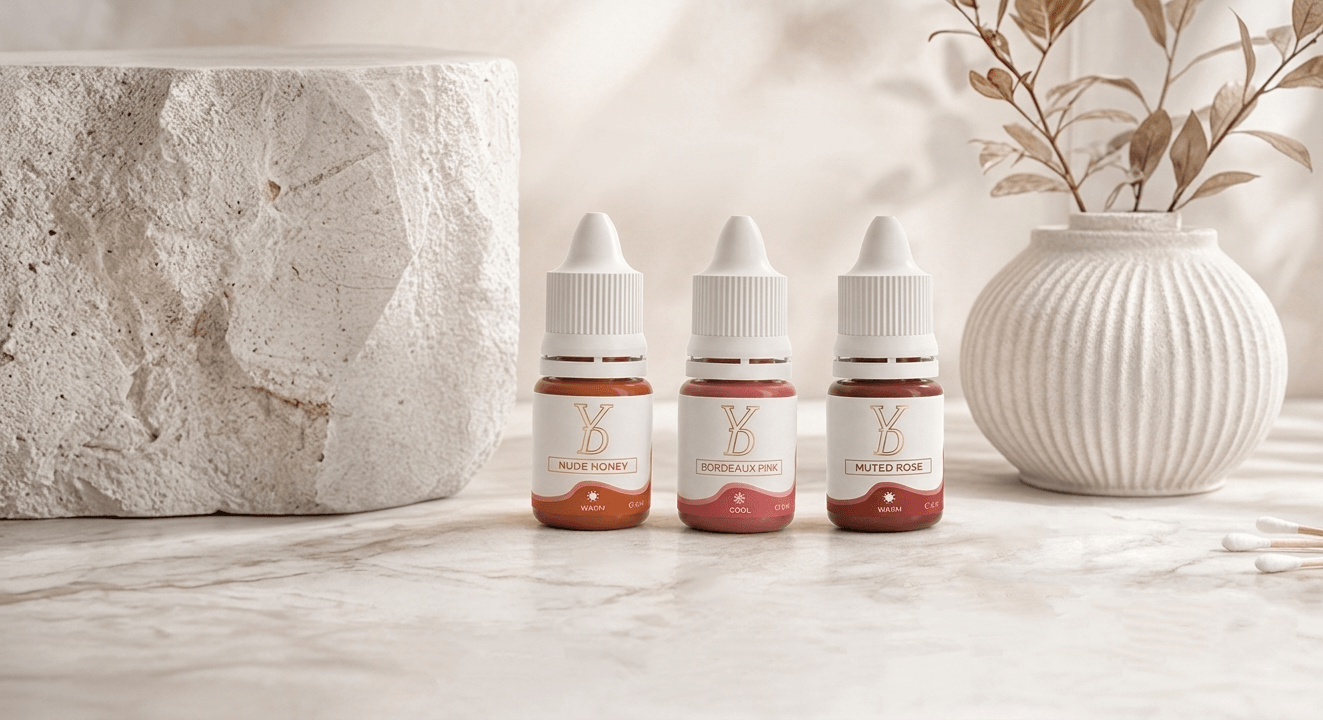
Artists researching a dedicated hairstroke pigment system can review the YDPMU NANO Organic Hairstroke Brow Pigment Set. Shade and product selection must still follow the exact bottle information, intended use, client assessment and professional training. No pigment can guarantee a fixed healed color or retention period.
Choosing a Machine for Nano Brows
A machine should be evaluated as a complete working platform rather than selected by one specification. Artists should compare balance, mechanical stroke, speed control, cartridge compatibility, power configuration, vibration, support and the machine behavior used in their training.
The YDPMU DEMO Pro Wireless PMU Machine, model CTM115, provides:
- adjustable 2.5–3.5mm mechanical stroke;
- 2–10V control in 0.1V increments;
- 700mAh magnetic battery options;
- wireless operation with RCA wired backup; and
- compatibility with standard universal-style PMU cartridges.
These specifications provide setup options; they do not prescribe a universal nano brow setting. Cartridge selection, stroke, voltage, protrusion, hand speed, movement, tissue assessment and professional training must still work together.
Artists can compare available configurations in the YDPMU PMU Cartridges and Needles Collection. Use only compatible, intact, sterile single-use cartridges intended for the selected machine and procedure.
Nano Brows Healing: What Can Clients Expect?
Nano brows do not follow one guaranteed day-by-day appearance. Temporary redness, swelling, dryness, surface shedding and changes in visible color may occur after a skin-breaking procedure. The duration and appearance vary between clients.
Fresh result
The strokes may appear darker, sharper and more contrasted than the expected healed result. Temporary redness or swelling can also make the pattern look heavier.
Surface recovery
Dryness and light surface shedding may change how individual strokes are seen. Some areas can temporarily look darker, lighter or less even. Clients should not pull, scratch or deliberately remove surface flakes.
Color becomes easier to assess
After the visible surface changes have settled, the strokes usually appear softer. Some may remain clearly separated, while others may look lighter, wider or less distinct.
Healed review
The artist should assess stroke separation, color, shape, density, residual pigment and tissue condition before deciding whether any additional work is appropriate. A maintenance session should not be scheduled only because a fixed number of days has passed.
For the broader recovery framework, read PMU Healing Stages Day by Day: What’s Normal and What’s Not.
Fresh vs Healed Nano Brows
Fresh photographs are useful for documenting the procedure, but they do not prove the final stroke quality. Temporary inflammation, fresh pigment contrast, moisture, lighting and image processing can make newly completed strokes look unusually fine and dark.
A healed nano brow portfolio should be evaluated for:
- separation between neighboring strokes;
- integration with natural eyebrow hair;
- consistent flow through the front, body and tail;
- color and undertone balance;
- areas of excessive density or weak retention;
- blur, spreading or unwanted merging; and
- whether the remaining pigment still supports the intended design.

Do Nano Brows Last Longer Than Microblading?
There is no responsible fixed answer. Nano brows do not automatically last longer because they are performed with a machine. Microblading does not automatically fade faster because it is performed manually.
Visible longevity depends on the interaction of:
- skin and tissue characteristics;
- stroke density and spacing;
- implantation and artist control;
- pigment formula, shade and saturation;
- previous permanent makeup;
- healing and aftercare;
- UV exposure and skincare practices; and
- the client’s preferred level of definition.
Residual pigment may remain visible after the individual strokes have lost their original crispness. Maintenance timing should therefore be based on the healed result rather than a promised lifespan.
Can Nano Brows Be Combined with Powder Shading?
Yes. Machine hairstrokes can be combined with controlled shading to create combination brows. This may help when the client wants hair-like texture in selected areas but also needs additional background density.
Combination work should not mean placing the maximum amount of both techniques into every brow. The artist should decide where strokes provide useful texture, where shading creates structure and where untouched space keeps the result light.
On unsuitable tissue or dense previous pigment, adding both strokes and shading can increase saturation without improving the design.
When Should Hairstroke Brows Be Reconsidered?
Sometimes the correct decision is not choosing between nano brows and microblading. It is deciding that new hairstrokes are unlikely to create a responsible healed result.
Hairstroke work should be reconsidered when:
- previous pigment creates a dark background with insufficient contrast;
- the old shape extends outside the proposed design;
- individual strokes would need to be placed too closely together;
- the skin shows active irritation, infection or unexplained changes;
- the tissue has been repeatedly treated and additional saturation may overload it;
- the client expects the fresh result to remain unchanged after healing; or
- the artist cannot produce the technique consistently within their training.
Correction, lightening, removal, soft shading, further healing or no additional treatment may be more appropriate than forcing another hairstroke procedure.
A Professional Selection Framework
- Define the desired healed finish. Determine whether the client wants individual hairs, soft density, stronger definition or a combination.
- Assess natural brow hair. Review direction, density, gaps and whether simulated strokes can blend realistically.
- Assess the skin and tissue. Consider oil, pores, thickness, elasticity, texture, irritation and treatment history.
- Review previous PMU. Determine whether new strokes will remain visible or disappear into the existing background.
- Confirm the terminology. Explain whether the planned procedure uses a machine, manual blade or combination.
- Select the trained technique. Choose a method the artist can perform consistently rather than following a treatment trend.
- Match the complete system. Coordinate the machine or hand tool, cartridge or blade, pigment and movement.
- Set healed expectations. Explain that fresh strokes will soften and that no technique guarantees fixed retention.
- Document the procedure. Record the tool, pigment, shade, batch and relevant treatment observations.
Common Nano Brow Claims That Need More Context
| Common Claim | More Accurate Explanation |
|---|---|
| Nano brows are suitable for every skin type | Suitability depends on current skin condition, previous pigment, design and artist control. |
| Nano brows cause no skin trauma | Nano brows break the skin. Tissue response depends on the complete procedure. |
| A finer needle always creates finer strokes | Healed width also depends on movement, pressure, spacing, repetition and healing. |
| Machine hairstrokes always last longer | No technique can guarantee a fixed lifespan. |
| Needle protrusion determines implantation depth | Protrusion is a mechanical reference, not a universal depth setting. |
| Nano brows always look more natural | Natural appearance depends on mapping, stroke flow, spacing, color, density and existing hair. |
Safety and Professional Practice
Nano brows and microblading are elective cosmetic tattoo procedures. They should be performed by appropriately trained professionals working within applicable local licensing, hygiene and infection-control requirements.
Artists should use suitable single-use components, document the exact pigment and batch, assess disclosed health and skin information, and provide procedure-specific aftercare. Product suitability should be evaluated from the exact formula, packaging, traceability, intended use and destination-market information—not from broad marketing categories alone.
The American Academy of Dermatology notes that permanent makeup may involve risks including infection, allergic reactions and other complications. Persistent or worsening pain, spreading redness, unusual discharge, fever, intense swelling or another concerning reaction requires qualified medical assessment rather than online diagnosis or additional pigment implantation.
Build a Controlled Machine-Hairstroke Workflow
Compare the YDPMU hairstroke pigment system, DEMO Pro machine and compatible cartridge configurations as parts of one professional workflow. Product specifications support setup decisions, but skin assessment, training and artist control remain essential.
Frequently Asked Questions
What is the main difference between nano brows and microblading?
Nano brows commonly use a motorized PMU machine and cartridge to build hair-like strokes. Microblading uses a manual hand tool with a fine blade configuration. Both aim to imitate natural eyebrow hairs, but they construct the strokes differently.
Are nano brows and nanoblading the same?
Not necessarily. Nano brows often refers to machine hairstrokes, while nanoblading may refer to manual work performed with a particularly fine blade. Because terminology is not standardized, clients should ask which tool and method will actually be used.
Do nano brows last longer than microblading?
Not automatically. Longevity depends on skin, implantation, design, pigment, previous work, healing, aftercare and lifestyle. Neither technique can guarantee a fixed retention period.
Are nano brows better for oily skin?
They may be considered, but they do not guarantee crisp healed strokes. Pore appearance, skin texture, stroke spacing, artist control and pigment behavior still matter. Powder or combination brows may sometimes provide a more suitable visual structure.
Are nano brows less painful than microblading?
Discomfort varies between clients and procedures. The technique name alone cannot predict pain. Treatment duration, movement, pressure, repetition, individual sensitivity and locally permitted comfort protocols may affect the experience.
What needle is used for nano brows?
Machine hairstrokes are commonly created with a fine cartridge configuration, but there is no single universal nano brow needle. Cartridge selection must match the machine, trained technique, intended pattern and client’s tissue. A smaller diameter does not guarantee a finer healed result.
Conclusion
Nano brows and microblading can both create natural-looking hairstroke eyebrows, but neither should be selected by name alone. Nano brows build strokes with a motorized machine, while microblading creates them with a manual tool.
The more suitable option depends on skin and tissue condition, natural brow hair, previous pigment, desired healed appearance and the artist’s control of the complete working system. In some cases, powder shading, correction, lightening, removal or no additional treatment may be more responsible than adding more hairstrokes.
The best result does not come from the finest needle or the strongest marketing promise. It comes from realistic assessment, controlled technique, appropriate product selection and evaluation of fully healed work.